One question comes up again and again whenever frequency technology is discussed: “is there any actual research behind it?”
That is a reasonable question. Frequency wellness has a long and controversial history, containing fascinating ideas about resonance and bioelectromagnetics as well as many claims that go far beyond what modern clinical research has established. Yet hidden within that history are experiments worth examining more closely.
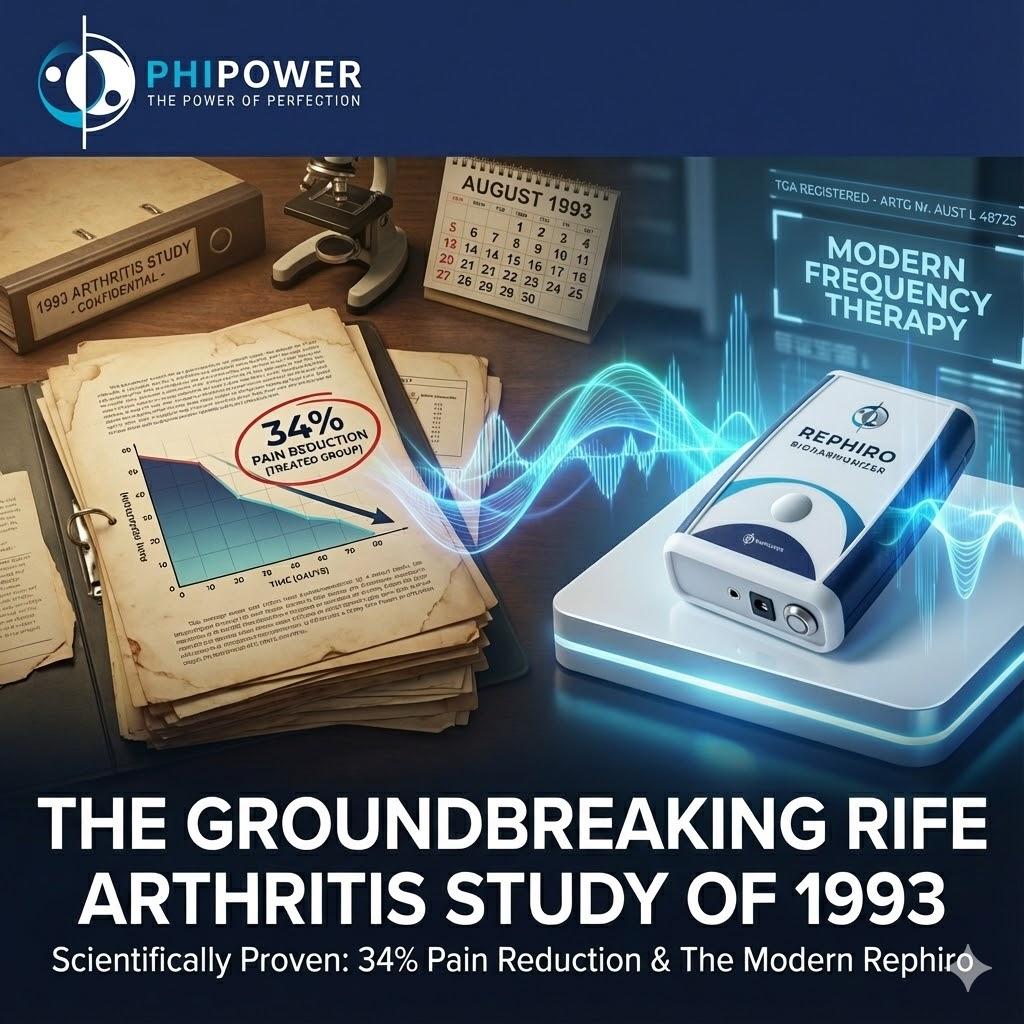
One of the most interesting is an Australian study conducted in 1993, involving people with chronic rheumatoid arthritis and osteoarthritis, testing a small contact-electrode device that delivered programmed audio-frequency electrical signals. According to the historical study report, participants using the active devices experienced a greater reduction in reported pain than those using placebo devices.
That makes it far more interesting than a collection of testimonials. But what did it actually find, how strong is the evidence, and can we legitimately connect it to a modern device such as the Rephiro Bioharmonizer?
What was studied, and how?
The investigation was conducted in New South Wales, Australia, between May and August 1993. According to the surviving documentation, 49 volunteers with chronic rheumatoid arthritis or osteoarthritis participated. The system tested was referred to as an Audio Frequency Therapy Unit (AFTU), later associated with the PET — Pulsed Electro-Therapy — device: a small electronic unit connected to the body through contact electrodes.
The original documentation describes the project as double-blind and placebo-controlled. That matters, because pain is particularly sensitive to expectation: if people know they are receiving an experimental treatment, some will report improvement simply because they expect to. A placebo group helps separate that effect from a possible treatment-specific one.
The reported pain results
average reported pain reduction
average reported pain reduction
in favour of the active group
This does not mean frequency therapy was proven to reduce arthritis pain by exactly 34%. The study was relatively small and does not appear to carry the published, peer-reviewed clinical-trial documentation we would expect today. The defensible conclusion is: this small historical placebo-controlled study reported a stronger reduction in pain in the active-frequency group than in the placebo group. That is interesting enough on its own.
The placebo result matters too. Pain is influenced by expectation, attention, stress, mood, changes in activity and simply taking part in a study — so a 13% placebo improvement is unsurprising, and it makes the comparison more useful. The question is not “did people improve?”, but “did the active group improve more?” According to the report, yes.
One further detail makes the study more credible as historical documentation: not everyone improved. The report mentions participants with severe joint degeneration and other causes of pain who experienced limited benefit. When a therapy is described as working for everyone, scepticism is appropriate — human biology rarely behaves that way. The 1993 report did not claim universal success.
What about the blood tests?
The study also included a smaller set of blood measurements using a method referred to as HLB blood analysis, measuring so-called ROTS masses before and after the intervention. Among the small subgroup tested, the report states that 8 active-treatment participants showed an average reduction of approximately 26%, while 7 placebo participants showed an average increase of approximately 1%.
These findings were presented as objective support for the subjective pain scores — but this section requires additional caution. HLB blood testing is not a mainstream validated marker for arthritis outcomes, so it should not be treated as equivalent to modern inflammatory biomarkers such as CRP or ESR. The pain results are interesting; the HLB observations are interesting too. Both are best understood as historical experimental data, not modern clinical proof.
Registration, and whether this was a “Rife” study
The historical documentation links the PET device with Australian Therapeutic Goods Administration registration under ARTG No. AUST L 48725. That is worth mentioning — but registration should not automatically be read as demonstrating clinical efficacy through today's most demanding regulatory pathway. The device was historically entered into the Australian regulatory system, which adds an interesting chapter to the story; it is not independent proof that all therapeutic claims were clinically established.
And was this a Rife study? The device tested in 1993 was not one of Royal Raymond Rife's original instruments. It was an audio-frequency contact device developed decades later, discussed within the wider Rife community because both approaches share an interest in specific frequencies as biological stimuli. A more accurate description is therefore a Rife-inspired or Rife-related frequency study.
Why the broader idea is not implausible
The human body is electrical as well as chemical. Cells maintain membrane potentials, the nervous system communicates through electrochemical signals, the heart generates measurable electrical activity and muscles contract through electrically mediated processes. Medicine already uses electrical and electromagnetic technologies:
This does not prove every Rife theory. It demonstrates that interacting with biology through electrical signals is not inherently implausible. The real questions are scientific ones: which signal, at what frequency, at what intensity, delivered where, for how long — and what outcome is actually measured?
Rife's own hypothesis, that microorganisms might respond to particular resonant frequencies, evolved into the idea of a Mortal Oscillatory Rate (MOR). Modern science has not validated that classical framework as medical fact, though research into biological responses to electromagnetic fields continues. There is a significant difference between “everything Royal Rife claimed has been proven” and “biological systems can interact with electrical signals, and some historical experiments produced results worth investigating”. Phipower takes the second position.
Does this study validate modern Rife machines?
Not directly. The 1993 device was a simple audio-frequency unit specific to its era — it is not the same equipment as any Rife-style device sold today, including the Rephiro Bioharmonizer, and the study cannot be used as clinical proof that a current product produces the same outcomes. What it does support is the broader, decades-long pattern of experimentation with contact-based frequency devices, not the performance of any one product.
For how today's devices differ from each other, what they cost and how to choose between them, see our complete Rife machine guide.
Try the Phipower frequency ritual
You don't need to diagnose yourself, search for a pathogen or keep a spreadsheet of thousands of frequencies.
Put your phone away
Give yourself a few minutes without distraction.
Connect your device
Follow the supplied instructions for the contact accessories.
Start the preset cycle
The electronic sequence runs automatically from there.
Sit, and breathe
No scrolling, no email, no multitasking. A few minutes of intentional stillness.
Technology provides the signal. You create the ritual.
So what does the 1993 study actually prove?
Not that any specific modern device works. The study involved a different piece of equipment, had a relatively small sample and used a historical research protocol — it does not establish clinical efficacy for any current product, and should not be used to claim that any device treats rheumatoid arthritis or osteoarthritis.
But that does not make it irrelevant. It demonstrates something more useful: contact-based frequency technology has a history of experimental investigation that extends well beyond online testimonials. Science doesn't progress only through perfect experiments; early research often asks questions before methodology is mature enough to answer them definitively. A study can be interesting without being conclusive. That is exactly how we view this one.
Anyone with a diagnosed or suspected medical condition should treat this carefully. Rheumatoid arthritis is an autoimmune disease that can cause progressive joint damage; osteoarthritis also requires professional diagnosis and care. If you experience persistent pain, inflammation, joint swelling or reduced mobility, seek appropriate medical care. Frequency-wellness devices are not an alternative to medical diagnosis or treatment.
Frequently asked questions
Conclusion: historical evidence, modern exploration
The 1993 Australian arthritis study occupies an unusual place in frequency-therapy history. It was more structured than a testimonial, it included a placebo group, it reported a meaningful difference in pain scores, and it attempted to add objective biological measurements. At the same time it was a small historical study using a device different from anything sold today.
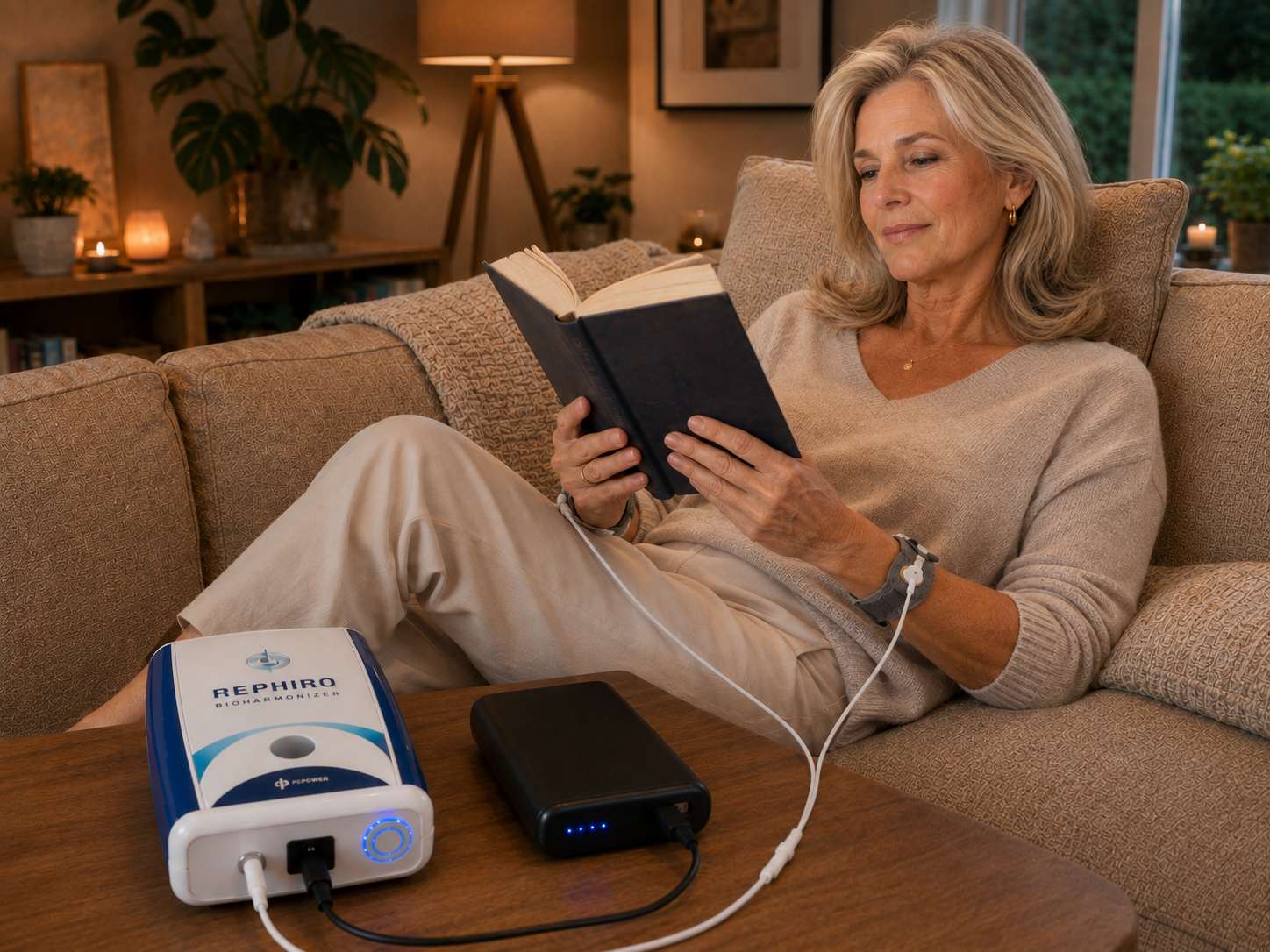
So we should neither dismiss it nor exaggerate it. The best conclusion: the study provides an intriguing historical signal — not final proof. Today, technology lets us explore electrical frequency wellness with devices that are dramatically smaller and easier to operate than anything available in 1993 — among them the Rephiro Bioharmonizer, a compact five-minute ritual built on that same broader idea.
This article discusses historical research for educational purposes. The 1993 study used a device different from the Phipower Rephiro Bioharmonizer, and its findings cannot be transferred directly to any current product or used to claim that it treats arthritis or any other disease. It is intended for personal wellness use and is not a substitute for professional medical advice, diagnosis or treatment. Do not use the device with an implanted electronic device such as a pacemaker, or during pregnancy, unless specifically cleared by an appropriate healthcare professional. For persistent pain, inflammation or other medical concerns, consult a qualified healthcare provider.