Search online for structured water and one term comes up constantly: H3O2, alongside its close relative EZ water (Exclusion Zone water). Both trace back to the same body of research, and both are frequently misquoted — in both directions.
This article looks specifically at what that research actually measured, what Gerald Pollack's lab proposed, and where the evidence stops.
Looking for the bigger picture? This page focuses narrowly on H3O2, EZ water and nanobubbles. For molecular water structure, hexagonal-water claims, vortexing and how it all relates to vitalized water, start with our Complete Guide to Structured Water.
What is H3O2 water?
The term H3O2 water is most strongly associated with the work of University of Washington bioengineering professor Gerald Pollack. Pollack and colleagues studied water next to hydrophilic surfaces and observed regions from which suspended particles were excluded. These areas became known as exclusion zones — or EZ water.
Research from Pollack's group found that these zones separate charge — the ordered zone itself turns negative while the water beyond turns positive, effectively forming what the book calls a "water battery" — and that radiant energy expands them. In the experiments, every tested wavelength drove growth, but to different degrees: ultraviolet least, visible light moderately, and infrared the most, peaking around the 3,000 nanometre wavelength. When infrared was blocked by placing the chamber in an insulated container, the exclusion zone shrank to roughly half its size within fifteen minutes.
As for structure, The Fourth Phase of Water describes stacked hexagonal, ice-like sheets of oxygen and hydrogen with a 3:2 hydrogen-to-oxygen ratio — the origin of the popular shorthand "H3O2". The formula itself never appears in the book. Pollack frames his own conclusion with care: the exclusion zone is "neither liquid nor solid", perhaps best described as a liquid crystal — "what might qualify as a fourth phase" of water.
It is an intriguing hypothesis. But there is an important distinction.
The strongest scientific observations concerning exclusion-zone water involve water next to interfaces or hydrophilic surfaces. That is not the same as demonstrating that you can create litres of permanently transformed H3O2 drinking water, pour it into a bottle and preserve that molecular state indefinitely. This distinction is frequently lost in structured-water marketing.
A critical review of the exclusion-zone literature has also pointed out that alternative mechanisms — such as diffusiophoresis — can account for key observations, meaning the interpretation of EZ water is still genuinely debated among researchers, not just among marketers.
Pollack himself is unusually candid about the limits of the structural model. In the book he notes that practically the same hexagonal structure was proposed back in 1969 for "polywater" — an episode that ended in embarrassment when anomalous findings turned out to involve impurities — and that his own model "derives mainly from precedent and logical inference". That honesty is worth matching: the exclusion-zone phenomena are measured, the structural explanation remains a proposal.
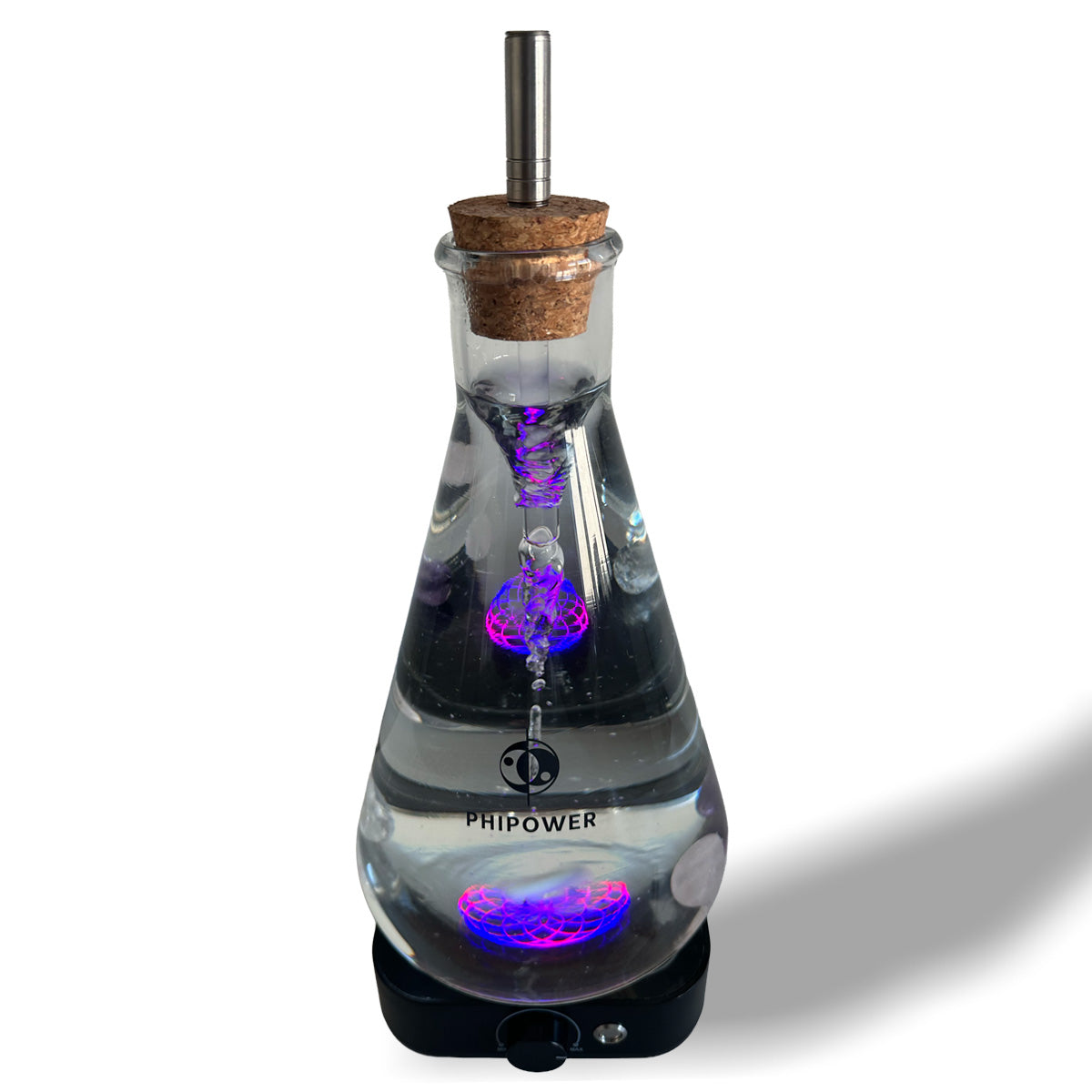
At Phipower we think transparency is more interesting than certainty. Instead of claiming that a Water Vitalizer converts H2O into a permanent new chemical phase, we prefer to look at physical processes that can actually be investigated: movement, vortex flow, gas exchange, microbubbles, light — and the sensory experience of the water itself. Read more about how light interacts with water in our LED light guide.
The missing link: microbubbles and nanobubbles
This is where the EZ-water discussion connects to a separate, very active field of research. When gas becomes dispersed in water in extremely small bubbles, those bubbles behave very differently from the large bubbles you see in sparkling water.
Small enough to be invisible to the naked eye, yet far larger than the nanoscale.
Because of their size and interfacial properties, ultrafine bubbles can remain suspended much longer than normal visible bubbles.
Nanobubble technology is now being investigated for applications ranging from agriculture to environmental engineering and aquaculture. A 2026 review describes nanoscale bubbles as having unusual stability and interfacial properties that make them interesting for agricultural applications. This is no longer fringe water science — it is an active field of research, and one that overlaps with exclusion-zone work without being identical to it.
Does vortexing water create these bubbles?
Potentially — depending on the system. A particularly interesting 2024 study investigated water subjected to vortex-swirl flow. Researchers measured a large population of small microbubbles around 1 μm after processing, and observed temporary changes in dissolved oxygen and other characteristics, with the bubble population gradually dissipating over a period of hours.
Perhaps even more interestingly, a blind taste panel in that study rated the processed water as fresher and less "thick" than untreated water — a statistically significant difference in blind ratings between treated and untreated samples.
That study used a specific vortex-flow system. Phipower has not yet published independent bubble-size measurements demonstrating a defined concentration of nanobubbles produced by the Water Vitalizer. We therefore do not claim that the Phipower Water Vitalizer produces a medically meaningful concentration of nanobubbles. We simply think the underlying physics is fascinating — and it's part of why we build the practical ritual around vortexing. See how vortexing is used in practice.
Why does the field matter so much? Research has investigated nanobubbles for improved gas transfer, irrigation, nutrient availability, aquaculture, water treatment and environmental remediation. A controlled rice study found that nanobubble irrigation improved plant growth and nutrient uptake and produced an approximately 8% higher field yield under the conditions studied. That does not mean drinking nanobubble water produces equivalent effects in humans — but it does show why micro- and nanoscale gas behaviour deserves serious scientific attention.
H3O2, EZ water and nanobubbles: what does the evidence show?
This nuance is exactly what makes the subject interesting. You don't need to accept every H3O2 claim to find the underlying exclusion-zone and nanobubble research worthwhile. For where this fits into the wider structured-water picture, see the Complete Guide to Structured Water.
Frequently asked questions about H3O2 & EZ water
The evidence, without the overreach
Exclusion zones are real and reproducible. Nanobubbles are a genuine, active research field. Vortex flow can measurably — if temporarily — change water. What isn't established is that any of this proves a permanent new molecular phase of drinking water, or that it treats disease.
For the full picture on structured water — including molecular structure, vortexing and vitalization — continue with our Complete Guide to Structured Water, or see how this research translates into a daily ritual with the Vitalized Water guide.
The Phipower Water Vitalizer is intended for personal wellness and water preparation. It is not a medical device and is not intended to diagnose, prevent, treat or cure disease. References to H3O2, exclusion-zone water, microbubbles and nanobubbles describe areas of scientific research and should not be interpreted as proof that the Phipower Water Vitalizer produces specific medical or therapeutic effects. If water is not already safe to drink, appropriate filtration or purification is required before using the Water Vitalizer.