Biophotons exist. The broader claims about water and geometry have not yet been proven.
Living cells demonstrably emit an extremely small amount of light, known as biophotons. This ultraweak photon emission has been measured using sensitive equipment and is associated with biochemical reactions, including oxidative processes. However, it has not yet been established whether cells deliberately use these photons as a communication system. Ideas about water memory, geometric resonance and bioresonance also remain largely hypothetical. It is therefore important to work with three clear levels: what has been measured, what is a reasonable research question and what is primarily marketing language?
Light, water and form: three fascinating but distinct subjects
The human body is not a simple machine. It is a dynamic system in which chemical reactions, electrical potential differences, mechanical forces, heat and light phenomena occur simultaneously. This makes it tempting to create one overarching narrative: cells communicate using light, water stores that information and geometric patterns organise the entire system.
Such a model sounds appealing, but it combines established biology with preliminary hypotheses. That distinction is often lost in wellness marketing. A measurable natural phenomenon is first described correctly and then used as evidence for a product or therapy that does not yet have clinical evidence.
In this article, we take a different approach. We retain the sense of wonder while placing each conclusion at the appropriate level. Biophoton emission has been measured. The distinctive organisation of water near molecular surfaces is a serious field of research. Biological structures undeniably display geometric patterns. However, this does not automatically mean that water stores memories, that DNA functions as a radio antenna or that an arbitrary frequency can correct a health problem.
The aim is therefore not to present a theory that explains everything. The aim is to show what we know, where the unanswered questions lie and how you can assess claims more critically.
What are biophotons?
Biophotons is a popular term for the ultraweak photon emission of living systems. In scientific literature, it is usually called ultraweak photon emission, abbreviated to UPE. Its light intensity is far below the detection threshold of the human eye. Detection requires dark measurement chambers and highly sensitive instruments, such as photomultipliers or cooled cameras.
This emission has been observed in plants, microorganisms, animal tissues and humans. The main explanation lies in normal metabolic processes. Reactions involving oxygen can produce reactive molecules. When excited molecules subsequently return to a lower energy state, a small portion of the energy may be released as a photon.
Measured: living cells and tissues emit ultraweak light. Not automatically proven: that this light forms a deliberate communication network, enables diagnoses or can easily be “optimised” externally.
The role of Fritz-Albert Popp
German biophysicist Fritz-Albert Popp brought the subject to the attention of a wider audience. Beginning in the 1970s, he studied ultraweak light emission and proposed that the emission could display characteristics of coherence. In physics, coherence means that waves have a predictable phase relationship with one another. Laser light is a familiar example of highly coherent light.
Popp’s work was important to the development of this field of research, but some popular interpretations go beyond what his measurements justify. The statement that biophotons are “laser light from cells” is too definitive. The idea that the degree of light coherence directly determines whether someone is healthy or ill is also not a generally accepted diagnostic principle.
UPE can change under the influence of oxidative stress, damage, temperature, light exposure and metabolism. This makes the phenomenon interesting as a research signal. However, altered emission is not specific enough to support a medical conclusion without additional information.
Does every cell emit light?
Many metabolically active cells can produce photons under suitable measurement conditions. This does not mean that every cell continuously emits a stable “light code”. The intensity, spectrum and temporal pattern depend on the cell type and the conditions during measurement.
Human UPE, for example, is measured at the skin. The result can vary according to the time of day, the body area measured and previous exposure to light. Such variation supports the idea that UPE is associated with biological activity. It does not yet prove that the emission is a separate regulatory system.
| Statement | Status | Nuance |
|---|---|---|
| Living tissues emit ultraweak light | Well established | Measurable using highly sensitive equipment |
| The emission reflects biochemical activity | Plausible and supported | Associated with oxidative reactions, among other processes |
| Cells use UPE as their primary communication system | Hypothesis | A specific physiological function has not been established |
| Greater coherence automatically means better health | Not proven | Not a validated general measure of health |
Do cells really communicate using light?
Cells demonstrably communicate through multiple pathways. They release chemical signalling substances, respond to hormones and neurotransmitters, use electrical potential differences and connect to one another through proteins and direct cell contacts. Light-sensitive molecules also play a role in specific processes, for example in the eye and in circadian rhythms.
The possibility that ultraweak photons may also transmit information is scientifically interesting. However, demonstrating communication requires more than detecting emission alone. There must be an identifiable source, an encoded signal, a receiver and a reproducible biological response that cannot be better explained by another mechanism.
That complete body of evidence is currently lacking. Experiments have shown that cells can respond to light and that optical signals can be guided through biological material. However, there is still a major gap between those observations and the conclusion that the body has a wireless photon network that coordinates organs at the speed of light.
DNA as a light source or antenna
DNA absorbs electromagnetic radiation, particularly in the ultraviolet range. Chemical reactions in and around the cell nucleus may also contribute to photon emission. The double helix also has a striking geometry. These facts have led to the metaphor that DNA could be an antenna.
As a figure of speech, this can help illustrate interactions between matter and electromagnetic radiation. As a literal biological claim, it is too simplistic. A technically engineered antenna receives and transmits signals within specific frequency ranges. The fact that DNA can absorb electromagnetic energy does not prove that genetic material transmits encoded wireless messages in the same way.
Popular calculations concerning the total length of DNA in the body primarily illustrate the enormous quantity of biological material involved. They are not evidence of a body-wide antenna network.
Light can affect biological processes, and cells produce ultraweak light. The idea that these phenomena together form an extensive communication system remains a research hypothesis. Product claims must not be presented as though this hypothesis has already been clinically proven.
Water in the body: far more complex than a glass of tap water
Water is the body’s primary solvent and transport medium. It supports temperature regulation, chemical reactions, protein structure and the transport of nutrients and waste products. Inside cells, water is not contained in an empty vessel. It is in contact with membranes, proteins, sugars, ions and other molecules.
Near such surfaces, water may temporarily organise differently from water in the bulk liquid. Researchers study hydration layers, interfacial water and the influence of electrical charges on water molecules. These are established subjects in physical chemistry.
Outside the laboratory, however, the term structured water is used very broadly. Sometimes it refers to short-lived molecular ordering, sometimes to vortexed water and sometimes to a supposed stable liquid capable of storing information or intentions. These meanings should not be confused.
EZ water and the ideas of Gerald Pollack
Gerald Pollack described a zone next to certain hydrophilic surfaces from which particles are excluded. He calls this the exclusion zone, often abbreviated to EZ. His experiments and interpretations have generated renewed interest in water at interfaces.
The existence of interfacial water layers and exclusion phenomena is not inherently unusual. However, the precise explanation, extent and biological significance of the zones described by Pollack remain subjects of debate. The popular formula H3O2 should therefore not be treated as though it establishes a generally accepted, stable fourth phase of drinking water.
The transition to health claims is even less certain. Laboratory research on water near a material surface does not demonstrate that “EZ water” from a bottle passes through the digestive system intact or has demonstrably superior health effects. Anyone wishing to explore this subject further can read our article about H3O2 and EZ water.
Can water remember information?
Water molecules continually form hydrogen bonds with one another. These bonds break and reform over extremely short timescales. Under specific conditions, water can form patterns around dissolved substances and surfaces, but this is different from a lasting memory in which the identity of a substance that is no longer present remains encoded.
Claims about water memory are often used to explain homeopathic dilutions. A robust and generally accepted mechanism through which water retains specific therapeutic information after extreme dilution has not been demonstrated. Experimental reports in this field remain disputed and have not been replicated independently to a sufficient degree.
Research claiming that water crystals change in response to words, music or human intention also provides no reliable evidence of a health effect. Attractive photographs are not a substitute for blinded procedures, predefined assessment criteria and independent replication.
| Water claim | What we can reasonably say |
|---|---|
| Water forms local structures | Yes, particularly around dissolved substances and molecular surfaces. These structures are dynamic. |
| EZ phenomena exist | Exclusion zones have been described experimentally. Their mechanism and broader biological significance remain subjects of debate. |
| Water stores specific healing information | Not convincingly demonstrated. |
| Structured drinking water has proven health effects | Convincing clinical evidence is lacking. |
What happens when water forms a vortex?
A vortex is a rotating flow. In nature, we see vortices in rivers, whirlpools, air currents and even around moving organisms. When water flows along a spiral path, its speed, pressure distribution and mixing change.
This movement can temporarily affect measurable properties. A vortex can mix air and water more intensively, changing the amount of dissolved oxygen. Small air bubbles may form at the same time. Depending on the system, temperature, turbidity and the distribution of dissolved gases may also change.
These are normal effects of fluid dynamics. They make a vortex relevant to water treatment, aeration and the user experience. They do not prove that the water acquires a permanently new molecular structure or that drinking it produces specific health outcomes.
Changes in dissolved oxygen, bubble formation, flow patterns and mixing.
The magnitude and duration of the effect depend on temperature, pressure, water quality and storage.
That vortexed water prevents disease, directly hydrates cells or restores the body’s energy.
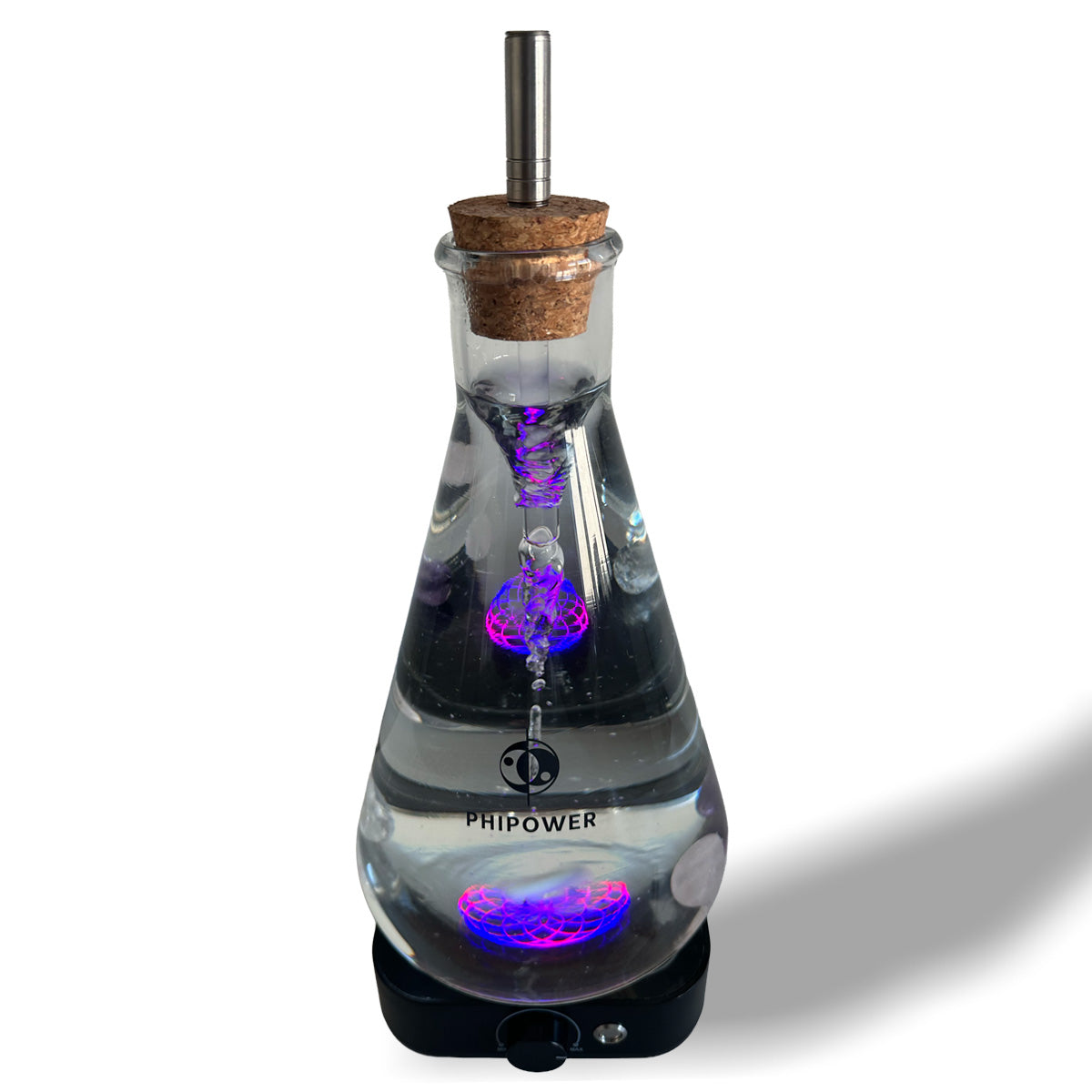
A water vitalizer can therefore be viewed as a device that circulates water and creates vortices. The most responsible question is not whether the water gains “life force”, but which physical properties change under controlled conditions. Read more about our approach to vitalized water and the meaning of structured water.
Geometry: why patterns recur throughout biology
Geometry is genuinely fundamental to living systems. The shape of a molecule partly determines what it can bind to. The branching of blood vessels and airways helps distribute substances efficiently. Cell membranes fold, curve and close according to physical principles. On a larger scale, we see spirals, branches, networks, symmetry and repeating patterns.
These forms do not arise because nature follows a symbolic design manual. They result from growth, evolution, material constraints, energy minimisation and selection. A branching network, for example, can serve a large surface area using relatively little material. A spiral can enable growth without completely changing the basic form.
Fractal organisation
Fractals are patterns in which similar forms recur at different scales. Biological structures are usually not perfect mathematical fractals, but they can have fractal properties. Branching structures in the lungs, blood vessels and some neural networks are familiar examples.
This type of organisation can be efficient because many small endpoints can be reached through a limited number of larger pathways. This supports transport and exchange. However, the conclusion that a single external frequency can therefore automatically resonate “from cell to organ” goes too far. Biological resonance is determined by properties such as mass, stiffness, damping, form and surrounding tissue.
DNA and the golden ratio
The DNA double helix has fixed average dimensions, although these partly depend on the form of the DNA and environmental conditions. The ratio between its diameter and pitch is sometimes compared with the golden ratio. Such numerical similarities are appealing, but they do not prove that DNA was constructed according to a mystical or universal design rule.
The biological function of DNA arises from the chemical properties of nucleotides, base pairing, protein interactions and the way genetic information is read and copied. The helical form is essential, but an approximation of a familiar ratio does not prove a special electromagnetic function.
Cymatics: making vibration patterns visible
In cymatics, sand, liquid or other materials are placed on a vibrating surface. At certain frequencies, stable nodal lines and symmetrical patterns form. This is a visible consequence of standing waves, resonance and the properties of the material and experimental setup.
Cymatics convincingly demonstrates that mechanical vibrations can organise matter. It does not prove that specific musical frequencies restore organs or selectively eliminate pathogens in the body. A metal plate covered with sand is not biological tissue. In the body, vibrations are also damped, scattered and altered by many different materials.
Geometric patterns in nature are a fact. It is also a fact that forms and vibrations can influence one another. The claim that “sacred geometry” or a selected frequency therefore has a therapeutic effect requires separate research. Without such research, it remains a hypothesis or marketing claim.
Connections with homeopathy, light therapy and bioresonance
Biophotons, water structure and geometry are often combined to explain various wellness practices and treatment methods. It is essential to examine the evidence for each modality separately. A plausible-sounding mechanism is not evidence that a treatment works in practice.
Homeopathy
Homeopathy uses serial dilution and shaking. At high dilutions, there is little chance that any molecules of the original substance remain. Nanoparticles found in some preparations may originate from the starting material, the containers used or the production process. Their presence does not prove that they cause a specific therapeutic effect.
Water memory is regularly proposed as a mechanism, but it has not been convincingly demonstrated. The general clinical effectiveness of highly diluted homeopathic remedies beyond placebo has likewise not been reliably established. Homeopathy should therefore not replace necessary medical diagnosis or treatment.
Light therapy and photobiomodulation
Photobiomodulation uses red or near-infrared light at carefully selected wavelengths and doses. Light can be absorbed by molecules in cells and consequently influence biochemical processes. For certain clearly defined applications, this field of research has a much stronger foundation than general theories about biophoton communication.
Wavelength, intensity, exposure duration, distance and application are important here as well. “More light” is not automatically better. Results for one studied indication must not be extended into claims about overall health, detoxification or restoring a supposed energy field.
Daylight also has a well-documented role in regulating the sleep-wake rhythm. This effect operates through light-sensitive systems in the eye and brain. It does not need to be explained through biophotons.
Bioresonance and frequency therapy
Bioresonance is usually based on the idea that organs, substances or pathogens have recognisable electromagnetic frequency patterns. Devices are claimed to measure abnormal patterns and subsequently correct them. Convincing clinical evidence for such broad diagnostic and therapeutic applications is lacking.
There is no dispute that the body displays electrical activity. Electrocardiograms and brain measurements make use of this. However, the existence of bioelectricity does not mean that every commercial frequency device can reliably diagnose or treat health problems. Device-specific, independently replicated and well-controlled studies are required to establish that.
| Modality | Genuine connection | Not demonstrated |
|---|---|---|
| Homeopathy | Dilutions are aqueous systems. Material and interfacial effects can be investigated. | A stable healing water memory and general effectiveness beyond placebo. |
| Photobiomodulation | Cells can absorb light and respond to it biochemically. | That every light product “harmonises” the body as a whole. |
| Bioresonance | Biological systems have electrical and electromagnetic properties. | Reliable broad diagnosis or treatment using commercial frequency programmes. |
| Water vitalization | Vortexing can alter flow, gas exchange and bubble formation. | Specific medical effects of vitalized drinking water. |
How do you assess the scientific evidence?
Discussions of complex wellness topics often mention a long list of scientists. Names such as Fritz-Albert Popp, Gerald Pollack, Herbert Fröhlich and Luc Montagnier give a text a scientific appearance. Nevertheless, each claim must be evaluated separately.
A researcher may have measured an interesting effect without every later interpretation being correct. A theoretical model is not a clinical trial. A conference publication does not automatically carry the same weight as a series of independent, blinded studies. A Nobel Prize for earlier work also does not validate every later experiment conducted by the same researcher.
UPE has been measured. That provides a solid starting point.
A large proportion of UPE can be explained by known oxidative chemistry.
Controlled studies involving humans are required to establish that.
Evidence for a general natural phenomenon does not prove that a product works.
A practical evidence ladder
- Directly measured phenomenon: ultraweak photon emission and changes in water flow.
- Supported mechanism: photons can be produced during oxidative reactions. Vortexing affects mixing and gas exchange.
- Reasonable hypothesis: under certain conditions, UPE could have a signalling function.
- Speculative extrapolation: water stores complex biological information or geometry organises a body-wide light network.
- Unproven marketing claim: a product restores health by correcting biophotons, water memory or resonance.
Sources for further reading
- Popp, F.A., publications on ultraweak photon emission and the proposed coherence of biophotons.
- Cifra, M. and Pospíšil, P., review work on ultraweak photon emission from biological systems.
- Pospíšil, P., Prasad, A. and Rác, M., research into the molecular mechanisms behind ultraweak photon emission.
- Pollack, G.H., work on exclusion zones and water at hydrophilic interfaces.
- Fröhlich, H., theoretical work on coherent excitations in biological systems.
- Hamblin, M.R., review work on the mechanisms of photobiomodulation.
These sources do not all represent the same degree of scientific consensus. They are particularly useful for distinguishing between observation, theoretical models and clinical applications.
How can you apply this in practice?
You do not need to accept an all-encompassing biophysical theory to approach light and water consciously. A practical, evidence-based approach starts with simple factors that can be properly controlled.
1. Use daylight as a time signal
Regular exposure to natural light during the day supports the regulation of the sleep-wake rhythm. In the evening, using less intense light with a lower blue-light content can help preserve the contrast between day and night. Do not look directly at the sun and take care around intense artificial light sources.
2. Prioritise safe and practical drinking water
For drinking water, microbiological safety, relevant contaminants, taste and a suitable installation are more important than unproven energetic properties. Filters and vitalizers also require proper maintenance. Poorly maintained systems can reduce water quality.
3. Assess a water vitalizer by its actual function
A vortex device can make water flow visible and influence its mixing with air. Some people appreciate the taste, presentation or ritual of freshly vortexed water. These are legitimate reasons for use, provided that subjective experiences are not presented as medical outcomes.
When comparing different systems, you can consider capacity, material, ease of cleaning, ease of use and how the vortex is produced. Phipower offers, among other products, a 1.6-litre water vitalizer and a 2-litre water vitalizer.
4. Keep experience and evidence separate
Water may taste different after aeration. A calm drinking moment can be pleasant. A visually attractive vortex may encourage attention and mindfulness. These experiences do not need to be dismissed, but they are not the same as a demonstrated physiological or therapeutic effect.
5. Do not use wellness as a substitute for healthcare
Persistent or serious symptoms require assessment by a qualified healthcare professional. A water vitalizer, light product or frequency device is not a substitute for diagnosis or treatment. Discuss the use of wellness technology with a doctor if you have a medical condition, take medication, are pregnant or are sensitive to light or electromagnetic stimulation.
Conclusion: wonder works best with clear boundaries
Biophotons are not imaginary. Living systems demonstrably produce ultraweak light, and researchers are studying what this emission can tell us about metabolism and oxidative processes. The possible role of photons in communication between cells is interesting, but it has not yet been convincingly established.
Water in biological systems is also more complex than a simple collection of separate H2O molecules. Water organises around proteins, membranes and charged surfaces. However, terms such as EZ water and structured water refer to different ideas, and their broader health claims remain unproven.
Geometry is an essential part of biology. Spirals, branches, networks and symmetry offer genuine functional advantages. However, geometric beauty is not independent evidence of energetic healing, water memory or therapeutic resonance.
The most reliable approach combines curiosity with discipline: appreciate what is visible and measurable, treat plausible ideas as hypotheses and recognise marketing whenever a product promise goes beyond the available research.
View our water vitalizers
Our water vitalizers create a visible vortex in water. Choose according to capacity, material and ease of use. We present them as wellness products for the experience and movement of water, not as medical devices.