A frequency measured in Hertz is not automatically a sound. Some Rife-related numbers fall inside the acoustic hearing range, while others exist as electrical or radio-frequency signals far beyond what your ears can detect. For the broad picture, start with our main Complete Guide to Rife Machines →
You can only "hear a Rife frequency" when that numerical frequency is converted into an acoustic signal within your audible range. A contact Rife machine primarily delivers an electrical waveform, while plasma/RF systems use high-frequency electromagnetic architectures. Those signals can exist without producing audible sound.
First: what does Hertz actually mean?
Hertz (Hz) means cycles per second.
If something repeats 100 times every second, its frequency is 100 Hz.
But Hertz does not specify what is repeating.
Sound pressure
Air pressure can rise and fall 1,000 times per second.
Voltage
An electrical voltage can oscillate 1,000 times per second.
Field strength
A magnetic field can change 1,000 times per second.
Light intensity
A light source can be pulsed 1,000 times per second.
All four could be described as 1,000 Hz. They are still different physical phenomena.
This is the foundation for understanding why a Rife-machine frequency and an online audio tone are not automatically equivalent.
What frequencies can humans hear?
The often-quoted human hearing range is approximately 20 Hz to 20,000 Hz (20 kHz) for young people with healthy hearing.
In practice, hearing varies with:
- age;
- sound-pressure level;
- hearing health;
- individual sensitivity;
- frequency;
- speaker or headphone performance.
Many adults cannot hear anywhere near 20 kHz.
| Frequency | Acoustic interpretation | Typical audibility |
|---|---|---|
| 10 Hz | Infrasound / very slow pressure change | Below normal pitch hearing |
| 100 Hz | Low audible tone | Normally audible |
| 1 kHz | Mid-range tone | Highly audible |
| 10 kHz | High-pitched tone | Audible to many people |
| 20 kHz | Upper edge of conventional young-adult range | Often inaudible to adults |
| 100 kHz | Ultrasonic if acoustic | Not normally audible |
| 3.1 MHz | Far beyond audio range | Not audible as pitch |
So what is a "Rife frequency"?
The phrase Rife frequency can mean several different things depending on the device and the historical source.
It may refer to:
- a low-frequency number in a frequency list;
- a modulation frequency;
- a frequency sweep;
- a higher-frequency carrier;
- a sideband component;
- a pulse or gating rate.
This is why the question "Can I hear this Rife frequency?" can be misleading unless you first identify what role the number plays in the signal architecture.
For the deeper explanation of where Rife-frequency values come from, read Rife Frequencies Explained: What Are They & Where Do They Come From? →
What happens when you play a Rife frequency as audio?
Suppose a frequency list contains 1,000 Hz.
You can generate a 1,000 Hz sine wave, send it to an amplifier and drive a speaker.
Audio path
Digital/audio source
Creates a 1 kHz waveform.
Amplifier
Drives the speaker.
Speaker cone
Moves back and forth.
Sound wave
Air-pressure oscillation reaches the ear.
You hear a 1 kHz tone.
But what reaches you is primarily a sound-pressure wave in air.
That is not the same physical delivery mechanism as putting an electrical 1 kHz signal across contact electrodes.
What happens in a contact Rife machine?
A contact device follows a different signal path.
Electrical contact path
Electronic oscillator
Generates the waveform.
Output stage
Defines voltage/current behavior.
Conductive accessory
Pad, band or electrode.
Electrical load
The signal exists across a conductive path.
Nothing in that chain requires a loudspeaker.
The electrical waveform can therefore be present even when the room is completely silent.
An oscilloscope may show a perfectly clear 10 kHz electrical waveform even though you cannot hear any 10 kHz sound, because the electrical signal has not been converted into an acoustic pressure wave.
For the full signal architecture, see How Does a Rife Machine Work? Frequencies, Signals & Delivery Explained →
What about radio frequencies and MHz carriers?
Many Rife-inspired architectures use frequencies much higher than the audio range.
For example:
3.1 MHz = 3,100,000 Hz.
That is more than 150 times higher than 20 kHz.
You cannot hear 3.1 MHz as an acoustic pitch.
But an electronic circuit can generate and measure a 3.1 MHz voltage waveform perfectly well.
No audible 3.1 MHz tone
The mechanical structures of human hearing are not designed to perceive millions of acoustic cycles per second as pitch.
Electrical waveform visible
Appropriate measurement equipment can display high-frequency electrical oscillation.
Carrier can transport modulation
A high-frequency carrier can be altered by a lower-frequency signal.
What is a carrier frequency?
A carrier frequency is a higher-frequency signal used as the foundation for modulation.
This is normal engineering, not something unique to Rife technology.
Radio broadcasting provides an intuitive example: the audio information you want to transmit is used to modify a much higher-frequency electromagnetic carrier.
In a Rife-inspired system, a lower-frequency waveform can similarly modulate a higher-frequency carrier.
Carrier + modulation
Carrier
Example: 3.1 MHz.
Modulating signal
Example: 10 kHz.
Modulator
Combines signal behavior.
Complex spectrum
Carrier plus sideband components.
The resulting signal does not have to be audible.
Can sidebands be heard?
Sometimes — but again, it depends on the signal medium and frequency range.
If a 10 kHz audio carrier is amplitude-modulated by 1 kHz, the resulting acoustic spectrum can contain components around 9 kHz and 11 kHz. Depending on playback equipment and hearing, those components may contribute to what you hear.
But if a 3.1 MHz electrical carrier is modulated by 10 kHz, the relevant sidebands are approximately:
3.090 MHz and 3.110 MHz.
Those are not audible pitches.
They are components of a high-frequency electrical/RF spectrum.
For the historical Rife context, see How the Hoyland Sideband Method Works →
Why a YouTube Rife frequency is not the same as a Rife machine
This is the practical reason the audio question matters.
If a YouTube video plays a "Rife frequency" through your headphones, the final physical stimulus is primarily:
speaker movement → sound pressure → ear.
A contact Rife device instead uses:
electronic waveform → output stage → conductive accessory → electrical path.
A plasma/RF system uses yet another architecture.
| Method | Final delivery mechanism | What you may perceive |
|---|---|---|
| YouTube / audio file | Acoustic pressure wave | Audible tone |
| Headphones | Acoustic pressure very close to ear | Audible tone |
| Contact Rife device | Electrical signal through conductive hardware | Possibly tingling/pulsing; often no sound |
| Plasma / RF system | Electromagnetic/RF architecture | Usually not perceived as an audible pitch from the RF itself |
That does not tell you which has a therapeutic effect. It simply establishes that they are different physical stimuli.
What about binaural beats?
Binaural beats are another source of confusion.
With a binaural-beat recording, slightly different audio tones are presented to the left and right ears.
For example: left ear: 400 Hz, right ear: 410 Hz.
The listener may perceive a rhythmic effect associated with the 10 Hz difference.
But there is not literally a 10 Hz loudspeaker tone entering both ears in the same way as a normal 10 Hz sound wave.
And a binaural beat is still an audio-neurosensory phenomenon, not the same as applying a 10 Hz electrical waveform through electrodes.
Is ultrasound the same as high-frequency electrical Rife output?
No.
Ultrasound is mechanical vibration above the normal human acoustic hearing range.
A 1 MHz ultrasound transducer physically generates pressure waves in material or tissue.
A 1 MHz electrical signal from a generator is an oscillating voltage/current.
The numerical frequency can be the same while the physical energy type is different.
1 MHz ultrasound ≠ 1 MHz electrical contact signal ≠ 1 MHz electromagnetic carrier. All are one million cycles per second, but what cycles is different.
Why can you sometimes feel a frequency you cannot hear?
Electrical stimulation and hearing use different physiological pathways.
When an electrical signal is applied through the skin, depending on its voltage, current, frequency, waveform and electrode contact, it may stimulate sensory nerves or muscles.
That can create sensations such as:
- tingling;
- pulsing;
- twitching;
- mild warmth;
- pressure-like sensation.
None of this requires the electrical signal to become sound.
Conversely, you can hear a loud tone without receiving any direct electrical current through your skin.
If you cannot hear a Rife machine, is it still producing a signal?
Potentially, yes.
Audibility is not a reliable test of electronic output.
The correct way to verify signal generation is with appropriate instrumentation.
Waveform over time
Useful for measuring frequency, amplitude, waveform shape, pulsing and sweep behavior.
Frequency measurement
Useful for stable periodic electrical signals within the instrument's specified range.
Frequency-domain view
Useful for seeing carriers, harmonics, modulation products and sidebands.
That is one reason Phipower's future technical measurement content should focus on actual signal traces rather than subjective statements such as "I can feel the frequency."
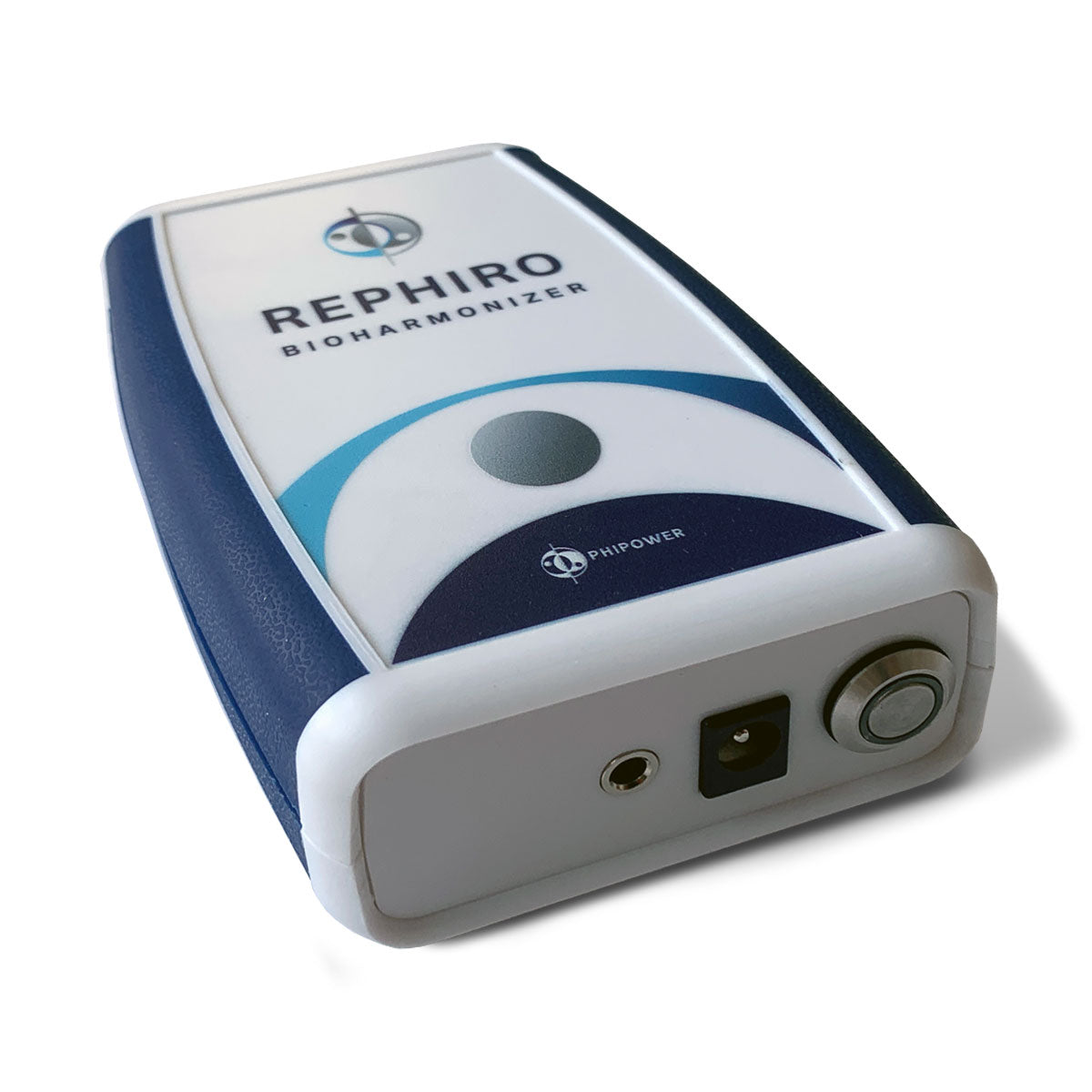
Can you hear the Rephiro Bioharmonizer?
The Rephiro Bioharmonizer is designed as a contact-based electronic frequency device, not as an audio player.
Its specified architecture combines:
~3.1 MHz
Far beyond the normal acoustic hearing range.
0.1–150 kHz
A lower-frequency component moves automatically across a broad range.
~14 Hz
A slower timing/gating rhythm structures the output.
Contact
Conductive accessories deliver the electrical signal.
The fact that some numerical components sit inside or near the conventional audio range does not turn the device into a loudspeaker.
Its primary output is electrical.
Can a phone or laptop generate Rife frequencies?
A phone or laptop can certainly generate digital audio waveforms.
But its audio system is designed to drive speakers or headphones, not to reproduce the full output architecture of a dedicated frequency device.
Typical limitations include:
- audio-band frequency response;
- speaker/headphone output rather than contact output;
- limited voltage;
- AC coupling;
- sampling-rate limits;
- no RF carrier in the MHz range through the normal audio chain;
- no dedicated electrode or plasma delivery hardware.
This is not a criticism of digital audio. It is simply a different tool.
Why digital audio has frequency limits
Digital audio represents signals using a finite sampling rate.
A common sampling rate is 44.1 kHz.
In an ideal sampled system, frequencies approaching half the sampling rate become the upper theoretical representation limit.
That is why normal consumer audio is built around the human hearing range rather than MHz radio-frequency output.
A sound file therefore cannot simply be treated as a faithful substitute for an RF carrier running at millions of cycles per second through dedicated hardware.
Should you turn an online frequency up very loud?
No.
If you are listening to audio frequencies through speakers or headphones, normal hearing-safety principles still apply.
A louder tone is not automatically more useful, and excessive sound levels can damage hearing.
Similarly, increasing electrical amplitude on a contact device is not evidence of greater effectiveness and can increase discomfort or risk.
Do not use sensory intensity as a proxy for effectiveness. Louder audio, stronger tingling or a more dramatic sensation does not prove a better biological outcome.
Does hearing or feeling a frequency prove that it works medically?
No.
Hearing proves that an acoustic signal is reaching your auditory system.
Feeling electrical stimulation proves that some form of electrical interaction is occurring.
Neither observation, by itself, proves that a frequency treats a disease.
Those are separate scientific questions requiring appropriate evidence.
This distinction is especially important in Rife discussions because technically real concepts — frequency, modulation, resonance and sidebands — are sometimes used to support biological claims that require much more evidence.
Audio vs electrical vs RF: the complete comparison
| Feature | Audio frequency | Contact electrical frequency | RF / carrier frequency |
|---|---|---|---|
| Measured in Hz | Yes | Yes | Yes |
| What oscillates? | Sound pressure after speaker conversion | Voltage/current | High-frequency electrical/electromagnetic signal |
| Needs speaker to hear? | Yes | No | No |
| Can be audible? | Yes, within hearing range | Only if converted to sound | Carrier itself usually far above audio range |
| Typical hardware | Phone, DAC, amplifier, speaker/headphone | Generator, output stage, electrodes | RF oscillator, modulation, amplifier/plasma hardware |
| Typical limitation | Audio bandwidth | Load/contact dependent | RF design and delivery architecture |
| Equivalent just because Hz matches? | No. Same repetition rate does not mean same physical stimulus. | ||
Six common myths about hearing Rife frequencies
"If I cannot hear it, the machine is not producing anything."
False. Electrical and RF signals can be completely inaudible.
"Hz means sound."
False. Hertz is a unit of repetition rate, not a type of energy.
"A 1 kHz YouTube tone is identical to a 1 kHz electrical signal."
False. The frequency number matches; the delivery mechanism does not.
"MHz carriers should make an extremely high-pitched sound."
False. MHz signals are far beyond normal acoustic hearing and may never be converted into sound.
"If I feel tingling, I am hearing the frequency through my body."
No. Electrical sensation and auditory perception are different systems.
"A stronger sensation means the frequency is working better."
There is no basis for using sensation alone as proof of therapeutic effectiveness.
Frequently asked questions
The bottom line
So, can you hear Rife frequencies?
Sometimes you can hear a numerical frequency when it is converted into an acoustic tone and lies within your hearing range.
But a Rife-style frequency can also exist as: an electrical waveform → a modulation frequency → a pulse rate → a radio-frequency carrier → a sideband component.
Those signals do not need to be audible.
The most important principle is therefore simple:
Frequency tells you how fast something repeats. To understand what a device actually does, you must also ask what is oscillating and how the signal reaches the user.
For the complete overview of Rife history, frequencies, machine types, evidence, safety and buying considerations:
Rife Machine: The Complete Guide to Rife Frequencies, Technology & Devices →
Phipower frequency products are wellness and lifestyle products, not medical devices. They are not intended to diagnose, prevent, treat or cure disease. Technical descriptions of audio, electrical and RF signals explain physical signal differences and should not be interpreted as proof of therapeutic effectiveness.