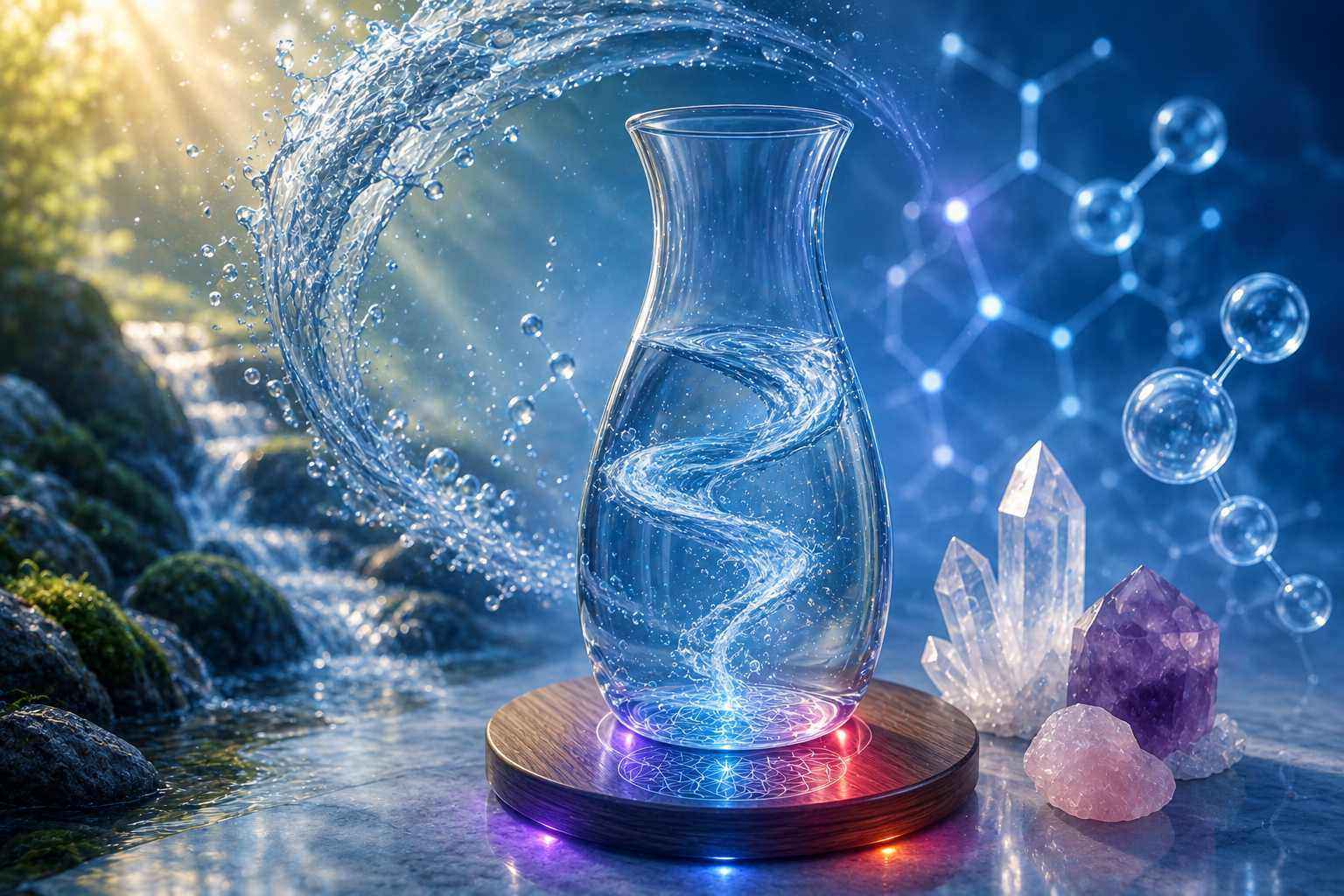
Some physical effects are measurable. Special health benefits are not yet established.
Science confirms that water has a dynamic hydrogen-bond network, that water near interfaces can behave differently from bulk water, and that certain vortex processes can temporarily change bubble populations, dissolved oxygen and other measurable properties. What science does not currently establish is that commercially "structured" water reliably improves cellular hydration, detoxification, energy, immunity or disease outcomes compared with ordinary safe drinking water.
First: what counts as a "structured water benefit"?
The phrase structured water is used for several very different ideas. Sometimes it refers to the genuine molecular organization of liquid water. Sometimes it means water near a surface. In wellness marketing it may describe vortexed, magnetically treated, light-exposed or otherwise "vitalized" water.
That makes the word benefit ambiguous too. There are at least three different questions:
Can processing measurably change the water?
For some methods, yes. Bubble population, dissolved gases, temperature, pH, conductivity or flow state can change.
Can people notice a difference?
Taste and mouthfeel are testable, but results may depend on the source water, processing method and expectation.
Does it improve health?
This requires controlled human studies. The evidence here is much weaker than the physical-water evidence.
The evidence map: claim by claim
| Claim | What science supports | Evidence for a special benefit |
|---|---|---|
| Hydration | Drinking safe water supports hydration. |
Not established Robust human evidence of superior hydration from "structure" itself is lacking. |
| Taste / mouthfeel | Dissolved gases, minerals, temperature and bubbles can influence sensory experience. |
Plausible / method-specific Needs blinded testing for the exact process. |
| More dissolved oxygen | Gas transfer can change with mixing and fine bubbles. |
Measurable in some systems Not automatically a health benefit. |
| Cellular hydration | Cell water is strongly influenced by membranes, solutes, proteins and osmotic regulation. | Not established |
| Energy / vitality | Subjective vitality can be measured with validated questionnaires. | No robust evidence |
| Detoxification | Hydration supports normal renal and physiological function. | No special effect established |
| Antioxidant effect | Oxidation-reduction chemistry is measurable. | No clinical benefit established |
| Long-lasting molecular clusters | Local hydrogen bonding exists. |
Not supported Stable bulk clusters conflict with ultrafast water dynamics. |
| EZ / interfacial water | Water near surfaces can differ from bulk water; exclusion phenomena are reproducible. | Real, interpretation debated |
What science definitely says: liquid water really is structured
Calling water "structured" is not inherently unscientific. Liquid water is held together by a constantly changing network of hydrogen bonds.
Experimental spectroscopy and molecular simulations show local arrangements that are not random. But the network is also extremely dynamic. Hydrogen-bond rearrangements occur on sub-picosecond to picosecond timescales, and experiments can observe ultrafast conversions between more and less strongly hydrogen-bonded configurations.
"Liquid water has structure" is established chemistry. "A home treatment locks bulk water into a special long-lived molecular architecture that produces health benefits" is a much stronger claim and needs its own evidence.
Benefit claim #1 — Does structured water hydrate you better?
Ordinary drinking water hydrates the body very effectively. Hydration is controlled through absorption in the gastrointestinal tract, blood osmolality, kidney function, electrolytes, hormones and fluid balance.
For "structured water" to be shown superior, a study would need to compare it directly with matched ordinary water under controlled conditions and measure outcomes such as:
- plasma or urine osmolality;
- body-mass recovery after dehydration;
- urine volume;
- fluid retention;
- electrolyte balance;
- blinded subjective outcomes.
As of August 2026, the peer-reviewed human literature does not provide robust evidence that commercially structured or vortexed water consistently hydrates people better because of a changed molecular structure.
The amount of fluid consumed, electrolyte content, exercise losses, food intake and individual physiology. Those factors should not be confused with a claim about permanent water clusters.
For a related practical routine, see what hydration can — and cannot — support around a frequency-wellness session.
Benefit claim #2 — Can structured or vortexed water taste different?
This is more plausible than many health claims because taste is influenced by measurable physical and chemical properties of the water.
Temperature, mineral composition, dissolved gases, pH, carbon dioxide and tiny bubbles can all influence sensory perception.
A 2024 study of a specific vortex–swirl water device reported creation of a large population of approximately 1 μm microbubbles, transient changes in dissolved oxygen and small pH shifts. The researchers also performed sensory comparisons.
That study is interesting because it offers a conventional physical explanation for at least some short-lived "freshness" observations after vortexing: bubbles and gas transfer, rather than a need to assume a permanent new form of H₂O.

A vortex is a real fluid-dynamic process. Whether it changes taste is a testable question; whether it creates a medically superior form of water is a different claim.
Benefit claim #3 — More dissolved oxygen
Vigorous mixing and fine-bubble generation can change gas transfer.
In the 2024 vortex–swirl experiment, dissolved oxygen rose immediately after processing and then declined toward baseline over several hours. That is a measurable physical result for that specific geometry and source water.
Two cautions are important:
- Not every vortex device will produce the same result. Geometry, rotation, temperature, source water and contact with air all matter.
- More dissolved oxygen in drinking water is not automatically a clinically meaningful oxygen therapy. Human oxygen delivery is dominated by breathing, lungs, hemoglobin and circulation.
Benefit claim #4 — Nanobubbles and microbubbles
Fine bubbles are a legitimate field of water engineering.
They are studied for aeration, flotation, cleaning, aquaculture and mass transfer. Recent experiments show that nanobubble-generation methods can improve oxygen-transfer efficiency, although stable nanobubbles do not necessarily produce a large persistent increase in bulk dissolved oxygen.
Vortexing can create transient bubble populations in some systems. Those bubbles can affect measurable water properties. This is not the same as proving permanent molecular restructuring or human health benefits.
Benefit claim #5 — "Better cellular hydration"
This is one of the most common commercial claims and one of the least precisely defined.
Cells do contain highly organized water environments near proteins, membranes and macromolecules. Interfacial water is important to biology.
But that does not demonstrate that drinking externally processed water preserves a special structure through:
- the mouth;
- stomach acid and digestive contents;
- intestinal absorption;
- blood plasma;
- cell membranes;
- intracellular environments.
To prove superior cellular hydration, researchers would need defined biomarkers and controlled human studies. The claim cannot be inferred from molecular diagrams alone.
Benefit claim #6 — EZ water and H₃O₂
Exclusion-zone (EZ) experiments are one reason structured water attracts scientific interest.
Near certain hydrophilic surfaces such as Nafion, researchers can observe zones from which suspended microspheres are excluded. Independent work has also measured unusual interfacial behavior.
However, the mechanism matters. Experiments published in PNAS showed that long-range particle exclusion near ion-exchange materials can be explained by ion exchange, ion diffusion and diffusiophoresis. Later experimental work also supported an electrophoretic/diffusiophoretic explanation.
Other studies using MRI found a low-mobility water layer near Nafion but showed that this layer and the much larger particle-exclusion zone are not the same thing.
The idea that EZ water represents a stable H₃O₂ phase is one proposed interpretation, not an established description of ordinary bulk drinking water. Even if an interfacial zone has unusual properties, that does not show that a glass of processed water becomes bulk H₃O₂ or delivers a proven health benefit.
Benefit claim #7 — "Hexagonal water" and smaller clusters
The word hexagonal sounds chemically precise because ordinary ice Ih has hexagonal crystalline symmetry.
Liquid water at room temperature is different. It contains a dynamic distribution of local hydrogen-bond arrangements. Simulations and experiments show rapid interconversion and continuous rearrangement.
That makes a simple marketing picture of persistent six-molecule hexagonal rings misleading if it is presented as the dominant, long-lived structure of bulk drinking water.
True
Local ordered motifs and tetrahedral tendencies exist in liquid water.
Not established
That vortexing creates stable, long-lived "hexagonal clusters" responsible for superior hydration.
Benefit claim #8 — Detoxification
Water is essential to normal kidney, circulatory and metabolic function, so adequate hydration is part of healthy physiology.
But "detox" is too vague to be a scientific endpoint unless the claim identifies:
- which toxin;
- how it is measured;
- the elimination pathway;
- how much faster removal occurs;
- the clinical relevance.
There is currently no robust evidence that molecular "structuring" of drinking water adds a special detoxification mechanism beyond normal hydration.
Benefit claim #9 — Antioxidant or redox effects
Oxidation-reduction potential (ORP) can be measured in water, but ORP is influenced by dissolved gases, minerals, pH, electrodes and chemical species.
A change in an ORP meter does not automatically mean that drinking the water produces an antioxidant effect in human tissues.
That biological claim would require direct studies with validated oxidative-stress biomarkers and appropriate controls.
Benefit claim #10 — More energy, vitality or well-being
People may genuinely report that a particular water feels smoother, fresher or more enjoyable to drink. That experience matters to the person having it.
But subjective experience should be distinguished from objective biomedical claims.
A good trial would blind participants to the water type and predefine validated measures of energy, fatigue or well-being. Without that kind of design, expectation and preference cannot be separated from a specific water effect.
How long could "structure" last?
This is one of the most revealing questions to ask. The answer depends entirely on what is meant by structure.
| Type of change | Typical scale | What that means |
|---|---|---|
| Hydrogen-bond rearrangement | Femtoseconds to picoseconds | Local molecular structure is continuously reorganizing. |
| Interfacial structuring | Persists while the interface and conditions persist | Relevant near surfaces, not automatically transferable to bulk bottled water. |
| Visible vortex | Seconds | Macroscopic flow ends after stirring stops. |
| Microbubble population | Minutes to hours, method dependent | Can provide a plausible transient post-vortex physical effect. |
| Mineral composition | Stable unless chemistry changes | Can influence taste, conductivity and hydration independently of "structure." |
The practical lesson is that "24-hour memory" should not be asserted simply from hydrogen-bond chemistry. If a processed water changes for hours, identify the feature that actually persists — bubbles, gas concentration, temperature, chemistry or something else — and measure it.
So does vortexing do anything at all?
Yes. A vortex changes the fluid mechanically. Depending on the apparatus it can alter:
- mixing;
- pressure gradients;
- gas exchange;
- bubble formation;
- particle distribution;
- temperature;
- sometimes pH or dissolved-gas readings.
The scientifically useful question is not "Is vortex water magic?" but: which measurable parameters change, by how much, and how long do they remain changed? That question can be answered experimentally.
A better way to test structured-water claims at home
If you want to experiment rather than rely on testimonials, use a simple blinded protocol.
- Start with one batch of the same source water.
- Split it into identical containers.
- Leave one untreated and vortex the others for 5, 15 and 30 minutes.
- Measure immediately and again after 1, 6 and 24 hours.
- Record temperature, pH, conductivity, dissolved oxygen and ORP if your instruments are appropriate.
- If possible, have an external laboratory measure bubble-size distribution.
- Run a triangle taste test using coded glasses so the tasters do not know which water is which.
A transparent result showing "no meaningful difference" is scientifically more valuable than selecting only the measurements that support a preferred story.
What should you look for in a structured-water or vortex device?
If you are buying a device for the experience of vortexed or vitalized water, focus on features you can actually evaluate:
| Feature | Why it matters |
|---|---|
| Food-safe water-contact materials | Basic hygiene and material safety come first. |
| Visible, reproducible vortex | You can directly observe the mechanical process. |
| Adjustable speed | Allows repeatable experimentation with different vortex conditions. |
| Easy cleaning | More important for real-world safety than speculative molecular claims. |
| Transparent specifications | Defined materials, capacity, speed and light wavelengths are verifiable. |
| Measured research | Prefer actual physical measurements over vague claims about "energy." |
How Phipower approaches the subject
Phipower uses structured water as the scientific umbrella and vitalized water as the practical wellness concept.
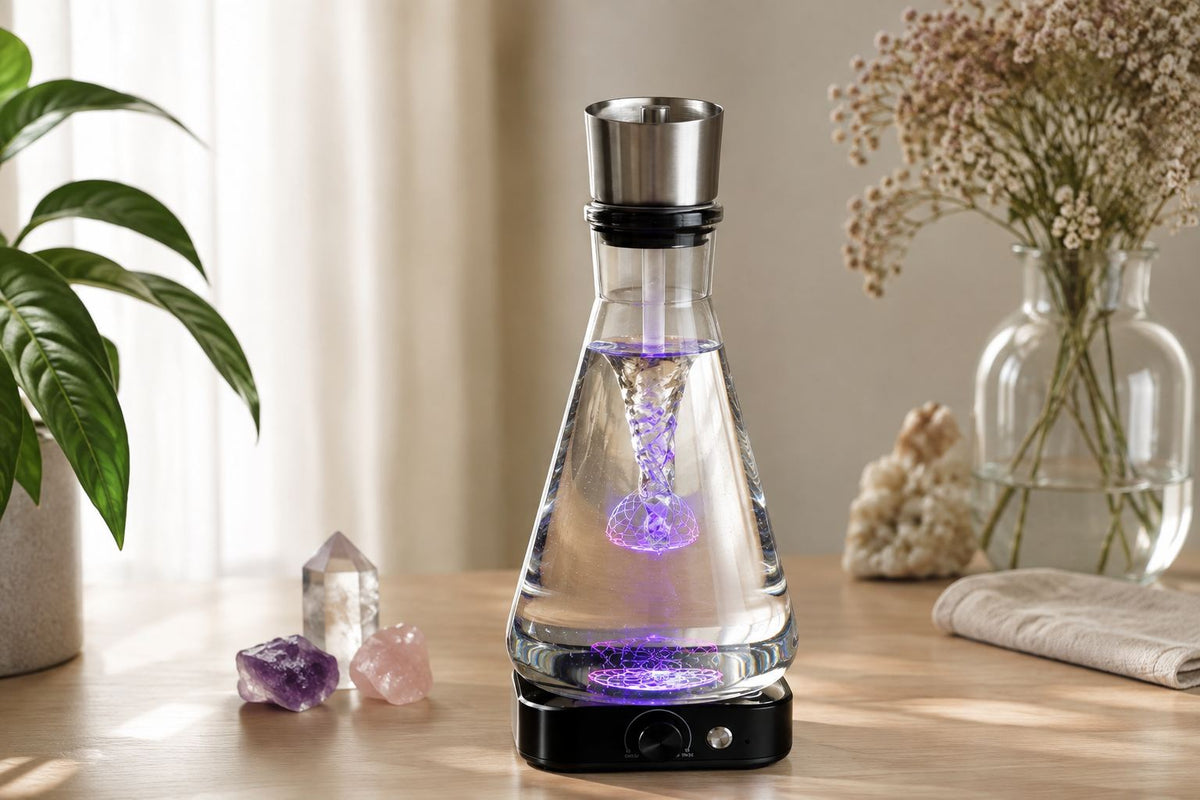
The Phipower Water Vitalizer 2.0 combines:
- a visible adjustable magnetic vortex;
- a 2-litre borosilicate glass carafe;
- four defined LED wavelengths: 405, 470, 660 and 850 nm;
- Golden Triangle crystals as an optional symbolic/ritual element;
- a stainless-steel spout and reusable countertop design.
Those features can be described directly without claiming that the resulting water diagnoses, prevents, treats or cures disease.
For the practical preparation approach, continue to Vitalized Water: What It Is & How to Make It.
Structured water benefits: the evidence-based verdict
| Statement | Verdict |
|---|---|
| Liquid water has molecular structure. | Yes |
| The structure is dynamic rather than a fixed bulk lattice. | Yes |
| Water near interfaces can behave differently from bulk water. | Yes |
| Vortexing can create measurable transient changes in some systems. | Yes |
| Vortexing always creates stable hexagonal water. | Not established |
| Structured water hydrates humans better because of its molecular structure. | Not established |
| Structured water detoxifies or provides antioxidant treatment. | Not established |
| EZ experiments prove bulk H₃O₂ drinking water. | No |
| Taste or sensory differences are possible after processing. | Plausible / testable |
Scientific sources & further reading
Energetics of hydrogen-bond network rearrangements in liquid water — experimental X-ray evidence for rearrangement between local hydrogen-bond configurations.
Ultrafast conversions between hydrogen-bonded structures — femtosecond X-ray spectroscopy showing sub-picosecond structural conversion in liquid water.
Structure of liquid water as a dynamical mixture — ab-initio molecular-dynamics work describing dynamic tetrahedral and ring/chain-like local structures.
Long-range repulsion driven by ion exchange and diffusiophoresis — experimental and theoretical explanation for exclusion zones near ion-exchange materials.
Interfacial water structuring at the Nafion surface by MRI — found a low-mobility interfacial layer that does not simply coincide with the larger microsphere exclusion zone.
Vortex–swirl flow and transient microbubble-enhanced water properties — measured ~1 μm microbubbles plus time-dependent dissolved oxygen and pH changes after a specific vortex–swirl process.
Primary experimental work on nanobubble generation, oxygen-transfer efficiency and dissolved oxygen.
Frequently asked questions about structured water benefits
The bottom line
The strongest case for structured water is not that every wellness claim is already proven.
It is that water is scientifically fascinating, interfacial structure is real, fluid processing can produce measurable transient changes, and those changes can be studied properly.
The evidence becomes weak when that science is stretched into unsupported statements about superior cellular hydration, detoxification, antioxidant treatment, immunity or stable bulk H₃O₂.
A credible water brand should therefore do three things:
- separate established chemistry from hypotheses;
- measure the actual effects of its own device;
- avoid turning interesting water physics into unproven medical claims.
Structured Water: The Complete Guide →
This article is educational and does not provide medical advice. Phipower water products are wellness and lifestyle products, not medical devices. Statements about vortexing, bubbles, interfacial water and molecular dynamics describe physical research and should not be interpreted as proof that Phipower products diagnose, prevent, treat or cure disease.