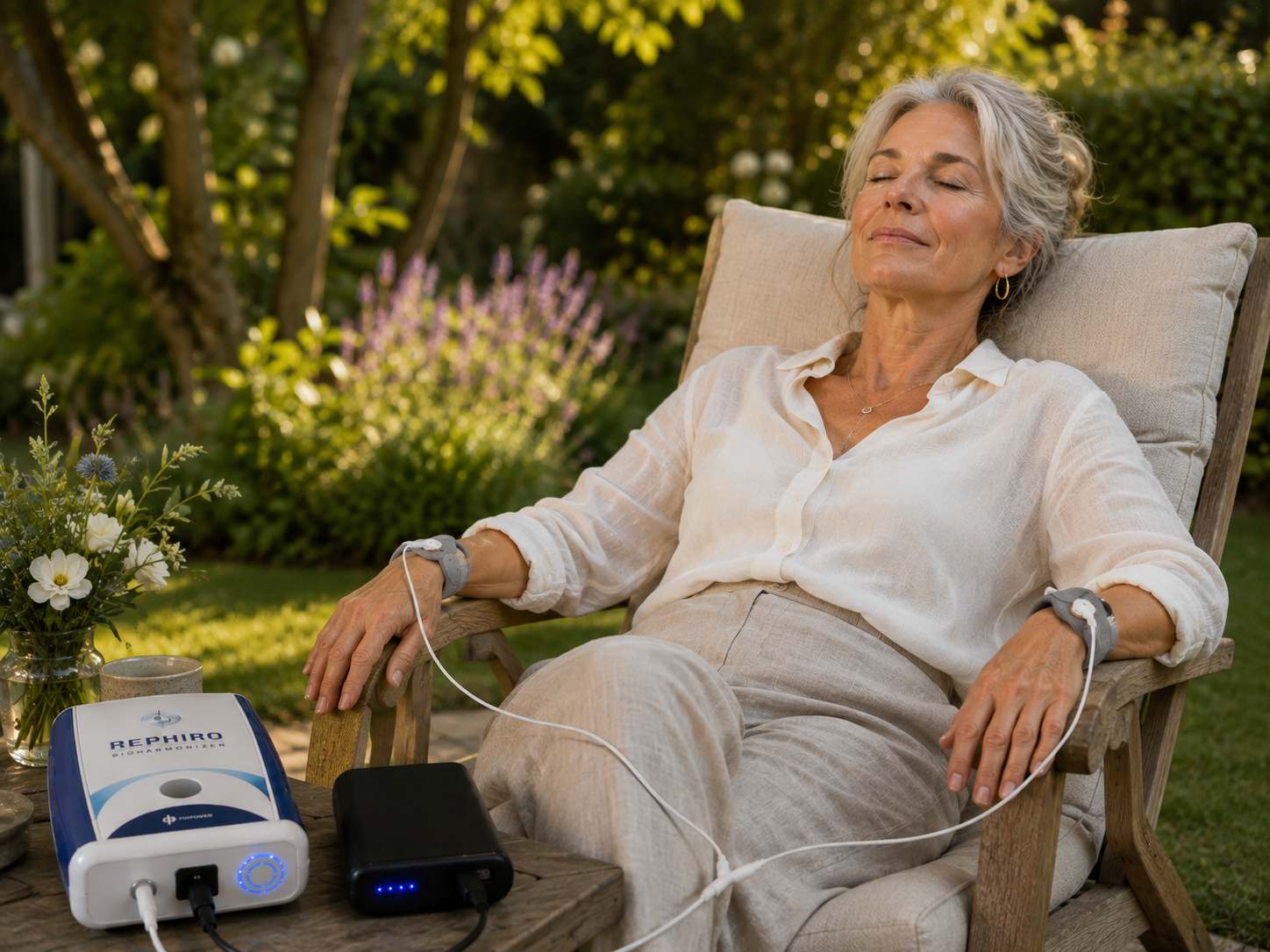
Rife frequencies are frequency values used in Rife-inspired systems and frequency lists. Some values are linked to historical Rife terminology such as Mortal Oscillatory Rates (MORs); many others come from later practitioners, compilations, harmonics, conversions or device-specific protocols. The number itself — for example 1,000 Hz — is physically measurable. What that number does biologically is a separate question that requires experimental and clinical evidence. This article goes deep into the frequencies themselves. For the broad overview of devices, history, contact vs plasma, evidence, safety, pricing and buying considerations, start with our Complete Guide to Rife Machines →
What are Rife frequencies?
The phrase Rife frequencies is used for numerical frequencies associated with Rife-inspired frequency devices, historical Rife claims and later frequency protocols. They are usually expressed in Hertz (Hz), kilohertz (kHz) or, for higher-frequency carriers, megahertz (MHz).
At first glance this can make a Rife list look like a medical lookup table. But technically, the number is only one property of a signal. It tells you how rapidly a repeating event occurs.
The standard unit is the hertz. That part is ordinary measurement science. The harder question is whether a chosen frequency has a specific biological or therapeutic effect. That cannot be established by the number alone.
What does Hz actually tell you?
Hz tells you the repetition rate. It does not tell you what is oscillating.
A speaker moves back and forth, creating pressure waves in air. The ear experiences those waves as sound.
An electronic generator can produce a voltage waveform that changes at a defined rate and is delivered through conductive hardware.
A high-frequency carrier can operate in the kHz or MHz range, with information added through modulation.
Mechanical resonance and vibration can also be expressed in hertz, even though the physical stimulus is different again.
A 1,000 Hz tone from headphones and a 1,000 Hz electrical waveform applied through contact electrodes share a repetition rate. They are not the same physical signal.
Where do Rife frequency lists come from?
There is no single modern, universally validated "official Rife frequency list". The lists circulating today have multiple origins, and those origins matter.
Terms and frequency claims attributed to early Rife work.
Values added or adapted after Rife's lifetime.
Large databases assembled from many different sources.
Multiples, divisions or translated values used for different hardware.
Preset sweeps and programs designed around a specific generator architecture.
This explains why two websites can publish different frequency values for the same label. A list may combine historical material, later experimentation and technical conversions while presenting everything in one column.
When you encounter a frequency value, ask: Who documented it? When? For what device? Was it a direct output frequency, a modulation frequency or a carrier relationship? Was it measured, inferred or simply repeated from another list?
What is an MOR — Mortal Oscillatory Rate?
In Rife history, the term Mortal Oscillatory Rate (MOR) is associated with the idea that a microorganism could have a characteristic frequency at which it might be disrupted.
This is one of the concepts that made Rife frequency lists so compelling: if an organism had a specific oscillatory characteristic, perhaps an external signal could be matched to it in a resonance-like way.
But there are three different layers that should not be collapsed into one:
Resonance exists
Physical systems can exhibit frequency-dependent responses and resonances.
Organism-specific MORs
Rife-associated material proposed characteristic frequencies for microorganisms.
Disease treatment
Showing that a consumer device can selectively eliminate a pathogen or treat disease in the human body requires separate high-quality evidence.
The first statement does not automatically prove the second, and the second does not automatically prove the third.
Why do different Rife frequency lists disagree?
Differences between lists do not necessarily mean someone made a simple transcription error. There are several technical reasons why numbers can diverge.
- Different historical sources: later compilations may not be based on the same documents.
- Harmonics: a practitioner may use a multiple or fraction of another frequency.
- Carrier translation: a low-frequency value may be used to modulate a higher-frequency carrier rather than being delivered directly.
- Hardware limits: devices with different output ranges may translate or sweep around a target.
- Protocol evolution: later users often added empirical values not found in early material.
- Rounding and notation: Hz, kHz and MHz can be confused when context is missing.
This is one reason a frequency database should not be treated like a pharmacopoeia. The numerical precision of a value can create an impression of certainty that the underlying evidence may not justify.
What are harmonics — and why do they appear in frequency lists?
A harmonic is a frequency related to a fundamental frequency by an integer multiple. If the fundamental is 1,000 Hz, examples of harmonics include 2,000 Hz, 3,000 Hz and 4,000 Hz.
Harmonics matter in electronics because waveform shape affects the spectrum. An ideal sine wave is dominated by one frequency. A square wave contains the fundamental plus a series of harmonics.
That means a device running "1,000 Hz" does not necessarily put energy only at 1,000 Hz. The actual spectrum depends on waveform, rise time, amplification and the rest of the signal chain.
Direct frequency or carrier frequency?
Another source of confusion is whether the number in a protocol is the direct electrical output or a modulation frequency placed onto a higher-frequency carrier.
With a direct-frequency approach, a generator may produce a waveform at the selected value itself.
10 kHz program → 10 kHz electrical waveform → output stage → contact electrodes
With carrier-based architecture, a higher-frequency signal is generated first. A lower-frequency signal then modifies that carrier.
3.1 MHz carrier + 10 kHz modulation → modulated high-frequency output
Those systems are technically very different even though both may be described using the same lower-frequency program number. To understand the electronics behind carriers, modulation and delivery, see How Does a Rife Machine Work? →
How modulation creates sidebands
When a carrier is modulated, additional spectral components can appear around it. These are called sidebands.
A simplified example using a 3.100 MHz carrier and 10 kHz modulation gives components around:
This is standard signal-processing physics, not something unique to alternative wellness devices.
Within Rife history, carrier-and-sideband concepts are particularly associated with Philip Hoyland. We have therefore kept the full technical discussion on its own page rather than duplicating it here. Read: Hoyland Sideband Method — Carrier Frequencies & Sidebands Explained →
Why do some devices sweep through frequencies?
A fixed-frequency program remains at one selected value. A frequency sweep moves automatically through a range.
One selected value
Useful when the operator wants precise control and repeatability at a particular setting.
A changing range
Useful when the design prioritizes broad coverage and simplicity rather than manual selection of individual values.
Sweeps can be continuous, stepped, linear, logarithmic or combined with other modulation. The sweep range is therefore part of the protocol, just like the starting frequency and waveform.
A sweep should not be interpreted as proof that every frequency inside the range has a specific biological effect. It simply describes how the generator moves through its programmed frequency space.
Are Rife frequencies audio frequencies?
Some are numerically inside the human hearing range. That still does not mean audio playback is equivalent to a dedicated Rife-style electronic device.
Does delivery method change what a Rife frequency means?
Yes. A frequency number without delivery context is incomplete.
| System | What oscillates? | Typical delivery | What the Hz value describes |
|---|---|---|---|
| Audio file | Acoustic pressure after speaker conversion | Speaker / headphones | Audio waveform repetition rate |
| Contact generator | Electrical voltage/current | Pads, handholds, wristbands, socks | Electrical waveform or modulation |
| Carrier-based contact system | High-frequency electrical signal | Conductive accessories | Carrier, modulation and/or sweep |
| Plasma system | Driven plasma / electromagnetic field | Plasma tube | Carrier and modulation architecture |
This is why comparing devices purely by their advertised frequency lists can be misleading.
Can one exact frequency selectively target one organism?
This is the central scientific question behind many historical Rife claims — and it deserves more caution than most frequency lists provide.
Biological systems can respond to electric and electromagnetic fields, and the response can depend on parameters such as frequency, field strength, waveform, modulation, exposure time and tissue properties. That is a legitimate field of research.
But that broader fact does not establish that a specific consumer-device frequency can selectively destroy one pathogen inside the human body while leaving surrounding tissue unaffected.
An oscilloscope can confirm that a generator outputs 10,000 Hz. That measurement tells us the signal exists. It does not, by itself, prove what the signal will do in a living organism.
High-quality clinical evidence would be needed for claims that a Rife frequency treats a specific disease. Phipower therefore distinguishes technical signal generation from therapeutic claims.
How does Rephiro use Rife-inspired frequencies?
The Rephiro Bioharmonizer takes a different approach from systems that ask the user to choose individual disease-labelled frequencies. Its preset architecture combines:
A high-frequency carrier forms the base signal.
The modulation range moves automatically rather than requiring manual frequency selection.
A slower pulsing component adds another timing layer to the output.
The signal is delivered through conductive contact accessories such as pads, wristbands or silver-fibre socks.
The practical consequence is simple: you do not need to choose a disease name from a frequency database or decide which MOR list to trust. Rephiro exchanges manual programmability for a preset sweep-based approach.
How should you read a Rife frequency list?
If you encounter a table online, resist the temptation to look only at the number. A technically useful list needs context.
- Check the unit. Is the value Hz, kHz or MHz?
- Check the source. Is it historical, later practitioner material or a modern compilation?
- Check the signal role. Is the value a direct frequency, a modulation frequency, a carrier or a sideband?
- Check the waveform. Sine, square and pulsed signals can have very different spectra.
- Check the amplitude and hardware. The same numerical frequency can be delivered very differently.
- Check the evidence level. Is a biological claim based on laboratory work, clinical research, historical anecdote or simply repeated from another list?
A frequency with six digits after the decimal point may look highly precise. Precision of notation is not the same thing as certainty of biological effect.
What matters when evaluating a frequency device?
If you are comparing Rife-style hardware, a frequency list is only one part of the specification.
Frequency range
Fixed settings, automatic sweep or both?
Waveform
Sine, square, pulse or modulated architecture?
Carrier
Does the device use a higher-frequency carrier?
Amplitude
What voltage/current or field output is produced under a defined load?
Contact or plasma
How does the physical signal reach the user?
Measured vs claimed
Are technical specifications independently measurable, and are health claims supported separately?
What is established — and what remains unproven?
| Statement | How to classify it |
|---|---|
| Frequency can be measured in Hz | Established physics |
| Electronic generators can create fixed frequencies and sweeps | Established electronics |
| Waveform shape can create harmonic components | Established signal theory |
| Modulating a carrier can generate sidebands | Established signal processing |
| Electric and electromagnetic fields can interact with biological matter | Established in general; effects depend strongly on exposure parameters |
| Every historical Rife frequency has a specific therapeutic effect | Not established |
| A consumer Rife machine can selectively destroy a named pathogen in the body at one exact frequency | Not established by reliable clinical evidence |
| Rife machines cure cancer or replace established treatment | Not supported by reliable evidence |
You do not have to choose between accepting every historical claim and dismissing the underlying electronics. The useful approach is to keep measurement, hypothesis and clinical evidence separate.
Frequently asked questions about Rife frequencies
The bottom line: a frequency number is only the beginning
Rife frequencies are numerical frequency values used within a broad historical and modern family of frequency devices and protocols. The unit — Hertz — is objective and measurable. But a complete signal also depends on waveform, amplitude, carrier, modulation, harmonics, sweep behavior and delivery method.
The origin of a frequency matters too. Historical MOR terminology, later frequency databases and modern device protocols should not be treated as if they all represent the same level of evidence.
For the complete context — Royal Raymond Rife, device types, contact vs plasma, evidence, safety, pricing and buying considerations — continue with our main pillar.
Rife Machine: The Complete Guide to Rife Frequencies, Technology & Devices →
For the basic definition of frequency and hertz, see the National Institute of Standards and Technology (NIST). For broader scientific context on biological interactions with electric and electromagnetic fields, see Bodewein et al., Environmental Research (2019), and Juutilainen et al., Bioelectromagnetics (2011). For an evidence-based overview of Rife-machine cancer claims, see Cancer Research UK.
The Rephiro Bioharmonizer and other Phipower frequency products are intended for personal wellness, education and experimentation. They are not intended to diagnose, prevent, treat or cure disease and should not be used as a substitute for appropriate medical care.