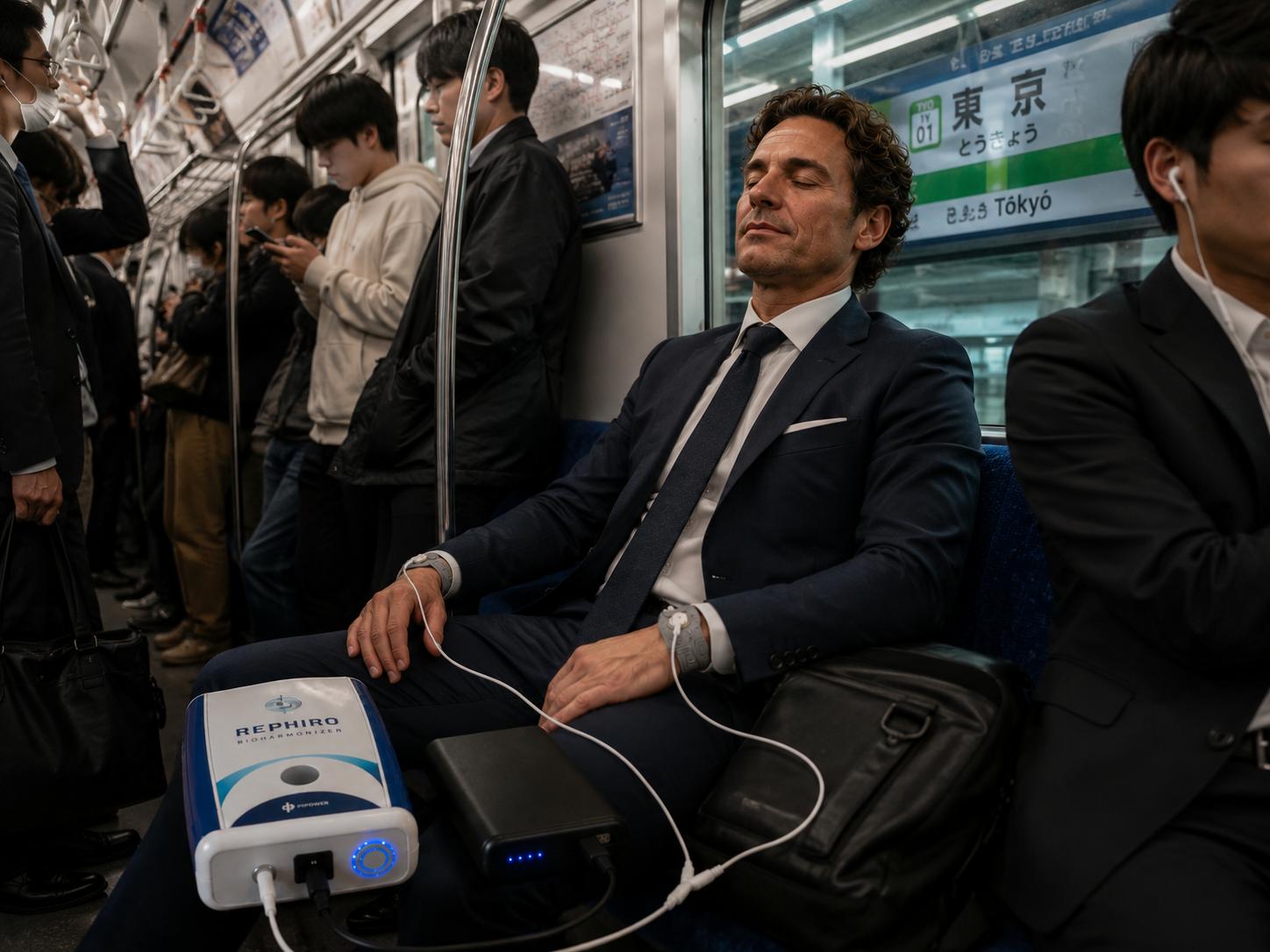
30 kHz positive-offset square wave vs a broad family of frequency systems.
The fastest way to understand the difference is to compare what the electronics actually generate rather than the disease claims attached to them.
The Hulda Clark Zapper is not the same thing as a Rife machine. Clark popularized a relatively simple battery-powered positive-offset square-wave device, most famously around 30 kHz. Modern Rife systems can be far more complex and may use different frequencies, carriers, sweeps, waveforms and delivery methods. Neither the shared use of Hertz nor the presence of hand electrodes makes the two technologies equivalent.
For the broader Rife architecture, start with the Complete Guide to Rife Machines →
Who was Hulda Clark?
Hulda Regehr Clark was an alternative-health author whose books connected parasites, environmental contaminants and electrical frequencies with a very wide range of diseases.
She became especially known for two concepts:
- the Syncrometer, which she claimed could detect substances or pathogens;
- the Zapper, a small electrical frequency generator intended to be used with conductive hand electrodes.
Clark's disease theories became popular in alternative-health communities, but the strongest claims made around her system were not supported by reliable clinical evidence.
The U.S. Federal Trade Commission later challenged companies selling Clark-related products over unsubstantiated claims involving serious diseases including cancer and AIDS.
What is a Hulda Clark Zapper?
The best-known Clark Zapper is conceptually simple.
Modern sellers that describe themselves as following Clark's published design characterize it as:
- powered by a 9-volt battery;
- producing a positive-offset square wave;
- typically operating around 30 kHz;
- using approximately 50% duty cycle;
- connected to conductive copper hand electrodes.
Clark-related sources also describe a later 1 kHz application, but the classic Zapper most people mean is the approximately 30 kHz version.
What does "positive offset" mean?
A normal symmetrical square wave can alternate between positive and negative voltage.
Clark's Zapper concept instead emphasized a waveform that remains above zero.
In simplified form:
Symmetrical bipolar square wave
Alternates above and below zero volts.
Positive-offset square wave
Oscillates between two positive voltage levels without intentionally crossing below zero.
That is an objectively measurable difference in waveform design.
What is not established merely by measuring that offset is Clark's biological claim that positive polarity selectively eliminates pathogens.
Why 30 kHz?
Clark-related technical material describes approximately 30,000 cycles per second as the original best-known Zapper frequency.
Her rationale involved perceived electrical current through the body and the harmonic spectrum generated by a square waveform.
Modern reproductions frequently use the range around 30–33 kHz.
Technically, however, 30 kHz is simply the fundamental repetition rate. To understand the full output, you also need to know:
- voltage;
- load;
- waveform rise/fall time;
- duty cycle;
- output impedance;
- harmonic spectrum.
Why did Clark use a square wave?
This part of the explanation starts with real signal theory.
An ideal 50% duty-cycle square wave contains a fundamental frequency plus odd harmonics.
For a 30 kHz fundamental, idealized components occur at:
Real electronic square waves are not ideal mathematical waves, so their measured spectrum depends on the circuit and edge speed.
The existence of harmonics is standard electronics. The claim that these harmonics kill parasites or cure disease is a separate biological claim and requires separate evidence.
What is a Rife machine?
The term Rife machine now covers a much wider family of frequency devices inspired by Royal Raymond Rife and later practitioners.
Modern systems can use:
- fixed frequencies;
- frequency databases;
- automated sweeps;
- sine, square or pulse waveforms;
- high-frequency carriers;
- amplitude or frequency modulation;
- contact electrodes;
- plasma tubes;
- multiple channels.
So while a Clark Zapper is a relatively narrow device concept, "Rife machine" is a broad umbrella term.
For the full breakdown, see How Does a Rife Machine Work? →
Hulda Clark Zapper vs Rife machine: side-by-side
| Feature | Classic Hulda Clark Zapper | Modern Rife-style system |
|---|---|---|
| Core concept | Positive-offset square-wave generator | Broad frequency-generation architecture |
| Typical famous frequency | ~30 kHz | Can range from low Hz to kHz/MHz depending on system |
| Power concept | Typically 9 V battery | Battery, USB/DC or mains-powered systems |
| Waveform | Positive-offset square wave | Sine, square, pulse, modulated or device-specific |
| Manual programs | Usually minimal/none in classic design | Common in advanced systems |
| Frequency sweep | Not central to classic design | Common in many systems |
| Carrier frequency | Not the defining classic architecture | Used in some Rife systems |
| Contact electrodes | Yes — commonly copper handles | Yes in contact systems |
| Plasma option | No in classic Zapper | Yes in some Rife systems |
| Historical lineage | Hulda Clark, mainly 1990s onward | Royal Raymond Rife / later Rife practitioners |
| Disease-treatment evidence | No reliable clinical validation of Clark's sweeping claims | No blanket clinical validation for consumer Rife systems as disease treatments |
They also come from different historical lineages
The technologies are often mixed together online, but their histories are separate.
1930s–1940s frequency experimentation
Associated with unusual microscopes, RF/plasma equipment, microorganism-frequency concepts and later MOR terminology.
1990s simplified Zapper
Associated with a portable positive-offset square-wave generator intended for home use with copper hand electrodes.
Clark was influenced by a larger alternative-frequency culture, but the Zapper is not simply an original Rife instrument in a smaller case.
Read the Rife history: Royal Raymond Rife: History, Claims & Evidence →
Clark Zapper vs Rife frequency lists
This is another major distinction.
Many programmable Rife systems invite the user to select individual frequencies or named frequency sets.
The classic Clark Zapper philosophy moved toward a simpler fixed square-wave approach.
Clark-related explanations argued that square-wave harmonics made it unnecessary to select every individual frequency one by one.
Whether that biological interpretation is valid is unproven, but technically the user experience is clearly different:
One simple waveform concept
Turn on a fixed positive-offset square-wave generator.
Select or construct programs
Choose frequencies, sweeps, carriers, waveforms or databases.
For the database issue, see Rife Frequencies Explained →
Do square-wave harmonics make a Zapper a "multi-frequency Rife machine"?
Not in a meaningful technical sense.
It is true that a square wave contains harmonics.
But those harmonics are mathematically related to the fundamental and their amplitudes fall with harmonic order in an ideal waveform.
A programmable generator can intentionally choose frequencies, timing, waveform shape and modulation in ways that a simple fixed oscillator cannot.
A rich spectrum is not the same thing as independent frequency programmability.
What did Hulda Clark claim the Zapper could do?
Clark and companies associated with her approach promoted sweeping claims that electrical "zapping" could eliminate parasites and contribute to treatment of serious diseases.
Those claims went far beyond what had been established by reliable clinical trials.
In 2003, the U.S. Federal Trade Commission charged the Dr. Clark Research Association and a related Swiss company with making unsubstantiated efficacy claims involving products including the Zapper, Syncrometer and a cancer program.
The FTC specifically described claims that the Zapper killed disease-causing parasites and was effective against serious diseases including cancer and AIDS.
A 2004 settlement required refunds to U.S. consumers and restricted unsubstantiated claims.
Clark's claims are presented here historically, not repeated as product claims.
What does the evidence say?
There are scattered laboratory studies involving electrical pulse generators and biological systems.
That is not surprising: electrical fields can affect cells under some experimental conditions.
But a laboratory result involving a particular pulse generator does not validate Clark's broad theory that her Zapper cures serious human disease.
Clinical effectiveness requires:
- a defined device;
- measured electrical output;
- a defined medical condition;
- controlled human trials;
- predefined outcomes;
- independent replication.
Those requirements are the same standards we apply to Rife claims.
What about safety?
A 9-volt battery does not automatically make every possible use harmless.
Electrical-stimulation risk depends on more than supply voltage, including current path, skin contact, hardware condition and implanted electronic devices.
As a conservative rule for contact electrical devices:
- do not use with a pacemaker, ICD or active implanted electronic device without explicit professional clearance;
- avoid current paths across the chest;
- avoid unsafe head/front-of-neck placement;
- do not use on broken or infected skin;
- keep equipment dry;
- do not use damaged leads or improvised power supplies.
For the complete safety review, see Are Rife Machines Safe? →
Where does Rephiro fit?
Rephiro is neither a classic Hulda Clark Zapper nor a fully programmable Rife generator.
It occupies a third position: a compact preset contact-frequency system.
~3.1 MHz
A high-frequency carrier, unlike the classic 30 kHz Clark architecture.
0.1–150 kHz
An automatic broad lower-frequency sweep.
~14 Hz
A separate slower timing layer.
Contact
Conductive accessories create the electrical path.
This makes Rephiro more signal-layered than a classic fixed 30 kHz Zapper, while remaining much simpler to operate than a fully programmable Rife system.
Clark Zapper vs Rephiro vs programmable Rife
| Clark Zapper | Rephiro | Programmable Rife | |
|---|---|---|---|
| Main philosophy | Minimal fixed oscillator | Preset layered signal | Maximum user control |
| Classic/base frequency | ~30 kHz | 3.1 MHz carrier + sweep | User/device dependent |
| Automatic sweep | No | 0.1–150 kHz | Often configurable |
| Slow pulsing layer | Not defining feature | ~14 Hz | Often configurable |
| Programming | Very low | None required | High |
| Software | No | No | Often |
| Best fit | People specifically interested in Clark's historical circuit concept | Simple preset frequency use | Technical experimentation |
Which type makes sense for you?
Choose a Clark-style Zapper
If your main interest is specifically reproducing or studying Hulda Clark's positive-offset 30 kHz concept.
Choose Rephiro
If you want a preset contact system with carrier, automatic sweep and pulsing but no software or frequency database.
Choose programmable Rife
If you want to select individual frequencies, waveforms, carriers or custom experiments.
This is a technology and usability comparison — not a claim that one system has superior medical effectiveness.
Seven common misconceptions
"Hulda Clark invented the Rife machine."
No. Clark's Zapper and Rife technology come from different historical lineages.
"A Clark Zapper is just a cheap Rife machine."
It is better described as a specific simple frequency-generator concept with its own design philosophy.
"Square-wave harmonics mean the Zapper generates every useful frequency."
A square wave has harmonics, but that does not establish biological effectiveness or reproduce every arbitrary frequency.
"30 kHz is an original universal Rife frequency."
No. It is most strongly associated with Clark's Zapper design, not a universal definition of Rife output.
"Positive offset proves it kills parasites."
Positive offset is measurable electronics; parasite treatment is a separate medical claim requiring evidence.
"Rephiro is a Clark Zapper with a different case."
No. Rephiro uses a different carrier/sweep/pulse architecture.
"If the device is battery-powered, there are no precautions."
Battery power reduces some electrical hazards but does not remove issues such as implanted electronic devices or unsafe electrode placement.
Sources & further reading
FTC description of Clark-related product claims, including the Zapper, Syncrometer and serious-disease claims.
Settlement and refund announcement involving Dr. Clark Research Association and related entities.
Current commercial implementation describing a positive-offset square wave, 30 kHz / 1 kHz options and 9-volt battery architecture. Included as a first-party description of Clark-style design, not as evidence for health claims.
Technical description of approximately 30 kHz, 50% duty cycle, positive offset and oscilloscope/multimeter verification.
Central overview of Rife history, signal architectures, evidence, device types and buying considerations.
Frequently asked questions about Hulda Clark Zappers and Rife machines
The bottom line
The Hulda Clark Zapper and Rife machines overlap in one broad sense:
both belong to the world of electrical frequency devices.
But technically they should not be merged into one category.
Clark Zapper: a simple positive-offset square-wave concept, most famously around 30 kHz and powered by a 9-volt battery.
Rife machine: a broad family that may include programmable frequencies, sweeps, carriers, modulation, contact electrodes or plasma/RF delivery.
Rephiro: a preset contact-frequency system with approximately 3.1 MHz carrier, 0.1–150 kHz automatic sweep and ~14 Hz pulsing.
Technical overlap does not transfer medical evidence. A shared frequency, waveform or pair of electrodes does not prove that one device has the effects claimed for another.
For the complete overview of Rife history, technology, frequencies, evidence and device types:
Rife Machine: The Complete Guide to Rife Frequencies, Technology & Devices →
This article is educational and historical. Hulda Clark's disease-treatment claims are discussed as claims, not as established medical facts. Phipower frequency products are wellness and lifestyle products, not medical devices, and are not intended to diagnose, prevent, treat or cure disease.