Water is structured — but its structure is dynamic.
Each H₂O molecule is polar and can participate in multiple hydrogen bonds. Those interactions create a connected network with a strong tendency toward local tetrahedral organization. At room temperature the network also contains distorted, under-coordinated and interstitial arrangements. Femtosecond X-ray experiments show that populations of strongly and weakly hydrogen-bonded configurations can interconvert on sub-picosecond timescales. So "water has structure" is scientifically correct; "bulk water is locked into one permanent cluster pattern" is not.
Start with one H₂O molecule
A water molecule contains one oxygen atom covalently bonded to two hydrogen atoms.
The molecule is bent rather than linear. Oxygen pulls electron density toward itself more strongly than hydrogen, giving the oxygen side a partial negative character and the hydrogen side a partial positive character.
That molecular polarity is the foundation of water's hydrogen-bond network.
The covalent O–H bonds hold each molecule together. Hydrogen bonds connect neighbouring molecules into a dynamic liquid network.
What is a hydrogen bond in liquid water?
A hydrogen bond forms when a hydrogen attached to one oxygen interacts with a neighbouring oxygen atom.
It is not another ordinary covalent bond. It is weaker, longer and much easier to rearrange.
But because every water molecule can participate in several hydrogen bonds, their collective effect is enormous.
Hydrogen bonding helps explain water's:
- high boiling point relative to similarly sized molecules;
- high heat capacity;
- strong surface tension;
- unusual density behaviour;
- structure of ordinary ice;
- exceptional importance as a biological solvent.
Why do people say water forms four hydrogen bonds?
A single water molecule has two hydrogens that can act as hydrogen-bond donors and two lone-pair directions on oxygen that can accept hydrogen bonds.
This creates a natural tendency toward approximately fourfold tetrahedral coordination.
In ordinary ice, this four-neighbour motif is highly developed. Room-temperature liquid water is less perfect.
Think of fourfold tetrahedral coordination as a preferred local motif, not a rule that every liquid-water molecule obeys perfectly at every instant.
Depending on the geometric or energetic definition, modern simulations give roughly three to four hydrogen bonds per molecule on average at ambient conditions. A recent high-level bulk-water simulation, for example, reported about 3.55 ± 0.12 hydrogen bonds per molecule at 298 K.
What does "tetrahedral water" mean?
Imagine one central oxygen atom with four neighbouring water molecules arranged toward the corners of a tetrahedron.
This geometry is favourable because it accommodates two donor and two acceptor hydrogen-bond directions.
More open & tetrahedral
Well-separated first and second coordination shells and stronger fourfold organization.
Less perfectly tetrahedral
Thermal motion bends and breaks ideal local arrangements.
Closer-packed neighbours
Additional molecules can intrude between ideal first- and second-shell positions.
Liquid water continually fluctuates among these kinds of local environments.
Coordination shells: how scientists describe local water structure
Instead of treating bulk liquid water as a set of permanent clusters, researchers often describe coordination shells.
The first shell contains the nearest neighbouring molecules. The second shell contains the next layer of neighbours.
X-ray and neutron scattering probe statistical correlations between molecules and reveal how strongly these shells are expressed.
Coordination-shell distributions describe the probability of finding neighbours at particular distances without pretending those same molecules remain permanently attached.
Are water clusters real?
Yes — but the word cluster needs context.
Hydrogen-bonded dimers, trimers, rings and larger networks can be studied in the gas phase, in molecular simulations and as transient local motifs in liquid water.
What is misleading is the picture of bulk water as a mixture of stable bottles-within-a-bottle, such as:
- permanent six-molecule "hexagonal water" clusters;
- permanent 12-, 24- or 280-molecule superstructures;
- fixed cluster sizes that supposedly determine hydration quality.
The molecules in liquid water continuously exchange partners.
How fast does liquid-water structure change?
Very fast.
Femtosecond X-ray spectroscopy by Wen and colleagues directly followed the conversion of more strongly hydrogen-bonded water structures into more disordered, weakly bonded structures after vibrational excitation.
The characteristic structural conversion occurred with a single sub-picosecond time constant.
That does not mean every conceivable structural correlation disappears in one picosecond. Different observables have different relaxation times.
It does mean that a molecular picture of bulk water being "locked" into one hydrogen-bond configuration for hours is incompatible with the known ultrafast dynamics of the liquid.
*Physical bubble persistence is device- and condition-dependent and is not a hydrogen-bond lifetime.
Temperature changes the structural population
As water cools, tetrahedral hydrogen bonding becomes increasingly important.
Smith and colleagues used temperature-dependent X-ray absorption to distinguish more fully coordinated "ice-like" local configurations from more distorted configurations.
Later scattering and simulation work similarly shows growing tetrahedral order as water is cooled.
Heating shifts the balance in the opposite direction:
- molecular motion increases;
- ideal tetrahedral arrangements become less common;
- more distorted local configurations appear.
Water remains a hydrogen-bonded liquid; the distribution changes.
Why does this help explain water's density anomaly?
Most liquids simply become denser as they cool.
Water behaves differently near freezing because stronger tetrahedral ordering creates a more open network.
This competition produces water's famous density maximum near 4 °C at ordinary pressure.
Pulls molecules closer
Like most liquids, reduced thermal motion tends to increase density.
Opens the network
Increasing ice-like local order leaves more empty space between neighbours.
In ice Ih, the open tetrahedral network wins completely — which is why ordinary ice floats on liquid water.
Liquid water vs ice: similar local preference, very different dynamics
| Feature | Liquid water | Ice Ih |
|---|---|---|
| Hydrogen bonds | Connected but continuously rearranging | Long-range crystalline network |
| Local tetrahedrality | Important but distorted and fluctuating | Highly developed |
| Neighbour exchange | Continuous | Strongly constrained |
| Long-range order | No crystal lattice | Yes |
| Density | Higher near room temperature | Lower for ordinary ice |
So "ice-like local structure" in liquid water does not mean that tiny crystals of ice are simply floating throughout the liquid.
Does water contain two different liquid structures?
This is an active research question.
Some models describe water's anomalies in terms of fluctuations between more open, tetrahedral low-density-like environments and more disordered, high-density-like environments.
Scattering and simulations support substantial structural heterogeneity and growing tetrahedral fluctuations on cooling.
But these should not be imagined as two macroscopic liquids permanently separated at room temperature.
"Two-state" or "two-structure" models are statistical descriptions of local liquid environments and thermodynamic behaviour. They are not evidence for two bottles of different "structured water" mixed together.
Pressure changes the balance too
Pressure tends to favour more compact local packing.
Under pressure, molecules can occupy positions that are less compatible with an open tetrahedral network. This gives water an unusually rich pressure-temperature phase behaviour.
That connection between packing, tetrahedrality and pressure is another reason water behaves differently from simple liquids.
What do salts, minerals and ions do?
Solutes create their own local water structure.
Ions are surrounded by hydration shells. Their electric fields orient nearby water molecules and alter local hydrogen-bond patterns.
The effects depend on:
- ion charge;
- size;
- concentration;
- counter-ions;
- temperature.
At high concentrations, salts can substantially reorganize the network.
This is ordinary solution chemistry — and it demonstrates an important rule: when claiming that something "structures water," specify the spatial range and the conditions.
Interfacial water can be much less bulk-like
Water at a surface does not experience the same environment as water deep inside the liquid.
Proteins, lipid membranes, minerals, polymers and air-water interfaces can alter:
- orientation;
- hydrogen-bond number;
- mobility;
- electric potential;
- ion distribution.
For example, a 2025 surface-specific X-ray study and accompanying high-level simulations found fewer hydrogen bonds in the first interfacial layer than in bulk liquid water.
This is a genuine form of altered water structure.
It also explains why EZ water should be discussed as an interfacial phenomenon rather than automatically generalized to an entire glass.
Does dynamic structure rule out every form of "water memory"?
It rules out one simplistic mechanism: the idea that the same hydrogen-bond cluster stays geometrically frozen for long periods in ordinary bulk water.
But "memory" is a broad word.
A sample can retain other measurable changes for longer periods if a treatment changes:
- dissolved gas concentration;
- bubble population;
- mineral chemistry;
- pH;
- temperature;
- particles or interfaces.
Those possibilities should be measured separately rather than attributed automatically to a persistent molecular cluster.
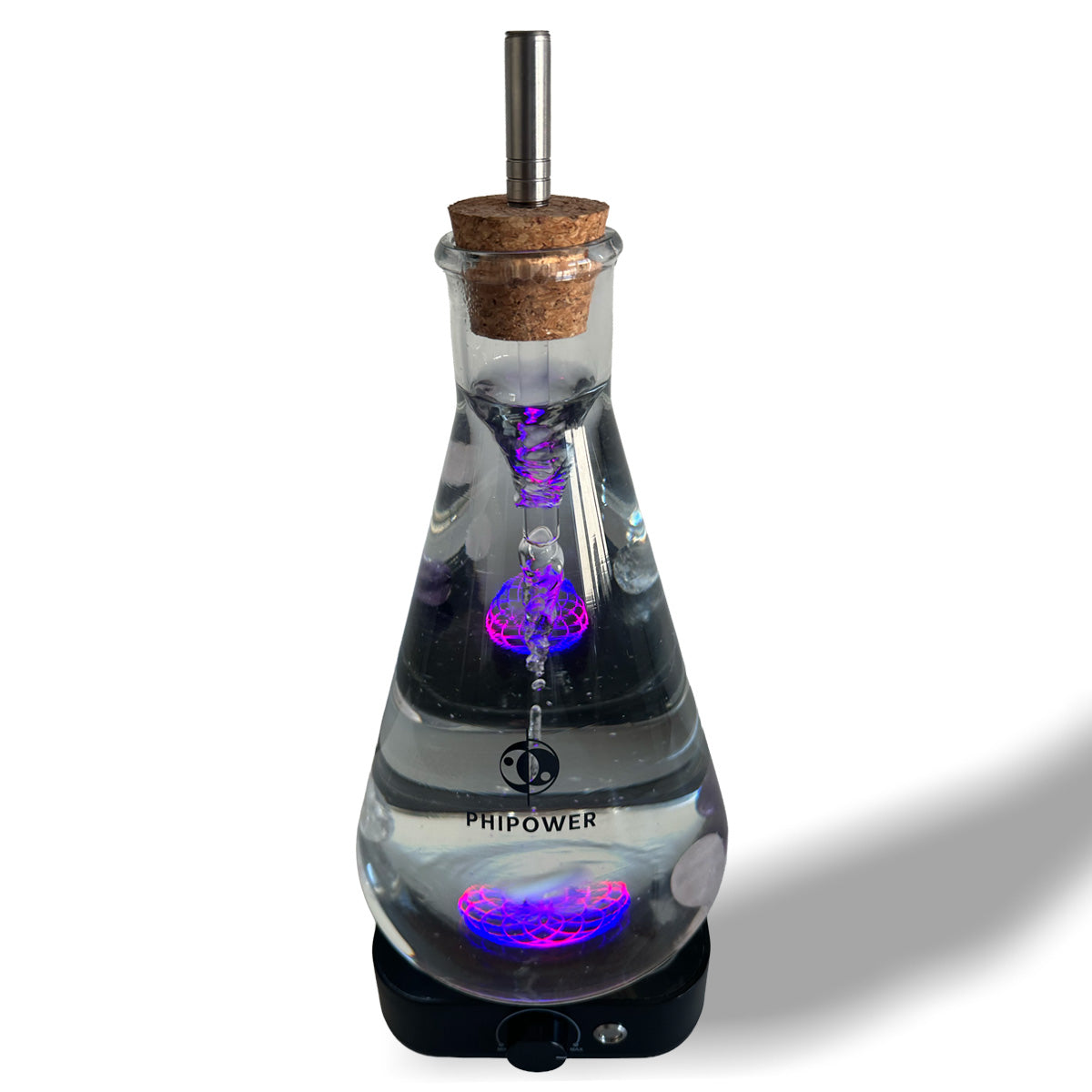
What does this mean for vortexed water?
A vortex absolutely changes the water while the flow is present.
It creates macroscopic motion, pressure gradients and mixing. Depending on the device, it can also influence gas transfer and create microbubbles.
But after the vortex stops, the hydrogen-bond network itself continues its ultrafast rearrangement.
Not "Did the vortex permanently freeze a special hydrogen-bond pattern?" but "Did the vortex produce a measurable physical or chemical change that persists after the flow stops?"
This is why the supporting article on nanobubbles in water is important: bubbles provide a plausible, measurable post-vortex feature with a much longer lifetime than individual hydrogen-bond configurations.
For the fluid-dynamics side of this question, read What Is Vortex Water? Science, Vortexing & How It Works →
How should we define "structured water" scientifically?
For Phipower's Knowledge Center, the most defensible definition is broad but precise:
That definition allows us to discuss:
- hydrogen-bond structure;
- tetrahedral fluctuations;
- interfacial water;
- EZ experiments;
- micro- and nanobubbles;
- vortexing;
- light-water interactions;
without implying that all of these are the same phenomenon.
Five structured-water marketing claims this science helps evaluate
| Claim | Scientific response |
|---|---|
| "Ordinary water has no structure." |
Incorrect Liquid water has extensive short-range hydrogen-bond order. |
| "All water molecules form perfect tetrahedra." |
Too simple Tetrahedral order is important but distorted and incomplete at ambient conditions. |
| "Water consists of stable small clusters." |
Misleading Local clusters/motifs exist, but bulk-water neighbour relationships are dynamic. |
| "A vortex can affect measurable water properties." |
Plausible & testable Flow, gases and bubble populations can change. |
| "A vortex permanently locks hydrogen bonds for 24 hours." |
Not established Direct structural evidence would be required. |
How would you actually measure a change in water structure?
A credible molecular-structure claim needs methods that probe molecular organization directly.
Depending on the question, researchers use:
- X-ray absorption and emission spectroscopy;
- X-ray and neutron scattering;
- infrared and Raman spectroscopy;
- nuclear magnetic resonance;
- ultrafast pump-probe spectroscopy;
- molecular dynamics simulations validated against experiment.
By comparison, pH, ORP or conductivity meters can be useful measurements but do not directly reveal a unique hydrogen-bond cluster structure.
What this means for Phipower's Water Vitalizer research
The strongest product-research strategy is to separate molecular claims from measurable bulk properties.
For the Water Vitalizer 2.0, the first useful measurements are therefore not "hexagonal cluster size."
They are:
- dissolved oxygen before and after vortexing;
- bubble-size distribution;
- pH;
- conductivity;
- temperature;
- ORP with appropriate interpretation;
- surface tension if measured properly;
- time decay at 1, 6 and 24 hours;
- blinded sensory testing.
If these measurements show a persistent change, the next question is what mechanism explains it.
That sequence — measure first, interpret second — is more credible than starting with a molecular diagram and assuming the product must create it.
Liquid-water structure: the evidence-based verdict
| Statement | Verdict |
|---|---|
| Liquid water has molecular structure. | Yes |
| Hydrogen bonds connect molecules into a network. | Yes |
| Tetrahedral local organization is important. | Yes |
| Every molecule always has exactly four perfect bonds. | No |
| Liquid water contains transient cluster-like motifs. | Yes |
| Bulk water consists of permanent fixed-size clusters. | Not established |
| Hydrogen-bond configurations rearrange ultrafast. | Yes |
| Interfacial water can differ from bulk water. | Yes |
| A water-treatment process can be assumed to create long-lived molecular structure without direct measurement. | No |
Primary scientific sources & further reading
Energetics of hydrogen bond network rearrangements in liquid water — temperature-dependent X-ray absorption study distinguishing more fully coordinated and more distorted local hydrogen-bond configurations.
Ultrafast conversions between hydrogen-bonded structures — femtosecond soft-X-ray experiment directly observing sub-picosecond conversion between strongly and weakly hydrogen-bonded populations.
Structural origin of anomalous properties of liquid water — scattering and simulation-based analysis linking water anomalies to fluctuations in local tetrahedral organization.
Ultrafast X-ray probing of deeply supercooled liquid water — experimental evidence that structural ordering increases continuously as liquid water is supercooled.
Liquid water contains building blocks of diverse ice phases — advanced molecular simulation showing a structurally diverse liquid with transient local motifs related to multiple ice structures.
Instantaneous asymmetry in the first coordination shell — computational work addressing the debate over local symmetry and hydrogen-bond asymmetry in liquid water.
High-level molecular dynamics reporting a fluctuating first coordination shell and an average of several hydrogen bonds per molecule.
Frequently asked questions about liquid water structure
The bottom line
The phrase "structured water" becomes much clearer once we understand ordinary liquid water.
Water is already highly organized by hydrogen bonding. It has short-range order, tetrahedral tendencies, coordination shells and fluctuating local motifs.
At the same time, that network is exceptionally dynamic.
So the scientifically accurate position is neither "water has no structure" nor "water is built from permanent fixed clusters."
The reality is more interesting:
That becomes the foundation for evaluating every other topic in the Phipower Structured Water cluster.
Continue with Structured Water: The Complete Guide →, Structured Water Benefits → or EZ Water & H3O2 Explained →.
This article is educational and discusses established and emerging physical chemistry of water. Phipower water products are wellness and lifestyle products. The existence of hydrogen-bond structure in ordinary liquid water does not by itself establish specific health benefits or prove that a water-treatment product creates a unique long-lived molecular phase.