Water and light are both fundamental to life, and we usually think of them separately: water hydrates, light illuminates. Physically, though, they are constantly interacting. Every beam of light passing through water is partly transmitted, partly scattered and — depending on its wavelength — partly absorbed.
That raises an intriguing question: can specific wavelengths of light influence the water we drink? At Phipower this is particularly relevant, because the Water Vitalizer 2.0 combines a magnetic vortex with four carefully selected wavelengths: 405 nm violet, 470 nm blue, 660 nm red and 850 nm near infrared.
Some effects associated with these wavelengths are well established. Others are still being explored. And some popular claims go far beyond what science can currently prove. This article separates those three worlds.
What happens when light enters water?
Light is electromagnetic radiation, and its wavelength determines both its colour and how it interacts with matter. Water is relatively transparent to much of the visible spectrum, but that transparency is not equal at every wavelength: blue and violet travel relatively efficiently through clear water, while red and especially infrared are absorbed more strongly. It is one reason deep ocean water appears blue.
Absorption is only part of the story. Light also interacts with dissolved minerals, organic molecules, pigments, microorganisms, suspended particles and the interfaces between water and other materials.
When we ask how light affects water, we have to separate light interacting with H₂O itself from light interacting with the substances or organisms present in the water. Most confusion in this field comes from mixing the two.
405 nm violet: high-energy visible light
Violet light at 405 nm sits close to the ultraviolet end of the visible spectrum and carries more photon energy than blue, red or near-infrared light. One of the most established research areas involving 405 nm is its interaction with microorganisms.
Certain bacteria naturally contain light-sensitive molecules called porphyrins. When these absorb light around 405 nm they can generate reactive oxygen species, and under appropriate conditions that oxidative process can damage microorganisms. This has led to research into 405 nm light for surface decontamination, food processing, environmental hygiene, antimicrobial lighting and water-treatment applications.
Does that mean 405 nm disinfects a glass of water?
No. Antimicrobial effectiveness depends on light intensity, exposure duration, distance from the source, water clarity, organism type, microbial concentration and total delivered dose. The Water Vitalizer 2.0 is not a drinking-water sterilizer and does not replace proper filtration or purification. Within the Vitalizer, 405 nm is one part of the broader light environment used during the vitalization ritual.
470 nm blue: a gentler visible wavelength
At 470 nm, blue light carries slightly less photon energy than 405 nm violet. It has also been investigated for antimicrobial and photochemical applications, with effects that depend heavily on the biological target and exposure conditions. Research has looked at blue light in relation to bacterial activity, biofilm formation, photochemical reactions and photosensitizing compounds.
Compared with 405 nm, 470 nm generally interacts differently with microbial pigments and is often less efficient for direct antimicrobial effects. It remains interesting, however, because it lies in a region where water itself stays highly transparent.
Within the Phipower ritual we see 470 nm less as a standalone treatment and more as one part of a multi-wavelength experience — a broader interaction between the water, the glass carafe, the moving vortex and the surrounding light field.
660 nm red: from water physics to photobiomodulation
Red light at 660 nm belongs to a very different part of the spectrum. It is widely known from photobiomodulation (PBM), where red and near-infrared light are applied directly to biological tissue and investigated for effects on cellular processes — one proposed mechanism involving the mitochondrial enzyme cytochrome c oxidase. This is why 660 nm appears in most modern red-light therapy devices.
But what happens when 660 nm is applied to water is a different question. Red light is absorbed more strongly by water than violet or blue, yet that does not automatically mean water retains the biological effects associated with red-light exposure.
Red light interacts with biological tissue when the tissue itself is illuminated.
That illuminating drinking water with 660 nm creates a biological signal persisting after the light is switched off.
At Phipower we deliberately keep those two claims separate.
850 nm near infrared: the most fascinating wavelength for water research
Of the four wavelengths in the Water Vitalizer 2.0, 850 nm near infrared may be the most interesting from the perspective of interfacial water research. Near-infrared energy is absorbed by water more strongly than visible blue light, and it is central to photobiomodulation and tissue–light interaction studies.
Within water science, one area has attracted particular attention: interfacial water next to hydrophilic surfaces, studied in depth by Professor Gerald Pollack's lab. Under particular conditions a region forms from which suspended particles are excluded — the Exclusion Zone (EZ) — which Pollack has proposed has a more ordered molecular arrangement, often described using H₃O₂-like stoichiometry. Radiant energy, including infrared, has been shown to affect the formation of these zones. H₃O₂ is not, however, an accepted stable bulk phase of ordinary bottled drinking water — the observation concerns water near interfaces, not litres of permanently transformed water. For the full picture, including the 2024 vortex-swirl study and nanobubble research, see our dedicated H3O2 & EZ Water guide.
Does infrared light permanently structure water?
There is currently insufficient evidence that illuminating bulk drinking water with 850 nm light permanently locks it into a new molecular structure. Water is extremely dynamic; hydrogen bonds form and break continuously, so claims about permanent "hexagonal water" should be treated cautiously. What it does tell us is subtler and more useful: water responds to its physical environment — surfaces, dissolved substances, temperature, electrical charge, radiation, pressure, movement and gases.
Why combine light with a vortex?

Light is only one part of the system. The second major component is movement. The Vitalizer uses magnetic stirring to create a powerful vortex inside the glass carafe, producing continuous circulation and exposing different parts of the water to the light source over and over again. Instead of illuminating static water, you illuminate moving water.
Water in nature rarely moves in straight lines. Mountain streams twist around stones, rivers curve, waterfalls create turbulence, whirlpools rotate. The Austrian naturalist Viktor Schauberger became well known for his interest in spiral water movement; modern fluid dynamics offers a more conventional explanation of what vortexing measurably changes — mixing, dissolved gases, bubble distribution, temperature, suspended material and fluid pressure.
Under sufficiently energetic conditions, vortex systems can also contribute to microbubble and cavitation phenomena. Whether a specific household system creates significant concentrations of stable nanobubbles has to be measured directly. So we don't need to claim that vortexing permanently restructures H₂O to appreciate what a vortex physically does.
Read next: the Complete Guide to Structured Water — EZ water, H₃O₂, vortexing and nanobubbles →
Science vs. theory at a glance
We don't believe the value of water vitalization depends on pretending every hypothesis has already been proven. The science is more interesting when there is room for both evidence and exploration.
The Water Vitalizer 2.0: what it is — and what it is not
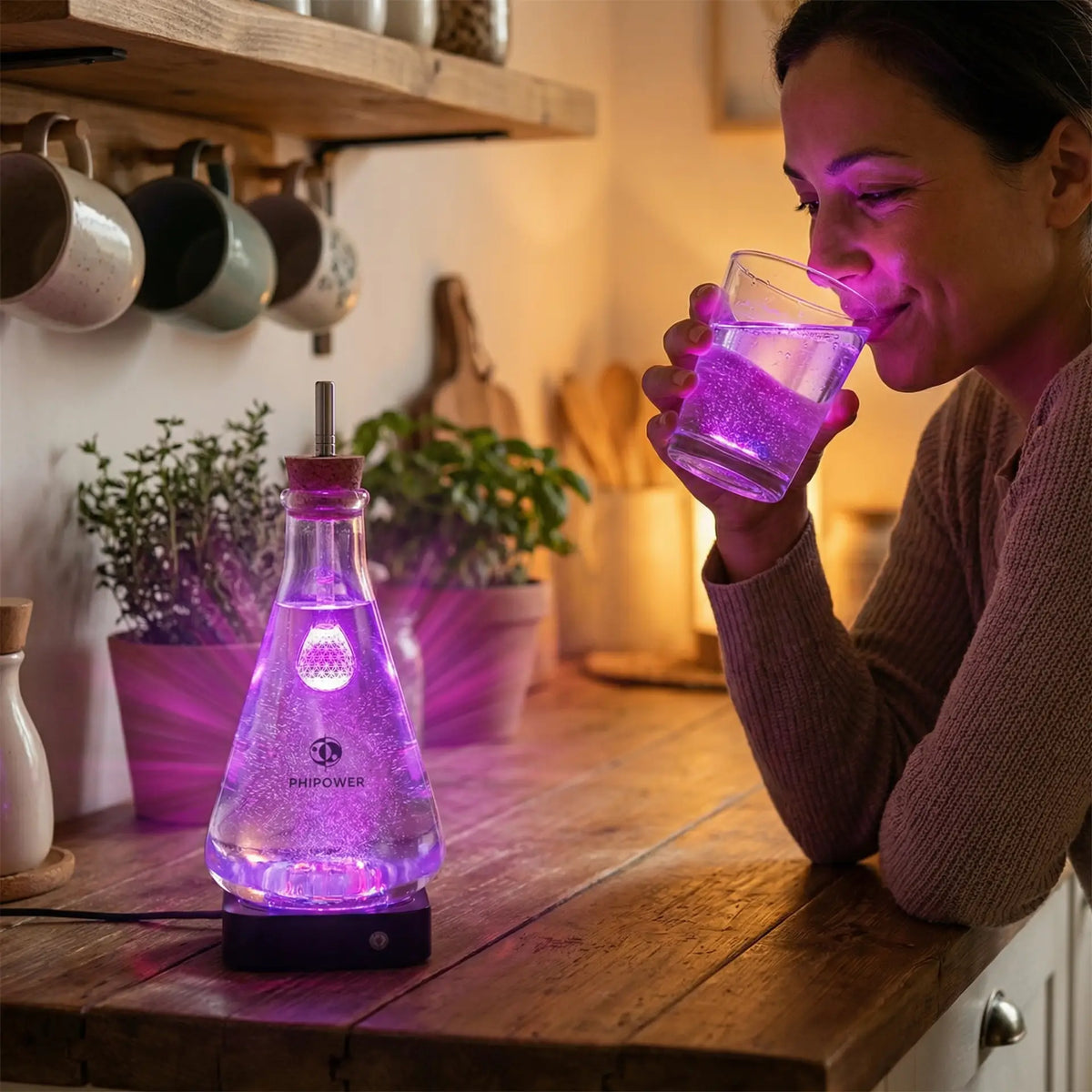
The Phipower Water Vitalizer 2.0 brings together light, movement, magnetism, glass, geometry and crystals in one premium water ritual: an adjustable magnetic vortex, all four wavelengths, a premium glass carafe and the Golden Triangle of amethyst, clear quartz and rose quartz.
- vortex movement and magnetic stirring;
- multiple wavelengths of light;
- natural crystals and sacred geometry;
- a deliberate daily water ritual.
- a medical device;
- a replacement for water filtration;
- a sterilizer;
- a guarantee of permanent molecular restructuring.
From drinking water to a daily ritual
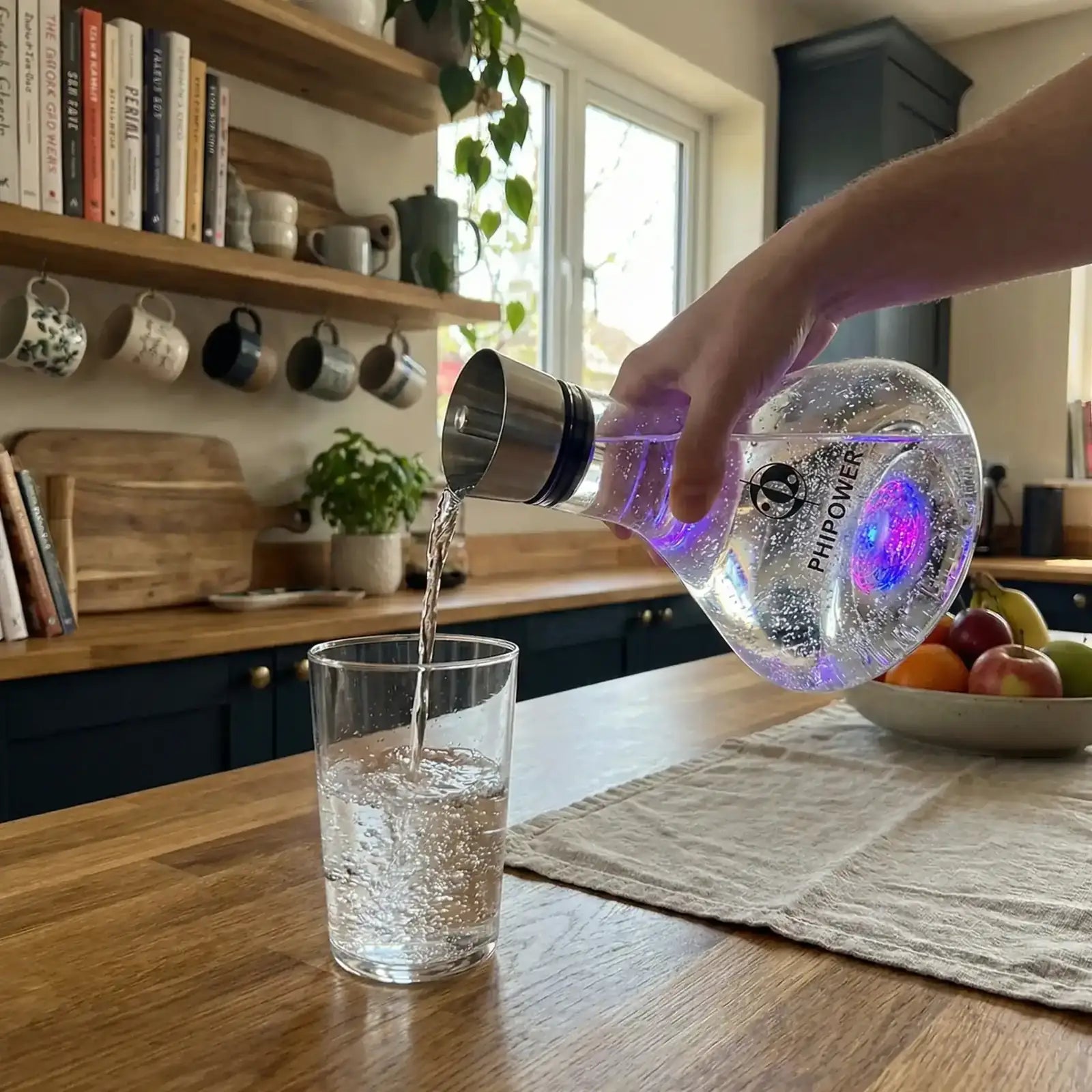
Most of us drink water without thinking about it. Fill, drink, repeat. The Water Vitalizer asks you to slow that down: fill the carafe, switch on the vortex, watch the water begin to spiral, select your light, let it move — then pour your glass.
In the morning, let the system run while you prepare breakfast, stretch or meditate, then pour your first glass. During the day, the 2-litre capacity works for individuals as well as couples or families. In the evening, use it as a transition: phone away, vortex on, slow down.
That small change turns something completely automatic into something intentional. And that is ultimately what Phipower means by water vitalization — not a promise that ordinary H₂O suddenly becomes a new substance, but a deliberate process of bringing water into movement and exposing it to selected physical influences before you drink it.
Frequently asked questions
Conclusion: water, light and movement
The interaction between water and light is real; the interpretation of that interaction requires nuance. Violet and blue light have well-studied photochemical and antimicrobial applications. Red and near-infrared light are central to photobiomodulation when used directly on tissue. Infrared energy is particularly interesting in research on interfacial water and exclusion zones.
What has not been conclusively demonstrated is that briefly illuminating ordinary drinking water permanently transforms it into a new molecular state. We don't need that claim — the bigger picture is already fascinating. Water responds to its environment, and the Water Vitalizer 2.0 deliberately changes that environment through movement, magnetism, light, geometry and natural materials, in one daily ritual.
Maclean, M. et al. — Environmental decontamination of a hospital isolation room using high-intensity narrow-spectrum light.
Guffey, J.S. & Wilborn, J. — In vitro bactericidal effects of 405-nm and 470-nm blue light.
Sommer, A.P. et al. — Mitochondrial mechanisms of photobiomodulation in context of interfacial water.
Hamblin, M.R. — Mechanisms and applications of the anti-inflammatory effects of photobiomodulation.
D'Souza, C. et al. — Applications of light-emitting diodes in food processing and water treatment.
Pope, R.M. & Fry, E.S. — Absorption spectrum of pure water in the visible range.
The Phipower Water Vitalizer 2.0 is a wellness product and not a medical device. It is not intended to diagnose, treat, cure or prevent disease. Research concerning structured water, exclusion-zone water and the long-term effects of light exposure on drinking water remains an evolving field. The Water Vitalizer is not a substitute for appropriate drinking-water filtration or purification.