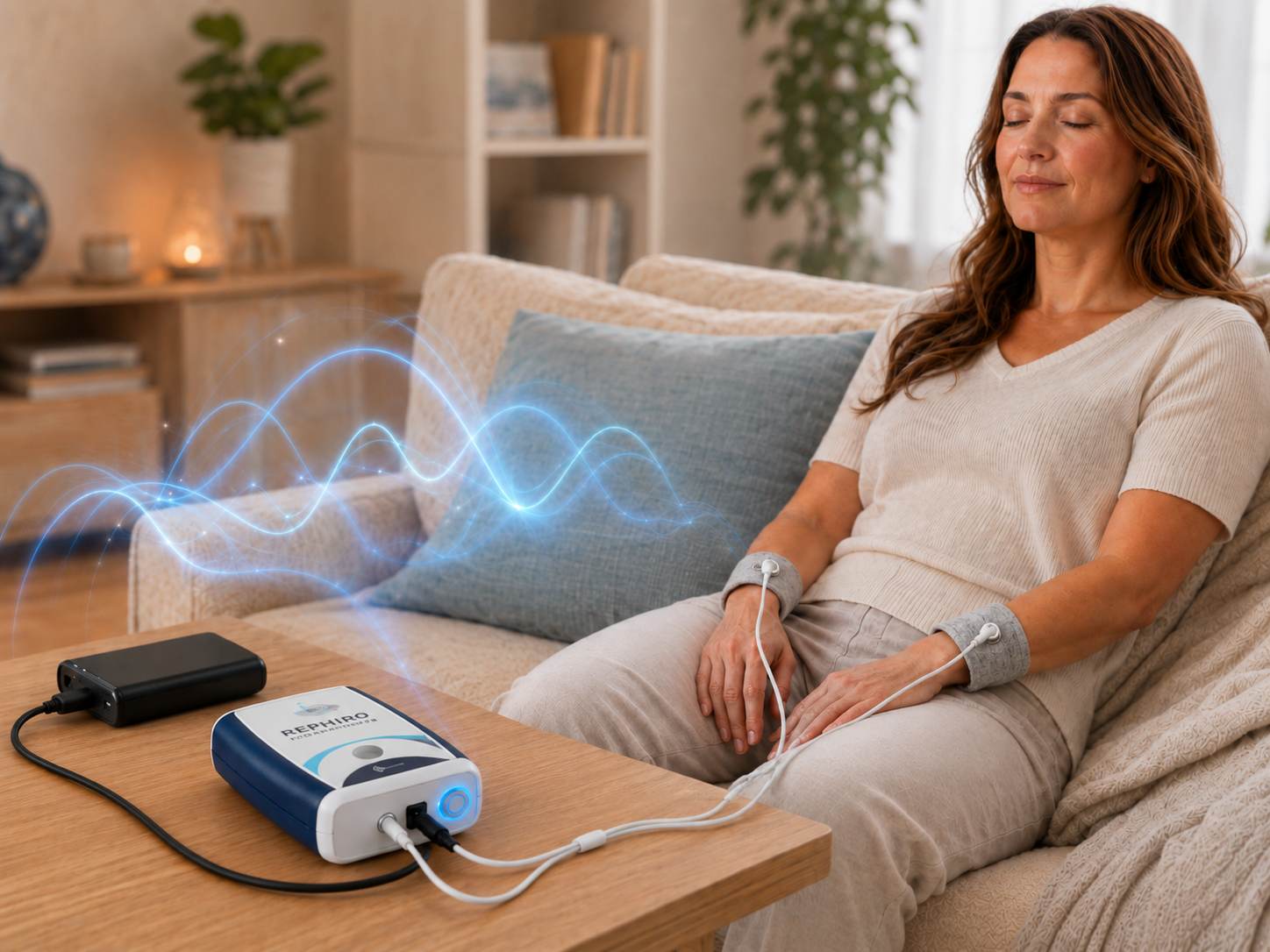
A Rife machine is an electronic signal-generating system. But frequency alone does not explain what it does — waveform, amplitude, carrier frequencies, modulation, sweeps and the delivery method all shape the output. This article focuses on the electronics and signal path. For the broader history, machine types, evidence, safety, prices and buying considerations, see our complete Rife machine guide.
How does a Rife machine work in simple terms?
At the most basic level, a Rife machine follows a sequence like this:
Creates a repeating electrical signal.
Sets how many cycles occur each second.
Defines waveform, amplitude and timing.
May add a carrier, sweep, sidebands or pulsing.
Sends the output to contact electrodes or plasma hardware.
The important point is that a Rife machine does not simply "contain frequencies." It generates physical electrical or electromagnetic signals that change over time. That distinction matters especially when comparing a dedicated frequency generator with a sound recording or YouTube video.
1. What is a frequency?
Frequency describes how many times something repeats each second. It is measured in Hertz (Hz).
cycle per second
cycles per second
cycles per second
cycles per second
If an electrical voltage rises and falls 1,000 times every second, its frequency is 1,000 Hz. That is straightforward physics.
Generating a 10 kHz electronic signal can be measured directly. Claiming that the same signal has a particular therapeutic effect is a separate biological and clinical question that requires separate evidence.
2. A Rife machine is more than a frequency number
Two devices can both generate a signal described as 10,000 Hz and still produce very different outputs. Frequency is only one property of a signal.
Sine, square, pulse or a more complex modulated shape.
The magnitude of the electrical signal, related to voltage and current under load.
How long the signal is active and how it repeats over time.
Whether a higher-frequency carrier is modified by another signal.
Whether the device remains fixed or moves automatically through a range.
Contact electrodes, plasma tube or another delivery architecture.
A better technical question is therefore: what kind of signal is being generated, how is it shaped, and how is it delivered?
3. What is a waveform?
A waveform describes the shape of an oscillating electrical signal over time.
An ideal sine wave contains one dominant fundamental frequency.
Switches rapidly between levels and contains the fundamental plus harmonic components.
The output is active and inactive according to a defined timing pattern.
Characteristics such as amplitude or frequency change over time.
That means two machines programmed to the same numerical frequency may still produce significantly different electrical outputs.
4. What is amplitude?
Frequency tells us how fast a signal oscillates. Amplitude describes how large that signal is. In an electrical system this can relate to voltage and, depending on the circuit and connected load, current.
Two speakers can both reproduce a 500 Hz tone. One can be extremely quiet and the other loud. The frequency is identical; the amplitude is different. Electronic frequency devices follow the same principle: frequency alone does not describe signal intensity.
5. How does a contact Rife machine deliver the signal?
One common Rife-machine design uses direct electrical contact. The device generates its waveform electronically and connects that output to conductive accessories such as hand electrodes, wristbands, adhesive pads, conductive socks or foot plates.
The electrical properties of the complete system depend not only on the generator but also on factors such as skin resistance, electrode surface area, contact quality, moisture, electrode position and output circuitry.
6. How does a plasma Rife machine work?
Another major category uses a plasma tube. Instead of relying primarily on conductive accessories touching the body, the electronic system excites gas inside a tube. The plasma becomes part of the mechanism by which electromagnetic output is produced.
Plasma systems are often larger and technically more complex than compact contact devices. That does not automatically make a plasma system "better"; it means the delivery architecture is fundamentally different.
7. What is a carrier frequency?
A carrier is a higher-frequency signal that can be modified by another, usually lower-frequency signal. This principle is common throughout communications engineering.
Radio is a familiar analogy: information such as speech or music is used to modulate a higher-frequency carrier. Rife-inspired systems can employ a related electronic principle.
high-frequency carrier + lower-frequency modulation = modulated signal
8. Why use a carrier frequency?
A carrier allows lower-frequency information to become part of a more complex higher-frequency electronic signal. For example, imagine a carrier at 3.1 MHz and a modulation frequency of 10 kHz.
Once the carrier is modulated, the resulting electronic spectrum can contain additional components associated with both signals. These are called sidebands.
9. What are sidebands?
When one signal modulates another, additional frequency components can appear on either side of the carrier.
More complex modulation can produce a richer spectrum. Sidebands are standard signal-processing physics, not something unique to Rife machines.
Within Rife history, the concept is particularly associated with Philip Hoyland. For the deeper technical discussion, see Hoyland Sideband Method Explained →
10. What is a frequency sweep?
Some frequency generators remain at one selected frequency. Others automatically move through a range of frequencies. This is known as a frequency sweep.
A sweep can be linear, logarithmic, stepped, continuous or repeating. Its practical advantage is that the user does not need to manually select one individual frequency after another.
11. Fixed frequencies or an automatic sweep?
Maximum manual control
The user selects a defined frequency or frequency set. This supports precise selection and repeatability, but requires more decisions and programming.
Simplicity and broad coverage
The system automatically moves through a range. There is less individual control, but no need to enter long frequency lists.
Neither architecture is automatically superior for every purpose. The trade-off is largely between programmability and simplicity.
12. How does the Rephiro Bioharmonizer work?
The Rephiro Bioharmonizer is Phipower's compact approach to Rife-inspired frequency technology. Instead of requiring users to choose individual programs or manually enter frequency lists, Rephiro uses a preset signal architecture.
A high-frequency carrier forms the foundation of the signal.
The lower-frequency component automatically moves through a wide range.
A slower repeating timing layer is added to the signal architecture.
13. Rephiro signal architecture
The user does not need to download frequency databases, choose individual MOR frequencies, install software or program waveforms. That is a deliberate design decision: Rephiro sacrifices much of the manual configurability found in advanced generators in exchange for simplicity and accessibility.
14. How is the Rephiro signal delivered?
Rephiro is a contact-based system. Its electrical output can be connected to conductive electrode pads, wristbands and silver-fibre socks. It is therefore technically different from a plasma Rife machine: Rephiro does not use a plasma tube.
15. Does Rephiro play audible frequencies?
No — its primary purpose is not to act as an audio player. A frequency expressed in Hertz is not automatically a sound. Hertz simply means cycles per second.
The speaker converts electrical input into mechanical movement and acoustic pressure waves.
The signal is delivered electrically rather than first being converted into airborne sound.
16. Can humans hear Rife frequencies?
Sometimes yes, sometimes no — depending on what is being generated and how it is delivered. Human hearing concerns acoustic frequencies within a limited range, but an electrical signal does not need to be audible to exist.
3.1 MHz = 3,100,000 Hz. That is far beyond the normal acoustic hearing range, yet it can exist perfectly well as an electrical or radiofrequency signal.
17. Rife machine vs normal frequency generator
A frequency generator is an electronic instrument capable of creating periodic signals. A Rife machine is better understood as a specific application of frequency-generation technology, usually combined with delivery hardware and a historical or conceptual connection to Rife-style use.
May produce sine waves, square waves, pulses, sweeps and arbitrary waveforms — but that alone does not make it a complete Rife system.
May combine generation, amplification, modulation, contact or plasma delivery, programmed sets and specialised user controls.
The categories overlap technologically without being identical.
18. Does every Rife machine work the same way?
No. The term Rife machine covers a broad category of devices. One may use low-frequency contact output, another a high-frequency carrier plus modulation, another plasma delivery, and another highly programmable waveform generation.
Statements about "a Rife machine" therefore need context. If two devices produce completely different signals and use different delivery mechanisms, it is difficult to assume they will behave identically simply because both use the same label.
19. Does the signal travel through the whole body?
This question needs a more careful answer than many simplified descriptions provide. With a contact device, electrical current follows conductive pathways between electrodes according to factors such as electrode location, tissue conductivity, skin impedance, frequency, voltage, current and body geometry.
The human body is electrically conductive, but it is not a homogeneous block of material. Different tissues have different electrical characteristics.
Statements such as "the frequency automatically reaches every cell equally" are too simplistic. How electrical and electromagnetic fields interact with biological tissue is a genuine field of biophysics, and the distribution depends on the technology and exposure conditions.
20. Can you feel a Rife machine working?
That depends on the device. With some contact-frequency systems, users may notice tingling, mild stimulation, warmth or pulsing. Under other signal parameters, little or nothing may be consciously noticeable.
A lack of sensation does not automatically mean that no electronic signal is present. Likewise, a stronger sensation does not prove a stronger therapeutic effect. Sensation and biological effectiveness are different questions.
21. What does the ~14 Hz pulse in Rephiro do?
Rephiro includes a slower pulsing or gating rhythm of approximately 14 Hz as part of its signal architecture. Technically, pulsing means the output is rhythmically altered over time.
The existence of that pulsing can be measured electronically. Claims that a specific 14 Hz rhythm necessarily produces a particular medical effect would require separate evidence.
22. Why does Rephiro have active and rest periods?
Rephiro uses an operating cycle of approximately 5.5 minutes active followed by 2 minutes rest before the sequence repeats.
This means the device does not continuously generate the same output indefinitely. The cycle becomes another part of the signal protocol. For the user, operation remains simple: connect → start → let the preset system run.
23. Is a more complicated signal automatically better?
No. Complexity and effectiveness are not the same thing.
May offer thousands of frequencies, waveform control, duty-cycle adjustment, modulation, custom sweeps, multiple channels and software integration.
Offers less flexibility but fewer decisions, less setup and a much lower learning curve for everyday use.
The right architecture depends on whether your priority is technical control or simplicity.
24. What did Royal Raymond Rife believe frequencies could do?
This is where we move from electronics into historical theory. Royal Raymond Rife proposed that microorganisms could possess characteristic oscillatory frequencies and that carefully chosen electromagnetic frequencies might disrupt them. These were often described as Mortal Oscillatory Rates (MORs).
That theory became central to later Rife culture and frequency lists. But the existence of measurable electronic frequency generation should not be confused with proof of the historical medical claims.
Modern electronics can unquestionably generate frequencies, modulation, carriers, sidebands, sweeps and pulses. The claim that particular consumer settings selectively eliminate specific pathogens or cure diseases inside the human body is a separate claim that requires clinical evidence.
For the full historical context, read the Complete Rife Machine Guide →
25. What parts of Rife-machine technology are established physics?
Frequency
Oscillations can be generated, measured and analysed.
Electrical signals
Circuits create and deliver voltage and current under defined conditions.
Waveforms
Sine, square, pulse and complex waveforms are standard electronics.
Modulation
One signal can modify another.
Sidebands
Modulation creates additional spectral components.
Sweeps
Generators can move predictably through selected ranges.
Electrical and electromagnetic fields also interact with conductive and dielectric materials, including biological tissue. The physics of signal generation is not the controversial part.
26. What has not been established?
The existence of the electronics should not be used as automatic proof of every therapeutic claim associated with Rife technology.
- that conventional consumer Rife machines cure cancer;
- that they eliminate specific infections throughout the human body;
- that they replace antibiotics or oncology treatment;
- that they diagnose disease based on frequency;
- that particular consumer settings are clinically proven treatments for specific illnesses.
You can be fascinated by frequency technology without turning technical observations into medical conclusions that the evidence does not support.
27. So what does a Rife machine actually do?
A Rife machine generates controlled oscillating electrical or electromagnetic signals and delivers those signals using contact electrodes, plasma hardware or another output system.
Depending on the design, it can additionally use fixed frequencies, frequency sweeps, carrier frequencies, modulation, sidebands, pulsing and multiple waveforms.
Everything beyond that — particularly claims about treating specific diseases — needs to be evaluated separately based on evidence.
28. Why choose a preset device such as Rephiro?
Rephiro is aimed at users who are interested in dedicated electronic frequency technology but do not want to operate a laboratory-style generator.
No software or database
The programmed sweep runs automatically.
Small contact device
No large plasma installation or separate control computer.
Preset signal architecture
No need to enter hundreds of individual frequencies.
Low learning curve
A simpler entry into dedicated electronic frequency technology.
An advanced system may still be more suitable if your priority is complete manual control of frequency, waveform, amplitude and program architecture.
29. Rephiro vs a traditional programmable Rife machine
| Feature | Rephiro Bioharmonizer | Advanced programmable system |
|---|---|---|
| Frequency generation | Automatic | Usually programmable |
| Approx. carrier | 3.1 MHz | Depends on system |
| Sweep | 0.1–150 kHz | Usually configurable |
| Pulsing | ~14 Hz | Often configurable |
| Delivery | Contact | Contact and/or plasma |
| Software required | No | Often |
| Manual programming | Minimal | Extensive |
| Learning curve | Low | Medium–high |
| Primary strength | Simplicity | Control |
Neither approach is universally better. They serve different users and different technical priorities.
30. Frequently asked questions
The bottom line
So, how does a Rife machine work? At its core, it is an electronic signal generator. But the number displayed in Hertz is only the beginning.
frequency + waveform + amplitude + carrier + modulation + sweep + pulsing + delivery method
That is why two devices both described as "Rife machines" can be technically very different — and why listening to a frequency through headphones is not automatically equivalent to receiving an electronic signal through dedicated hardware.
The physics of frequency generation is measurable. The historical medical theories associated with Rife require a separate discussion and should not be treated as proven simply because the underlying electronics are real.
This article focused specifically on the mechanics of signal generation and delivery. For Royal Raymond Rife, MOR frequencies, device types, evidence, safety, prices, home use and buying advice, continue with the central guide.
Rife Machine: The Complete Guide to Rife Frequencies, Technology & Devices →
The Rephiro Bioharmonizer and other Phipower frequency products are intended for personal wellness, education and experimentation. They are not intended to diagnose, prevent, treat or cure disease and should not be used as a substitute for appropriate medical care.