The Hoyland sideband method is one of the most fascinating concepts associated with the early development of Rife frequency technology. Instead of programming hundreds of individual frequencies one by one, the principle uses frequency modulation to create a much broader spectrum around one central carrier frequency.
That same basic principle — modulation creating sidebands — is established physics, and is used throughout radio, telecommunications and signal processing every day.
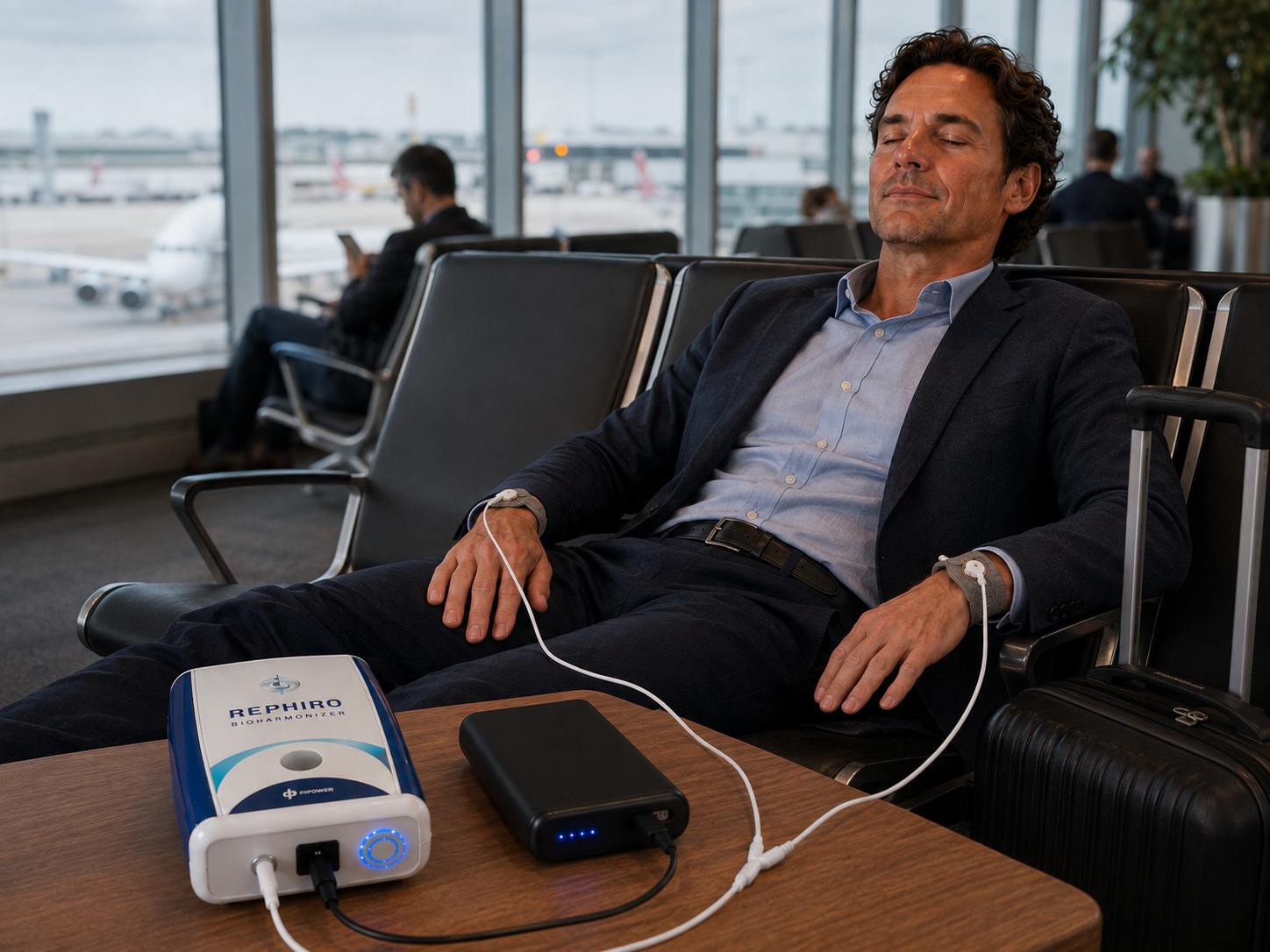
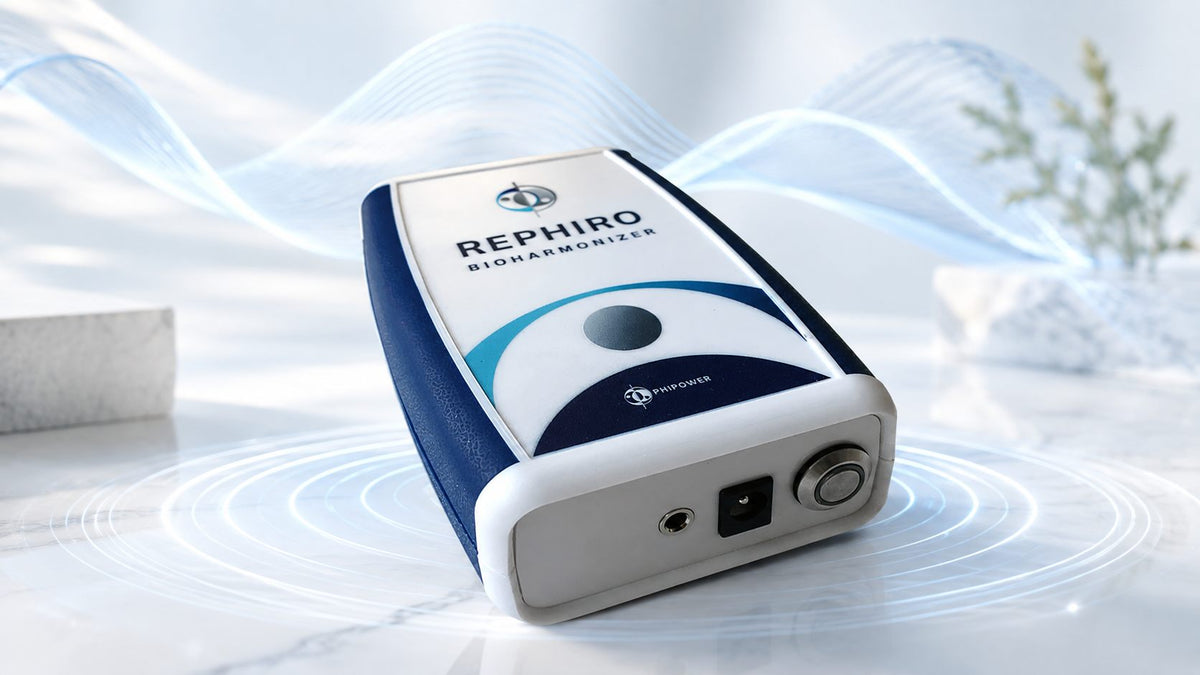
The Phipower Rephiro Bioharmonizer takes inspiration from this approach, and its exact carrier and sweep are the worked example used throughout this article. For device types, cost and safety, see our complete Rife machine guide.
What is the Hoyland sideband method?
To understand sidebands, imagine a radio station. A transmitter starts with a stable carrier frequency. Information such as music or speech is then added to that carrier through modulation. Once a carrier is modulated, additional frequencies appear around it. These are called sidebands.
Now imagine that the modulation frequency does not stay fixed at 2 kHz, but continuously moves through a much wider range. Instead of generating only two additional frequencies, you create an entire spectrum surrounding the carrier. That is the principle behind the frequency sweep used in the Rephiro.
Why use a frequency sweep?
Early approaches to frequency technology often relied on long lists of individual frequencies. Select one frequency. Run it. Select the next. Run it again. And continue.
The Hoyland approach is fundamentally different. Rather than working through hundreds of isolated values, a changing modulation frequency creates a moving series of frequency relationships around the carrier. As the sweep moves, the frequency relationships around the carrier move with it — a broad and continuously changing frequency environment, with no manual selection at all.
A stable foundation. The carrier itself does not change — modulation happens around it.
Runs automatically, generating continually changing frequency relationships around the carrier.
The mathematics behind sidebands
fsideband = fcarrier ± fmodulation
More complex modulation can also generate harmonic relationships around these frequencies. None of this is unique to frequency wellness technology: sidebands are a fundamental consequence of modulation and can be measured with electronic test equipment such as a spectrum analyser.
The generation of sidebands is established physics. What remains an evolving field of exploration is how specific electromagnetic and electrical stimulation patterns may interact with complex biological systems. Phipower therefore presents the Rephiro as a personal wellness, experimentation and research device — not as a medical treatment.
From historical Rife technology to a modern device
Royal Raymond Rife became well known during the early twentieth century for experiments involving frequencies and biological material. Engineer Philip Hoyland later became associated with the technical development of Rife's frequency-generating equipment.
Historical Rife systems were technologically complex. Working with these ideas could involve radio-frequency generators, modulation equipment, frequency calculations, tuning, manual controls, multiple components and specialised technical knowledge. For most people, that made experimenting with the technology impractical.
The philosophy behind the Rephiro is different: make frequency exploration simple enough for everyday use.
Three frequency elements in one compact device
3.1 MHz carrier
A stable signal at the centre of the system, acting as the foundation around which all modulation takes place.
0.1–150 kHz sweep
An automatically changing modulation sweep that continually shifts the frequency relationships around the carrier.
14 Hz pulsing cycle
A low-frequency component giving the delivered signal a rhythmic on/off character rather than one uninterrupted waveform.
Because everything is pre-programmed, you never need to enter frequencies, create programs, calculate sidebands, synchronise generators or understand RF engineering. The electronics handle the sequence automatically — and the combination of carrier, sweep and pulsing produces a considerably more complex signal architecture than a simple single-frequency generator.
Why does a gated signal matter?
A continuous sine wave is relatively simple. Switch that signal rhythmically on and off and its frequency spectrum becomes more complex. This is known as gating, or pulsing.
On an oscilloscope the result can sometimes appear somewhat block-shaped, because packets of the original waveform are being switched on and off. But the underlying signal is not a conventional square wave — it is a modulated, pulsed waveform. From a signal-processing perspective, gating can introduce additional frequency components and harmonic relationships. That is one reason the Rephiro's waveform is more interesting than simply selecting a single fixed frequency.
Historical Rife frequencies and the 3.1 MHz range
Historical Rife literature contains a number of frequencies around the 3 MHz region. Examples frequently mentioned in historical documentation include approximately:
These descriptions reflect historical terminology found in Rife-related literature. They should not be interpreted as modern medical indications, or as evidence that these frequencies diagnose, prevent or treat these conditions.
What is technically interesting is that these values sit relatively close to the approximately 3.1 MHz carrier region used by the Rephiro. A modulation sweep around that carrier therefore creates signal components across much of this historical frequency range.
You don't need to understand the technology
Frequency theory becomes complicated very quickly. Carrier waves. Harmonics. Sidebands. Modulation depth. Sweep rates. Gating. Oscillators. Fortunately, none of that knowledge is required to use the Rephiro.
Think of it like listening to music through a smartphone: you do not need to understand digital signal processing to enjoy the music. Likewise, the Rephiro performs its programmed frequency sequence automatically.
Is the Hoyland sideband method scientifically proven?
This requires an important distinction — and it is worth making carefully.
Sideband generation itself is established physics. When a carrier is modulated, additional frequency components appear around it. These principles have been used in radio engineering and telecommunications for generations.
Biological and therapeutic interpretations are different. Research continues into the ways electrical stimulation and electromagnetic fields interact with biological systems. However, historical Rife theories and specific therapeutic frequency claims have not been established through large, high-quality clinical trials to the standard required for accepted medical treatments.
The Rephiro should therefore not be considered a medical device or treatment. It is intended for personal wellness, frequency experimentation, relaxation rituals, educational exploration and non-medical research.
Continue exploring
For device types, cost comparisons and safety, see the complete Rife machine guide. For the history and evidence behind Rife-inspired frequency wellness more broadly, read Rife therapy explained.
Frequently asked questions
From frequency laboratory to your living room
Perhaps the most interesting aspect of modern frequency technology is not that the laws of physics have changed. They haven't. What has changed is the electronics. Components that once required large generators and complex laboratory equipment can now be integrated into extremely small devices.
That makes it possible to explore fascinating concepts — resonance, modulation, carrier frequencies, sidebands, harmonics, pulsed signals — without turning your living room into an electronics laboratory. And that is exactly what the Rephiro was created to do.
The Rephiro Bioharmonizer is an electronic device intended for personal wellness, experimentation and research. It is not a medical device and is not intended to diagnose, prevent, treat or cure any disease or medical condition. Historical references to Royal Raymond Rife, Philip Hoyland or historical frequency designations are provided for educational and historical context only and do not constitute medical claims. If you have a medical condition, use an implanted electronic device, are pregnant or have concerns about electrical stimulation, consult an appropriate healthcare professional before use.