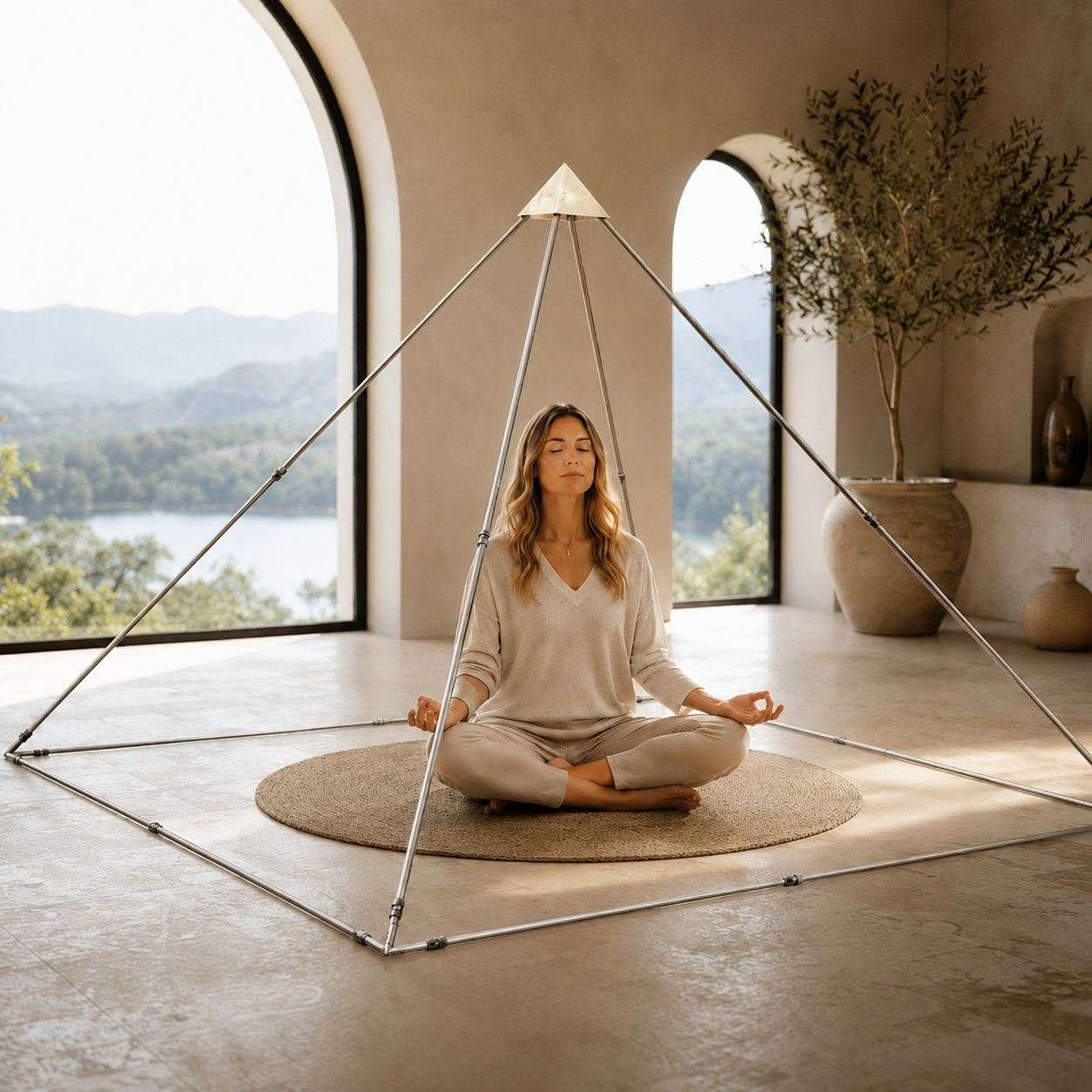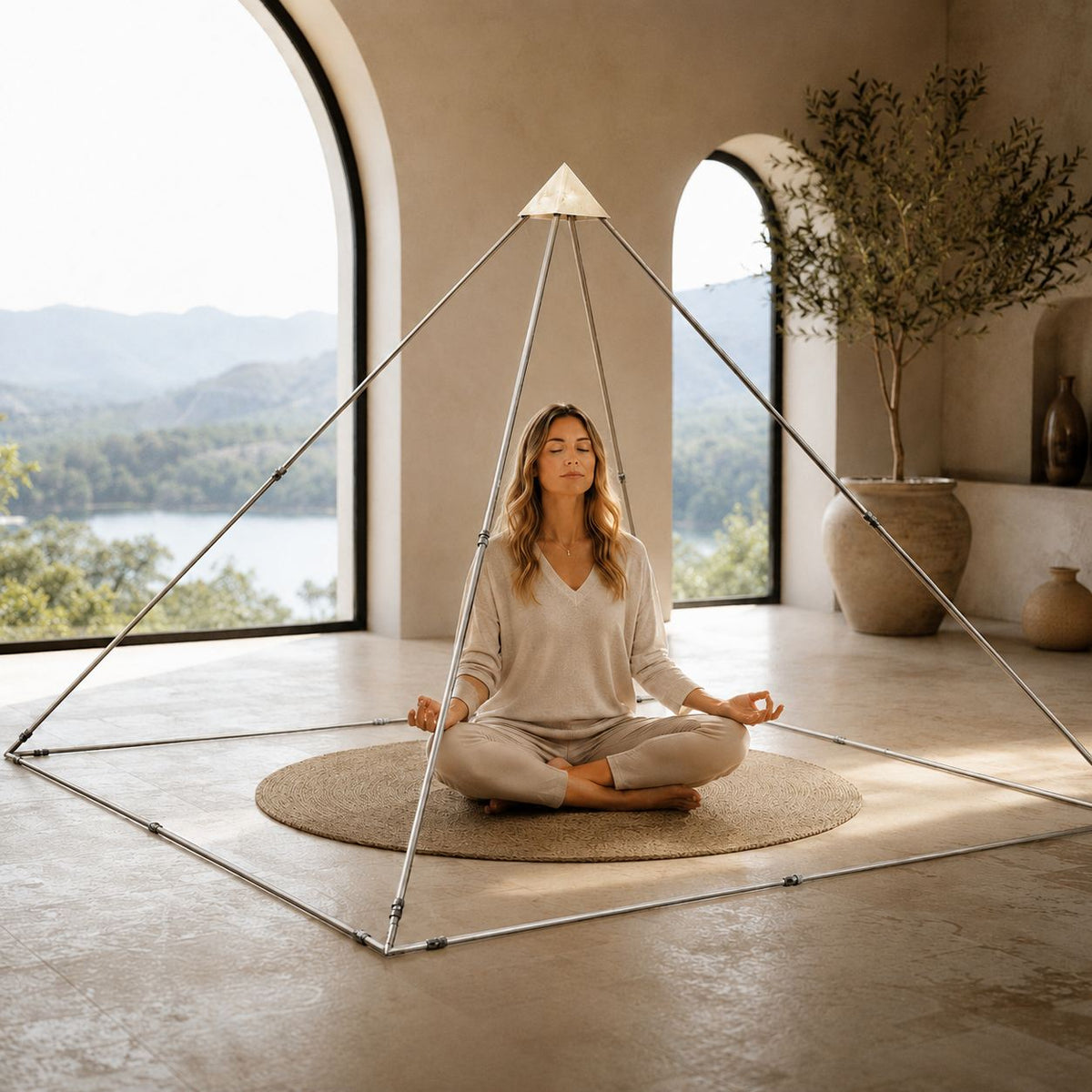
A quiet room. No phone. No notifications. You sit down, close your eyes and bring your attention inward. Now imagine doing exactly the same thing inside a geometric structure inspired by one of the most iconic buildings ever created: the Great Pyramid of Giza.
That is the idea behind a meditation pyramid. For some people the pyramid is symbolic. For others, geometry and orientation are an important part of energetic traditions. And for many, simply sitting beneath a clearly defined structure changes the feeling of meditation: it creates a dedicated space in which the outside world temporarily becomes less important.
Where did the idea come from? Does a pyramid really create an energy field? And can it genuinely help you meditate more deeply? To answer that properly we need to separate three things: history, science and experience.
What is a meditation pyramid?
A meditation pyramid is an open geometric structure designed for sitting or lying beneath during meditation, breathwork, relaxation or other contemplative practices.
Most modern versions consist of a square base with four diagonal elements meeting at a central apex, and the concept is usually inspired by the geometry of the Great Pyramid of Khufu — also known as Cheops — at Giza.
The Phipower Meditation Pyramid follows that tradition. It uses an inclination of approximately 51.83°, corresponding closely to the proportions associated with the Great Pyramid, and can be assembled in either a 77 cm or 140 cm-high configuration. But the interesting question is not what it looks like. It is: why would you meditate inside one?
Why geometry can change a meditation ritual
Human beings have used architecture to influence inner experience for thousands of years. Temples feel different from offices. Cathedrals feel different from supermarkets. A small meditation room feels different from sitting beside your laptop.
Part of that difference can be explained very practically. Architecture creates boundaries. Boundaries affect attention. A dedicated physical space tells the brain: this is where I stop doing and start being.
A meditation pyramid creates that boundary without enclosing you inside a room. You remain connected with your surroundings, but four sides rising toward one central point create a strong visual and spatial centre. For many users that alone makes meditation feel more intentional — and intention is where ritual begins.
Meditation itself: where the evidence is strongest
Before discussing “pyramid energy”, it is worth separating the pyramid from the practice taking place inside it. Meditation has been practised in different traditions for thousands of years. Modern research has investigated meditation and mindfulness in relation to stress, anxiety, mood, pain and sleep. Evidence varies by outcome and study quality, but mindfulness-based practices may be helpful for reducing stress-related symptoms and improving aspects of psychological wellbeing.
That does not mean a pyramid has been proven to amplify those effects. It means meditation itself is a legitimate practice worth creating time and space for.
The meditation is the practice. The pyramid creates the setting.
Why the pyramid shape?
Of all possible geometric structures, why a pyramid? Part of the answer is cultural. The pyramid is one of humanity's most powerful geometric symbols: its wide square base feels grounded, its four sides converge upward, everything leads toward one point. That naturally lends itself to symbolism around focus, ascent, balance, stillness, connection and intention.
But one historical structure has shaped almost every modern discussion of pyramid geometry: the Great Pyramid of Giza.
The Great Pyramid of Cheops as inspiration
The Great Pyramid was constructed during Egypt's Fourth Dynasty for Pharaoh Khufu, known by the Greek name Cheops. Modern measurements confirm the remarkable precision of its orientation toward the cardinal directions, and its geometry has fascinated architects, mathematicians, historians and spiritual thinkers for generations.
Over time this produced two very different streams of interest. One is archaeological and mathematical: how was it constructed, how was it oriented so accurately, what proportions did its builders use? The other is more speculative: does the shape itself influence matter, does it concentrate energy, does orientation matter, does sitting inside the geometry change consciousness? It is from that second tradition that modern pyramid meditation developed.
Where did the idea of “pyramid energy” come from?
Modern interest in what became known as pyramid energy grew substantially during the twentieth century, through experimenters such as Antoine Bovis, Karel Drbal and the authors who popularised “pyramid power” in the 1970s.
One particularly curious example is the Czech radio engineer Karel Drbal. In 1949 he filed an application that later became Czechoslovak Patent 91304, describing a pyramid-shaped device intended to maintain razor-blade sharpness; the patent was published in 1959.
A patent establishes that an invention was formally described and registered. It does not establish that claims about a mysterious pyramid energy field have been independently demonstrated scientifically. Stories like this nevertheless created the modern “pyramid power” movement — and eventually people began sitting inside pyramids rather than placing objects inside them.
From pyramid power to pyramid meditation
By the latter part of the twentieth century, pyramids increasingly appeared in meditation and spiritual communities. Instead of asking whether a pyramid could influence food, plants or razor blades, practitioners began asking: what happens when a person meditates inside the geometry?
People described greater stillness, warmth, tingling, a sense of protection, reduced awareness of outside distractions, greater focus — or simply a feeling that meditation became more intense. These experiences are interesting, but they should be described correctly: they are experiences, not proof of a measurable energy field. And paradoxically that makes the meditation pyramid more interesting rather than less, because you can test the experience yourself.
Does a pyramid scientifically create an energy field?
There is currently no established scientific evidence demonstrating that an open meditation pyramid creates a unique therapeutic energy field, raises human energy levels or measurably amplifies the Earth's magnetic field. Claims about pyramid energy, orgone energy or geometric resonance therefore belong to energetic, spiritual and experimental traditions, not established medical science.
Phipower does not need to pretend otherwise. There is a much more compelling invitation: sit underneath one and observe what happens to your meditation. Do you settle more quickly? Do you become less distracted? Does the defined space help you remain seated longer? Does the apex create a stronger sense of focus? Does the ritual make you look forward to meditating? Those are real questions you can answer through experience.
Why ritual matters more than most people realise
Many people do not struggle with meditation because they lack the ability to meditate. They struggle because meditation has no defined place in their day. They sit on the sofa where they normally watch television. Their phone is beside them. Their laptop is open. The room is associated with a dozen other activities.
A physical meditation structure changes this. Once a pyramid becomes part of your room, its purpose is unmistakable. You see it and remember: sit. breathe. become still. Over time, repeatedly using the same physical place may become a behavioural cue for your meditation routine — and that is where the Phipower Meditation Pyramid becomes more than decoration. It becomes your personal meditation space.
Inside the pyramid: a different kind of space
A meditation pyramid does not have walls, and that is part of its appeal. You still feel the room around you. There is air and light. You do not feel enclosed. Yet you are clearly sitting inside something: the lines rise from four corners toward a single point above you, creating a subtle separation between the space beneath the pyramid and everything outside it.
You do not need a completely separate meditation room. The pyramid creates a meditation zone inside an existing one.
The Phipower Meditation Pyramid: inspired by Cheops geometry
This is where the design becomes important. The Phipower Meditation Pyramid is not four random poles joined at the top. Its proportions are based on the geometry associated with the Great Pyramid of Cheops, with an inclination of approximately 51.83°. The structure is handmade from lightweight aluminium with brass connectors, making it considerably easier to move and assemble than a permanent copper or wooden pyramid — and it is designed for indoor or outdoor use.
Most importantly, one complete kit can create two different meditation spaces.
220 × 220 cm floor area — the full meditation configuration, with room for a seated setup and a substantial presence in the room.
121 × 121 cm floor area — a compact setup when space is limited or when you want to work closer to the apex.
Why 140 cm?
A meditation pyramid does not need to be as tall as the person sitting underneath it. Seated on a cushion or low chair, the body occupies considerably less vertical space. At 140 cm high with a 220 × 220 cm base, the large configuration creates a spacious footprint while keeping the apex relatively close to the meditation zone. It feels substantial without becoming permanent architecture.
An orgonite and amethyst centrepiece
At the apex hangs another element from modern energetic traditions: an orgonite ball containing amethyst crystals, combining resin, metallic material, a copper spiral and amethyst.
Orgonite originates from concepts surrounding “orgone” energy and belongs to alternative energetic traditions rather than established physics. Amethyst likewise has a long history of symbolic use and is commonly associated in crystal traditions with calm, contemplation and awareness. There is no established scientific evidence that an orgonite ball generates a therapeutic energy field — but as part of a meditation ritual it serves another purpose: it gives the centre of the pyramid a focal point. Look upward and everything converges there. Geometry, crystal, intention.
Curious about the stones themselves? The Golden Triangle crystals: amethyst, rose quartz & clear quartz.
Should a meditation pyramid face north?
Traditional pyramid practices often pay particular attention to orientation, and the Phipower ritual recommends aligning one side toward magnetic north. There is an interesting historical connection: the actual pyramids at Giza are extraordinarily accurately aligned with the cardinal directions, as modern archaeological measurements confirm.
Whether aligning a lightweight meditation pyramid to magnetic north produces a distinct energetic effect has not been scientifically established. So treat orientation as part of the traditional ritual. If you want to follow it: use the compass on your phone, find north, rotate the structure, then begin. It takes less than a minute.
What might you experience beneath a pyramid?
You may feel several of these. Or none. There is nothing you are supposed to experience — which is why our preferred approach is observe rather than believe.
A simple 10-minute pyramid meditation
Arrive
Sit comfortably beneath the centre. Close your eyes. Let shoulders and jaw relax. Do not try to meditate yet — simply arrive.
Breathe
Breathe slowly through the nose, exhale slightly longer than the inhale. Notice where your body meets the floor or cushion.
Observe
Stop controlling the breath. Notice thoughts without removing them. When attention wanders, gently return to breathing.
Silence
Drop the technique. Sit. Do nothing. When the timer ends, stay still for a few more breaths before moving.
That is enough. Repeat it regularly and the pyramid begins to become associated with the act of becoming quiet.
You don't need to be “spiritual” to use one
You do not have to believe in pyramid energy. You do not need crystals, mantras or any specific spiritual philosophy. Perhaps you simply want a beautiful and unmistakable place in your home where you meditate. That alone is a valid reason to own one.
On the other hand, if sacred geometry, energetic traditions, amethyst or the symbolism of the Great Pyramid are meaningful to you, the same structure can carry all of those layers. That is the beauty of a physical ritual: you decide what it means.
Portable instead of permanent
Traditional meditation pyramids can be large permanent structures — beautiful, but not particularly practical. The Phipower design was developed to solve exactly that. The complete structure arrives as a compact system of tubes, connectors and installation tools: base and diagonal tubes, corner connectors, top connector, tube connectors, two installation wrenches, the amethyst orgonite ball and instructions.
The entire shipping package weighs approximately 10 kg. That means it can be assembled at home, moved between rooms, taken apart, stored, used in a yoga or therapy space, or transported to a retreat.
Meditation corner or full ritual space?
For the minimalist approach: your pyramid, a meditation cushion, and nothing else. Clean, quiet, simple. For a more personal ritual, add elements that already have meaning to you — a mat, a candle outside the structure, natural materials, soft lighting, a singing bowl, a meditation object. The key is not to fill the pyramid. The empty space is part of the design.
Who is it for?
It may be particularly appealing if you already meditate but want the practice to be more consistent; find it difficult to create a dedicated meditation space at home; are interested in sacred geometry or the Great Pyramid; enjoy energetic and crystal traditions; lead meditation, breathwork or yoga sessions; want a visually striking element for a studio or treatment room; or simply want to discover for yourself whether sitting beneath pyramid geometry changes your experience.
It is not a shortcut to meditation. It is something arguably more useful: a place that invites you to practise.
Pyramid vs cushion — and vs a meditation room
A cushion helps you sit. A pyramid helps define where and why you sit. They serve completely different functions, so for many people the most powerful setup is both. And a dedicated meditation room is wonderful — but most people do not have one. A pyramid creates a recognisable meditation zone inside a bedroom, living room, office, practice, studio or garden, then moves or dismantles when you are finished. That is a very different proposition from renovating a room.
Frequently asked questions
The real power of a meditation space
Perhaps the biggest mistake is asking only: “does the pyramid have energy?” A more useful question might be: “what happens when I deliberately create a place where I do nothing except meditate?”
The geometry gives that place identity. The apex gives it focus. The Cheops proportions connect it to an architectural form that has fascinated humanity for millennia. The amethyst orgonite ball adds a layer of modern energetic tradition. But ultimately you provide the essential ingredient: attention.
The pyramid cannot meditate for you. It can remind you to meditate, surround the practice with ritual, and transform an ordinary corner of a room into a place you intentionally return to. Day after day.
The Phipower Meditation Pyramid is a wellness and meditation product. References to pyramid energy, orgone, resonance, energetic harmonisation and crystal properties describe traditional, spiritual or experiential concepts and should not be interpreted as scientifically established medical effects. The product is not intended to diagnose, treat, cure or prevent disease.