Simple preset. Full control. Contact-free plasma.
The "best" Rife machine depends less on price and more on how much control, complexity and hardware you actually want.
Choose Rephiro if you want a compact, affordable, preset contact-frequency device without programming. Choose an advanced generator if you want manual control over frequencies, waveforms and programs. Choose plasma if you specifically want a contact-free RF/plasma architecture and accept a larger, more complex setup.
Not sure what a Rife machine is? Start with the Complete Guide to Rife Machines →
First: what are we actually comparing?
The term Rife machine covers a surprisingly broad range of hardware.
For a practical buying comparison, it helps to divide the market into three categories:
Preset contact device
A fixed architecture designed to work out of the box. Rephiro belongs here.
Programmable contact generator
A more flexible system where users select frequencies, waveforms, sweeps and programs.
Plasma Rife system
A larger RF/plasma architecture that delivers a field without conductive contact electrodes.
These categories can overlap, but they make the key trade-offs much clearer.
For the engineering differences behind those categories, see Contact vs Plasma Rife Machines →
What is Rephiro?
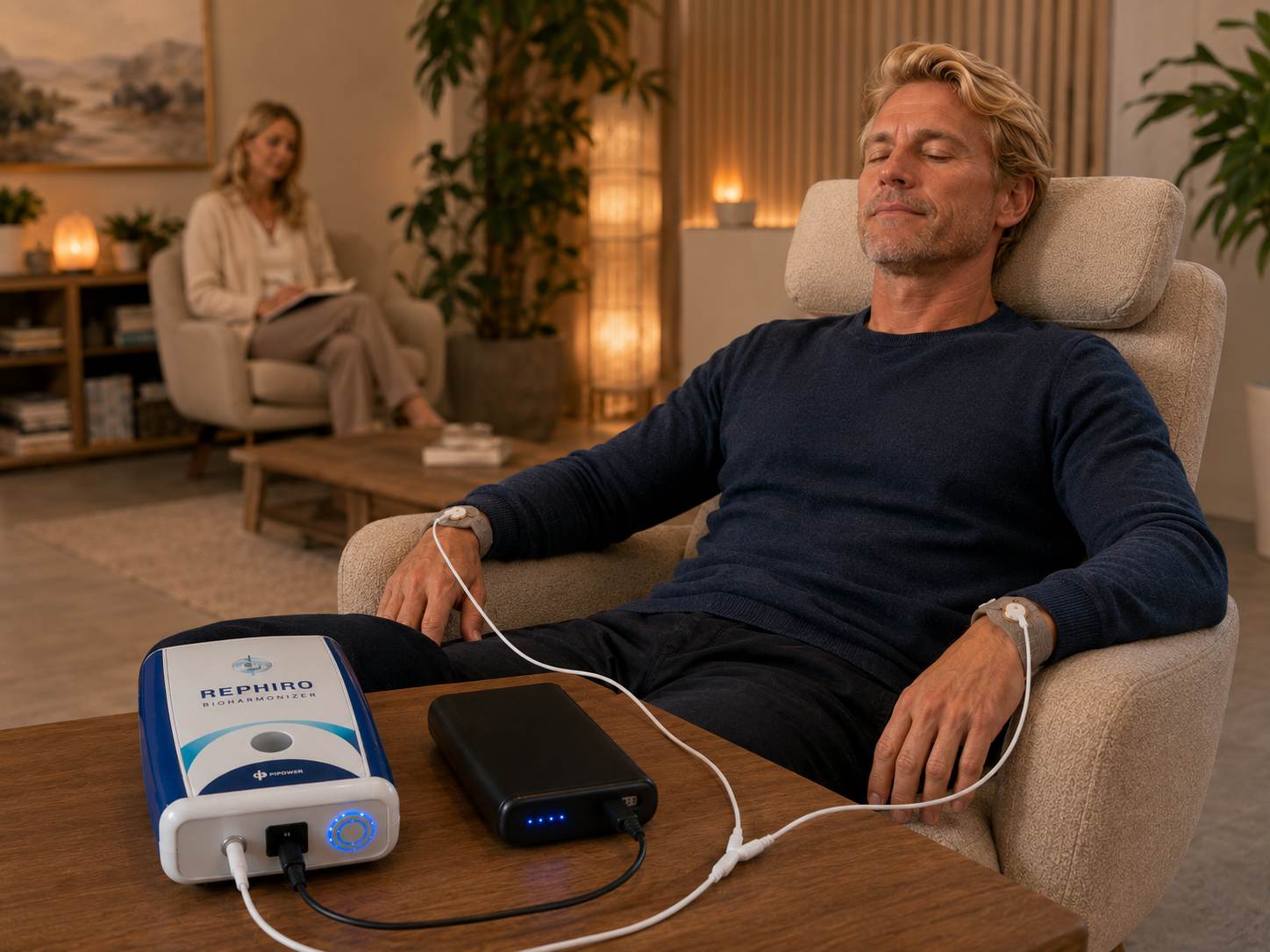
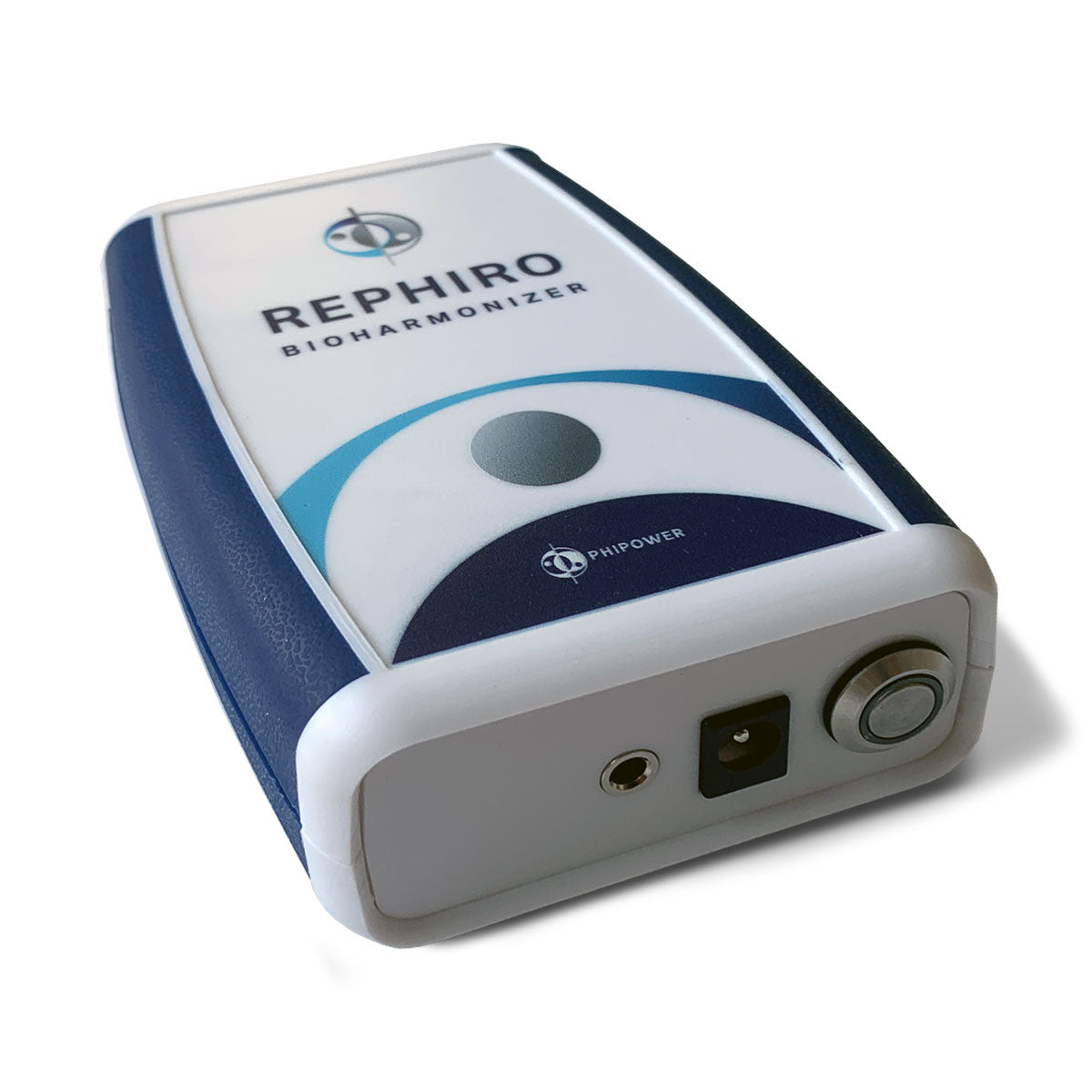
The Rephiro Bioharmonizer is Phipower's compact preset frequency device.
Its current architecture uses approximately:
A higher-frequency carrier forms the basis of the electronic output.
The lower-frequency component automatically moves through a broad range.
A slower pulsing/gating layer structures the output over time.
Conductive accessories provide the electrical path.
Rephiro is deliberately not a laboratory-style function generator.
You do not need to:
- choose individual frequencies;
- download a database;
- install software;
- program waveforms;
- configure carrier values;
- create your own sweeps.
The design goal is simplicity.
What is a "traditional" programmable Rife machine?
There is no single standardized traditional Rife machine, but many modern systems are built around a programmable signal generator.
Depending on the system, the user may be able to select:
- individual frequencies;
- frequency sets or databases;
- sine, square or pulse waveforms;
- amplitude;
- duty cycle;
- carrier frequency;
- modulation;
- frequency sweeps;
- multiple channels;
- session timing.
For a technical user, that flexibility can be valuable.
For someone who simply wants a ready-to-use device, the same flexibility can become friction.
Rephiro optimizes for simplicity. Programmable systems optimize for control.
How does a plasma Rife machine differ?
Plasma systems use a different delivery architecture.
Instead of relying primarily on conductive pads or bands, the electronics excite a gas-filled plasma tube.
A simplified architecture looks like:
Plasma Rife signal path
This can be attractive if the user specifically wants a contact-free architecture.
But plasma hardware is usually:
- larger;
- more expensive;
- less portable;
- more technically complex;
- more dependent on RF/amplifier design.
Rephiro vs programmable Rife vs plasma: side-by-side
| Feature | Rephiro | Programmable contact system | Plasma Rife system |
|---|---|---|---|
| Primary design goal | Simplicity | Control | Contact-free RF/plasma delivery |
| Delivery | Contact | Usually contact | Plasma / RF |
| Manual frequency entry | No | Yes | Often |
| Automatic sweep | Yes, preset | Usually configurable | Depends on system |
| Waveform control | Preset | Often extensive | Depends on generator |
| Carrier/modulation control | Preset architecture | Often adjustable | Common in many systems |
| Software | Not required | Often used | Often used |
| Frequency database | Not required | Common | Common |
| Learning curve | Low | Medium–high | High |
| Portability | High | Medium | Low–medium |
| Setup time | Minimal | Moderate | Moderate–high |
| Current Phipower price | €199 | Varies widely | Usually among the more expensive architectures |
| Best for | Simple daily use | Technical experimentation | Users specifically seeking plasma architecture |
Which type is the most affordable?
Rephiro is positioned at the affordable end of dedicated frequency hardware, currently priced at €199.
More advanced Rife systems can cost substantially more because the price can include:
- programmable signal generators;
- amplifiers;
- multiple output channels;
- frequency software;
- contact accessories;
- plasma tubes;
- RF power electronics;
- larger enclosures and cooling;
- technical support.
But the lowest price is not automatically the best value — and the highest price is not automatically the best machine.
The real question is:
Are you paying for features you will actually use?
For a full cost breakdown, see Rife Machine Price: What Should You Pay? →
How much frequency control do you really need?
This may be the most important buying question.
I want it simple
You do not want to choose frequency lists or learn waveform programming. Rephiro fits this profile best.
I want to experiment
You want to test specific frequencies, sweeps, waveforms and repeatable settings. A programmable generator fits better.
I specifically want plasma
You want contact-free RF/plasma hardware and accept more complexity. Choose a plasma architecture.
More control is valuable only if you actually want to use that control.
Do you need Rife frequency lists?
Many programmable Rife systems are built around frequency databases.
Users select a named program or manually enter a list of frequencies.
Rephiro takes the opposite approach.
Instead of asking you to choose individual values, it automatically sweeps from approximately 0.1 to 150 kHz.
No frequency database. No manual selection. No program hunting. The system is intentionally preset.
If choosing individual frequencies is central to how you want to experiment, Rephiro is probably not the right architecture.
For the history and meaning of Rife frequency values, read Rife Frequencies Explained →
Software vs standalone operation
Advanced frequency systems can be powerful because software allows:
- saved programs;
- custom frequency sets;
- automated sweeps;
- multi-step sessions;
- database searching;
- logging and repeatability.
But software also introduces:
- computer setup;
- drivers;
- updates;
- compatibility issues;
- more configuration decisions.
Rephiro avoids that entire layer.
For users who value plug-in-and-use simplicity, that is a feature rather than a limitation.
Which Rife machine is easiest to travel with?
Rephiro is significantly smaller and simpler than most multi-component programmable or plasma systems.
That makes it useful when portability matters:
- home use in different rooms;
- travel;
- simple storage;
- minimal desk space;
- fewer accessories to organize.
A programmable contact system can also be portable, especially if it uses a compact generator and small accessories.
Plasma systems are generally the least convenient for travel because of the tube, RF electronics and larger setup.
Setup time: seconds vs configuration
Rephiro is designed around a very short setup path:
Typical Rephiro workflow
An advanced system may instead require:
select software → choose program → configure output → confirm waveform → attach accessories → start session.
That is not inherently worse. It is simply a different user experience.
Which system is better for technical experimentation?
An advanced programmable generator wins here.
If your goal is to compare:
- 5 kHz vs 10 kHz;
- sine vs square wave;
- different duty cycles;
- different carriers;
- fixed frequencies vs sweep;
- different modulation methods;
you need a system that exposes those settings.
Rephiro does not.
Rephiro is not intended to replace a laboratory-style frequency generator.
Its value proposition is the opposite: preset operation with minimal configuration.
When is a plasma system the better choice?
A plasma system may be the better fit if:
- you specifically want contact-free application;
- you are interested in RF/plasma architecture;
- you do not want to hold or wear conductive electrodes;
- you accept a larger system;
- you are comfortable with more complex hardware;
- budget and portability are secondary.
Rephiro should not be marketed as a cheaper plasma machine.
It is a different type of device.
When is Rephiro the better choice?
Rephiro makes the most sense when you want:
No programming
You want the device to handle the sweep and timing automatically.
Minimal hardware
You prefer a small contact device instead of a desktop generator/plasma setup.
Lower entry price
You want dedicated frequency hardware without moving immediately into a high-cost advanced system.
It is especially attractive to someone whose thought process is:
"I am interested in electronic frequency technology, but I do not want to become a frequency-generator technician."
When should you choose an advanced programmable system instead?
Choose a more sophisticated generator if you know you want:
- manual frequency entry;
- repeatable custom programs;
- specific waveform selection;
- adjustable amplitude;
- custom sweep ranges;
- multiple channels;
- carrier/modulation control;
- laboratory measurement and experimentation.
Buying Rephiro and later becoming frustrated because it does not offer manual frequency programming would be the wrong product match.
A transparent buying guide should say that clearly.
Does more control mean greater effectiveness?
No conclusion like that can be made from feature count alone.
A programmable machine can generate more different signals.
A plasma system can use a different delivery architecture.
Rephiro is simpler.
Those are technical facts.
They do not automatically establish which device produces a superior medical or biological outcome.
Therapeutic claims require device-specific evidence.
More frequencies, higher price, more power or more complex electronics do not by themselves prove better health outcomes.
Which is best for home use?
For many home users, the key criteria are not laboratory flexibility but:
- ease of use;
- setup time;
- space;
- accessories;
- clear instructions;
- support;
- budget.
On those criteria, Rephiro has a strong position.
But if home use for you means running custom experiments, logging exact parameters and choosing specific frequency programs, an advanced generator may be more appropriate.
See the complete buying guide: Rife Machine for Home Use: What to Look For Before You Buy →
Do the safety considerations differ?
Yes.
Contact systems and plasma systems have different risk profiles.
With a contact system, electrical placement and skin contact matter.
With plasma/RF systems, the higher-voltage/RF architecture introduces a different set of engineering considerations.
Regardless of type:
- follow manufacturer instructions;
- do not use damaged hardware;
- do not improvise with power supplies or cables;
- treat implanted electronic devices as a major precaution;
- do not replace medical care with an unproven device.
Read the dedicated guide: Are Rife Machines Safe? →
Which type should you choose?
| If your priority is… | Best fit |
|---|---|
| Lowest learning curve | Rephiro |
| No software | Rephiro |
| Compact portable device | Rephiro |
| Automatic broad sweep | Rephiro |
| Manual frequency selection | Programmable Rife system |
| Waveform experimentation | Programmable Rife system |
| Custom modulation | Programmable Rife system |
| Contact-free RF/plasma delivery | Plasma Rife system |
| Maximum technical flexibility | Advanced programmable/plasma system |
| Simple entry into dedicated frequency hardware | Rephiro |
The bottom line
Rephiro is not trying to be the most configurable Rife machine.
That is precisely its position.
It takes a preset electronic architecture — approximately 3.1 MHz carrier + 0.1–150 kHz automatic sweep + ~14 Hz pulsing — and packages it into a compact contact device that does not require software or frequency programming.
If you want complete technical control, choose a programmable system.
If you specifically want plasma, choose a plasma system.
If you want simple, compact, preset frequency hardware at an accessible price, Rephiro is the more logical fit.
Users who value simplicity, portability, automatic operation and a low learning curve more than manual programming.
For the complete overview of Rife machine types, history, evidence, safety and technology:
Rife Machine: The Complete Guide to Rife Frequencies, Technology & Devices →
Phipower frequency products are wellness and lifestyle products, not medical devices. Rephiro is not intended to diagnose, prevent, treat or cure disease. Technical comparisons in this article describe hardware and usability differences and should not be interpreted as proof of therapeutic superiority.