All three technologies use frequencies, but they do not create or deliver the same physical signal. This guide separates the electronics from the terminology and shows what actually changes when you move from a function generator to a contact Rife device or a pulsed electromagnetic-field system. For the broad picture, start with our main Complete Guide to Rife Machines →
A frequency generator creates an electrical waveform. A Rife machine is a broader frequency-device architecture that uses a generated signal together with a delivery system. PEMF drives a coil to create a changing magnetic field. All three can be described in Hertz, but Hertz alone does not make them equivalent.
Why are these technologies so often confused?
The confusion starts with one word: frequency.
Rife machines use frequencies. Function generators use frequencies. PEMF devices use frequencies. Audio systems use frequencies. Radio transmitters use frequencies. Even mains electricity has a frequency.
But frequency only tells us how often a repeating event occurs. It does not tell us what physical quantity is changing.
Voltage or current changes
A signal generator can create an oscillating voltage or current waveform at its terminals.
Magnetic field changes
A PEMF coil converts changing current into a changing magnetic field around the coil.
Air pressure changes
A speaker converts an electrical signal into mechanical movement and sound waves.
These can all share the same numerical frequency while remaining different physical stimuli.
For the broader history, device categories, evidence and buying considerations, see our Complete Guide to Rife Machines →
What is a frequency generator?
A frequency generator — often called a function generator or signal generator — is an electronic instrument designed to create repeatable electrical waveforms.
Depending on the instrument, the user may be able to set:
- frequency;
- waveform shape;
- amplitude;
- DC offset;
- duty cycle;
- pulse width;
- frequency sweep;
- modulation;
- phase;
- multiple output channels.
In a laboratory, a function generator might be connected to an oscilloscope, amplifier, test circuit or research setup. Its purpose is not inherently "Rife." It is a general electronic signal source.
A frequency generator describes how the signal is produced. It does not by itself define how that signal is delivered to a person, material or experiment.
What makes a Rife machine different from a normal frequency generator?
The term Rife machine is used for devices inspired by the frequency concepts associated with Royal Raymond Rife and later Rife practitioners.
Technically, many such systems contain some form of signal generator, but the complete device may also include:
Frequency programs
Fixed frequencies, frequency lists, automatic sweeps, carriers, modulation or preset sequences.
Signal conditioning
Amplification, isolation, impedance matching or circuitry designed for the selected delivery method.
Contact or plasma
Conductive electrodes can create an electrical path, while plasma systems use a different RF/electromagnetic architecture.
So a useful shorthand is:
A Rife-style system is usually more than the oscillator
Frequency source
Creates the repeating signal.
Waveform
Defines signal shape.
Modulation
Optional carrier, sweep or pulse structure.
Output stage
Conditions the signal.
Delivery
Contact accessories or plasma hardware.
For a deeper breakdown of those building blocks, read How Does a Rife Machine Work? Frequencies, Signals & Delivery Explained →
What is PEMF?
PEMF stands for pulsed electromagnetic field.
A PEMF system typically sends a controlled electrical current through a coil. As the current changes, the magnetic field around the coil changes with it.
The user is therefore not simply connected to the output terminals of a signal generator. The coil acts as a transducer: it converts the electrical drive waveform into a magnetic-field waveform.
Simplified PEMF signal path
Control waveform
Sets pulse timing and repetition.
Power stage
Drives current through the coil.
Coil
Produces a changing magnetic field.
Field region
Magnetic flux extends around the coil.
That is the defining physical distinction: PEMF is organized around magnetic-field delivery.
The main difference: electrical signal vs magnetic-field delivery
It helps to compare the output that actually leaves the application hardware.
| Characteristic | Frequency generator | Rife-style system | PEMF system |
|---|---|---|---|
| Core purpose | Generate electrical waveforms | Apply Rife-inspired frequency signals | Create pulsed/time-varying magnetic fields |
| Typical output element | BNC/output terminals | Contact electrodes or plasma hardware | Coil / applicator |
| Main physical output | Voltage waveform | Electrical current/voltage or electromagnetic output, depending on architecture | Changing magnetic field |
| Frequency control | Usually highly programmable | Preset or programmable | Preset or programmable pulse repetition |
| Waveforms | Sine, square, pulse, arbitrary, etc. | Depends on device | Depends on drive and coil system |
| Carrier/modulation | Often available | Used in some architectures | Not required to define PEMF |
| Contact with skin | Not inherent | Yes for contact systems; no for plasma systems | Usually no conductive electrical contact required |
| Typical use context | Electronics/test bench | Frequency/wellness experimentation | Magnetic-field applications |
Can the same frequency be used in all three systems?
Numerically, yes. Physically, that does not make the exposures identical.
Imagine three systems all operating at a repetition rate of 10 Hz:
10 Hz electrical waveform
A 10 Hz voltage appears at the output terminals.
10 Hz electrical delivery
The waveform is delivered through conductive accessories and a body-dependent electrical load.
10 Hz magnetic pulses
A coil generates a changing magnetic field repeating ten times per second.
The number is the same. The coupling mechanism is not.
Comparing frequency devices only by the Hz value is like comparing a loudspeaker, flashing light and electrical stimulator because all three operate at 10 cycles per second. The repetition rate is only one parameter.
Waveform matters just as much as frequency
A signal at 1,000 Hz can be a sine wave, square wave, narrow pulse or complex modulated waveform.
Those waveforms are not mathematically or spectrally identical.
A square wave, for example, contains the fundamental frequency plus harmonic components. A narrow pulse can contain a wide range of spectral energy. A modulated carrier can create sidebands around the carrier frequency.
This is why the phrase "my machine outputs 1,000 Hz" does not completely describe what the machine does.
For the Rife-specific context, see Rife Frequencies Explained: What Are They & Where Do They Come From? →
Amplitude, current and field strength are not interchangeable
Another common mistake is comparing "strength" across different technologies as though one number could describe everything.
For an electrical generator you might measure:
- voltage;
- current;
- output impedance;
- power under a defined load.
For a PEMF system you may additionally care about magnetic parameters such as:
- magnetic flux density at a defined location;
- distance from the coil;
- pulse rise time;
- pulse duration;
- repetition rate;
- coil geometry.
These are different measurements.
10 volts, 10 millitesla and 10 watts describe different physical quantities. They cannot be ranked directly without understanding the complete system.
Where do carrier frequencies fit?
Carrier frequencies are common in communications engineering and appear in some Rife-style signal architectures.
A higher-frequency carrier can be modified by a lower-frequency waveform. Depending on the type of modulation, this can create additional spectral components known as sidebands.
For example, if a 3.1 MHz carrier is modulated by a 10 kHz signal, components can appear around the carrier at approximately 3.09 and 3.11 MHz.
This is standard signal-processing physics.
A carrier is not what defines PEMF. A PEMF system can pulse a coil without using a radiofrequency carrier at all.
For the historical Rife context and the role associated with Philip Hoyland, read How the Hoyland Sideband Method Works →
Contact Rife vs PEMF: how does coupling differ?
A contact Rife-style system creates a conductive path between the output stage and conductive accessories.
The resulting electrical behavior depends on the generator and the load, including skin contact and tissue impedance.
PEMF works differently. The user does not need to form the same conductive circuit through electrodes. Instead, the changing current in the coil creates a changing magnetic field around it.
| Contact Rife-style system | PEMF system | |
|---|---|---|
| Primary coupling | Conductive electrical contact | Magnetic field |
| Electrodes | Typically yes | Not required for magnetic coupling |
| Skin impedance | Relevant to electrical path | Not the primary coupling parameter |
| Distance | Accessories normally contact the user | Field varies with distance and coil geometry |
| Sensation | May be noticeable depending on electrical parameters | Can be subtle or imperceptible depending on system |
Plasma Rife vs PEMF: are they both electromagnetic?
This comparison is more subtle because both can involve electromagnetic fields.
A plasma Rife system commonly uses high-frequency electronics to excite a gas-filled plasma tube. The resulting setup can radiate electromagnetic energy around the tube.
A PEMF applicator uses a coil driven by a pulsed current to create a changing magnetic field.
Both involve electromagnetism, but the architectures, frequencies, field geometry and waveforms can be very different.
"Both create an electromagnetic field" does not mean "both create the same field." Frequency spectrum, electric-field component, magnetic-field component, distance, geometry and power all matter.
For the Rife delivery comparison, read Contact vs Plasma Rife Machines: What's the Difference? →
Can a normal function generator become a Rife machine?
A laboratory function generator can reproduce many signal-processing features used in frequency experiments:
- fixed frequencies;
- sine and square waves;
- pulses;
- frequency sweeps;
- amplitude modulation;
- frequency modulation;
- arbitrary waveforms.
But that still does not make every bench generator a complete Rife setup.
You would also need to consider:
- the output voltage and current available;
- electrical isolation;
- output impedance;
- load behavior;
- appropriate application hardware;
- amplification if required;
- safe use of electrodes or other delivery hardware.
So a function generator may be the signal source, but the application system around it defines how the signal is actually delivered.
Can one device combine Rife and PEMF technologies?
Yes. A manufacturer can combine multiple technologies in one enclosure or product ecosystem.
For example, a device could contain:
- a waveform generator;
- a contact output;
- a coil driver;
- PEMF applicators;
- additional light or audio outputs.
That makes the product a hybrid system.
But the important rule remains:
Classify the output by the hardware and signal that are actually being used — not by the marketing label printed on the box.
How should you compare the specifications?
If you want to compare technologies objectively, look beyond lists of frequencies.
For generator/contact systems
Frequency range, waveform, voltage, current under defined load, output impedance, duty cycle, modulation and sweep behavior.
For PEMF systems
Field strength at a stated distance, coil size and geometry, pulse shape, pulse duration, repetition rate and how the value was measured.
For both, ask whether the specification is:
- measured or merely advertised;
- defined under a stated load;
- measured at a stated distance;
- peak, RMS or average;
- repeatable;
- supported by technical documentation.
This is why first-party oscilloscope and field measurements can be more useful than a long list of unexplained "frequencies."
Which architecture is most practical for home use?
That depends on what you want from the device.
Programmable frequency generator
Best suited to technically minded users who want to define their own waveform, frequency, sweep and modulation parameters.
Preset contact Rife device
Useful when you want a dedicated frequency system without software, databases or extensive configuration.
PEMF system
Appropriate when the desired architecture is specifically a coil-generated pulsed magnetic field rather than direct electrical contact.
For a dedicated Rife-focused buying guide, see Rife Machine for Home Use: What to Look For Before You Buy →
Where does the Rephiro Bioharmonizer fit?
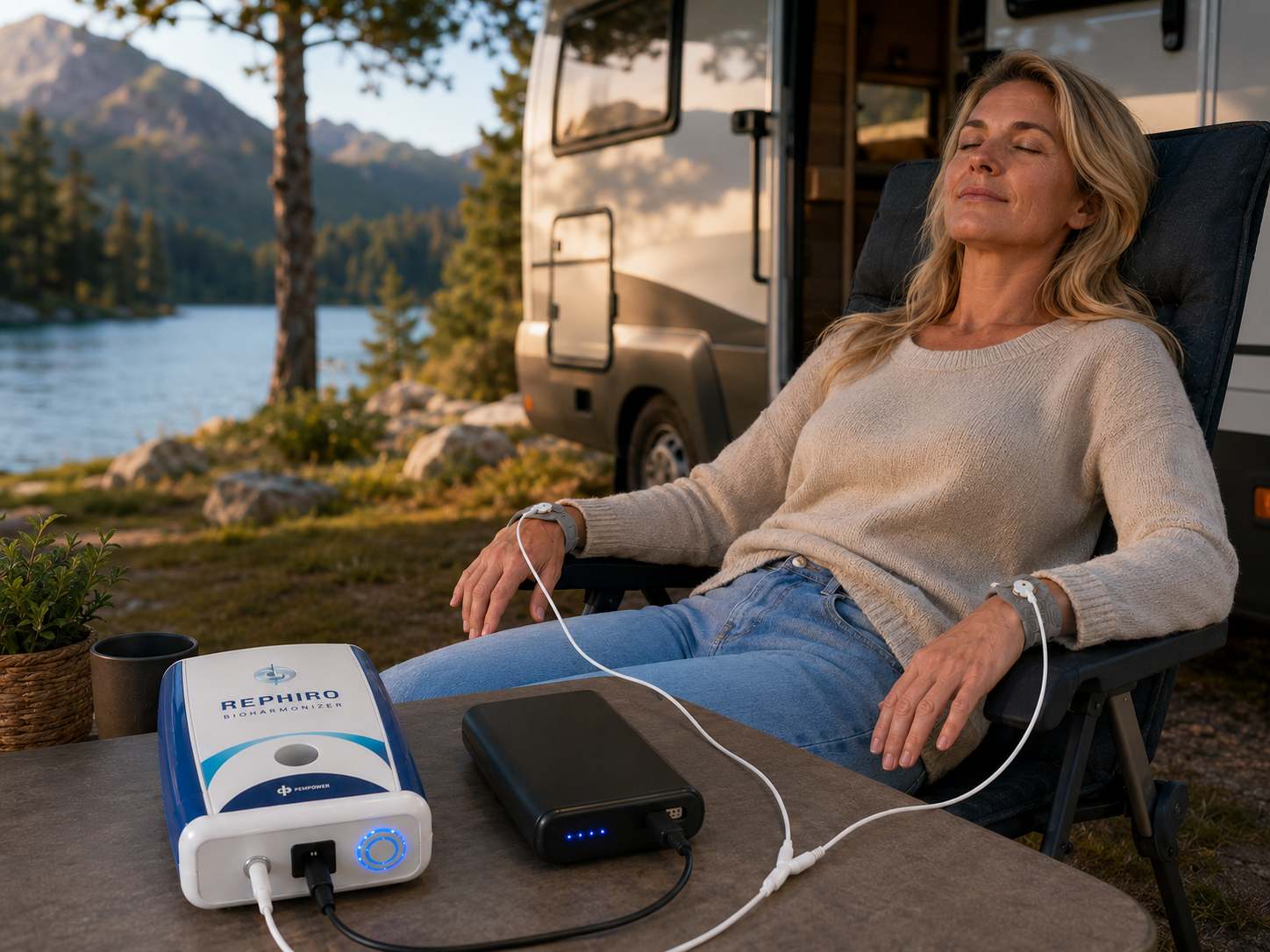
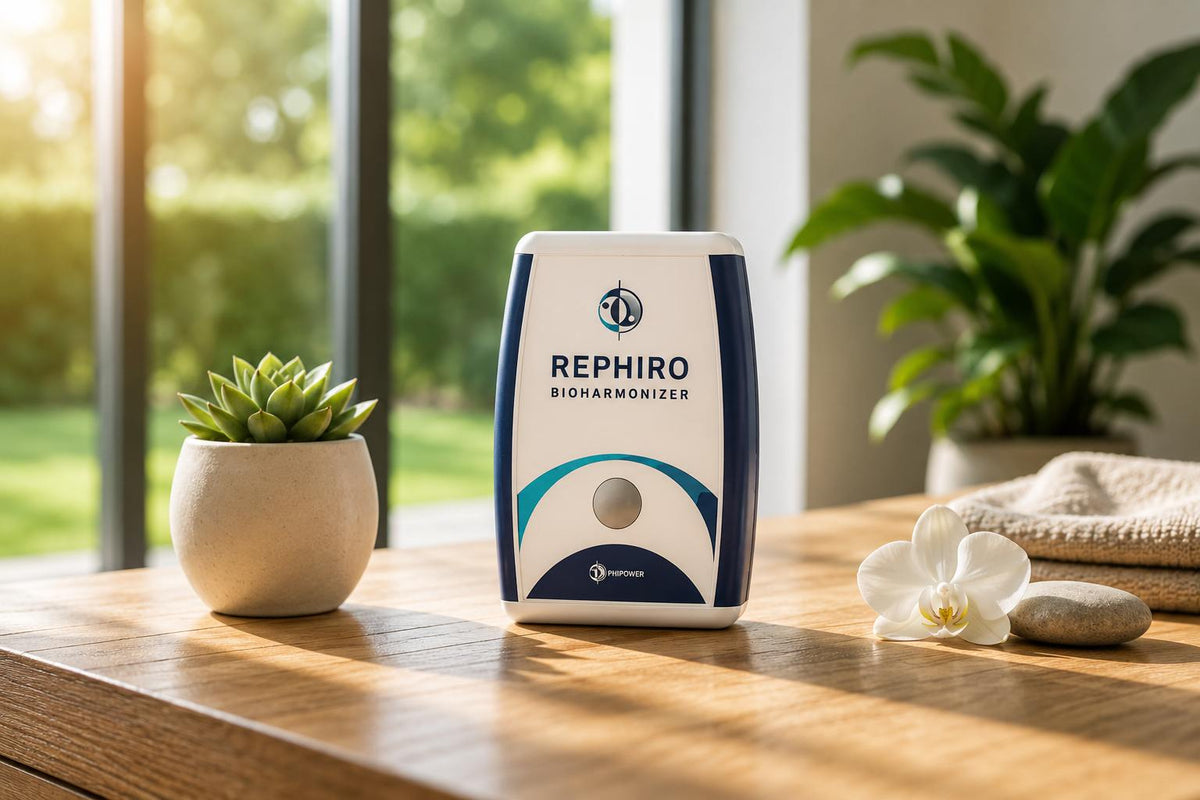
The Rephiro Bioharmonizer is neither a general-purpose bench function generator nor a PEMF coil system.
It is a compact, preset, contact-based Rife-inspired frequency device.
Its signal architecture combines:
~3.1 MHz
A higher-frequency carrier forms the foundation of the output architecture.
0.1–150 kHz
The lower-frequency component moves automatically through a broad range.
~14 Hz
A slower pulsing/gating rhythm adds another timing layer.
Contact
Conductive accessories provide the electrical delivery path.
Rephiro does not require the user to program individual waveforms or connect an external coil.
Rephiro is a preset contact-frequency system with carrier, sweep and pulse structure — not a PEMF machine and not a laboratory signal generator.
Does different physics mean different medical effectiveness?
Not automatically.
It is important to separate two questions:
- What physical signal does the device produce?
- What clinical effect has that specific device and protocol been shown to produce?
The first question can be answered with electronics and field measurements.
The second requires appropriate biological and clinical evidence.
A technically measurable frequency, pulse or magnetic field does not by itself establish that a device diagnoses, treats or cures a particular disease.
That is why we keep the engineering comparison in this article separate from therapeutic claims.
Five common misconceptions
"If two devices use the same Hz, they do the same thing."
No. Frequency does not define waveform, amplitude, field type, coupling or delivery.
"Every frequency generator is a Rife machine."
No. A general signal generator is a building block. A Rife-style device adds a specific application architecture and delivery method.
"Every Rife machine is PEMF."
No. A contact Rife device and a coil-based PEMF device use different primary coupling mechanisms.
"A magnetic field is automatically stronger because it is contact-free."
No. Field strength depends on the actual coil, current, geometry, waveform and distance.
"More complicated hardware automatically means better outcomes."
Complexity describes capability and configurability, not proven effectiveness.
Frequently asked questions
The bottom line
A frequency generator creates an electrical waveform.
A Rife machine uses generated frequency signals within a broader application system, often adding contact or plasma delivery, presets, sweeps, carriers or modulation.
A PEMF system drives a coil to create a changing magnetic field.
The technologies can overlap in their electronics and all can be described using frequency — but they should not be treated as interchangeable simply because each uses Hertz.
For the complete overview of Rife history, frequencies, machine types, contact vs plasma, evidence, safety, pricing and buying considerations:
Rife Machine: The Complete Guide to Rife Frequencies, Technology & Devices →
Phipower frequency products are wellness and lifestyle products, not medical devices. They are not intended to diagnose, prevent, treat or cure disease and should not be used as a substitute for appropriate medical care. Technical descriptions in this article explain signal generation and delivery concepts; they should not be interpreted as proof of a therapeutic effect.