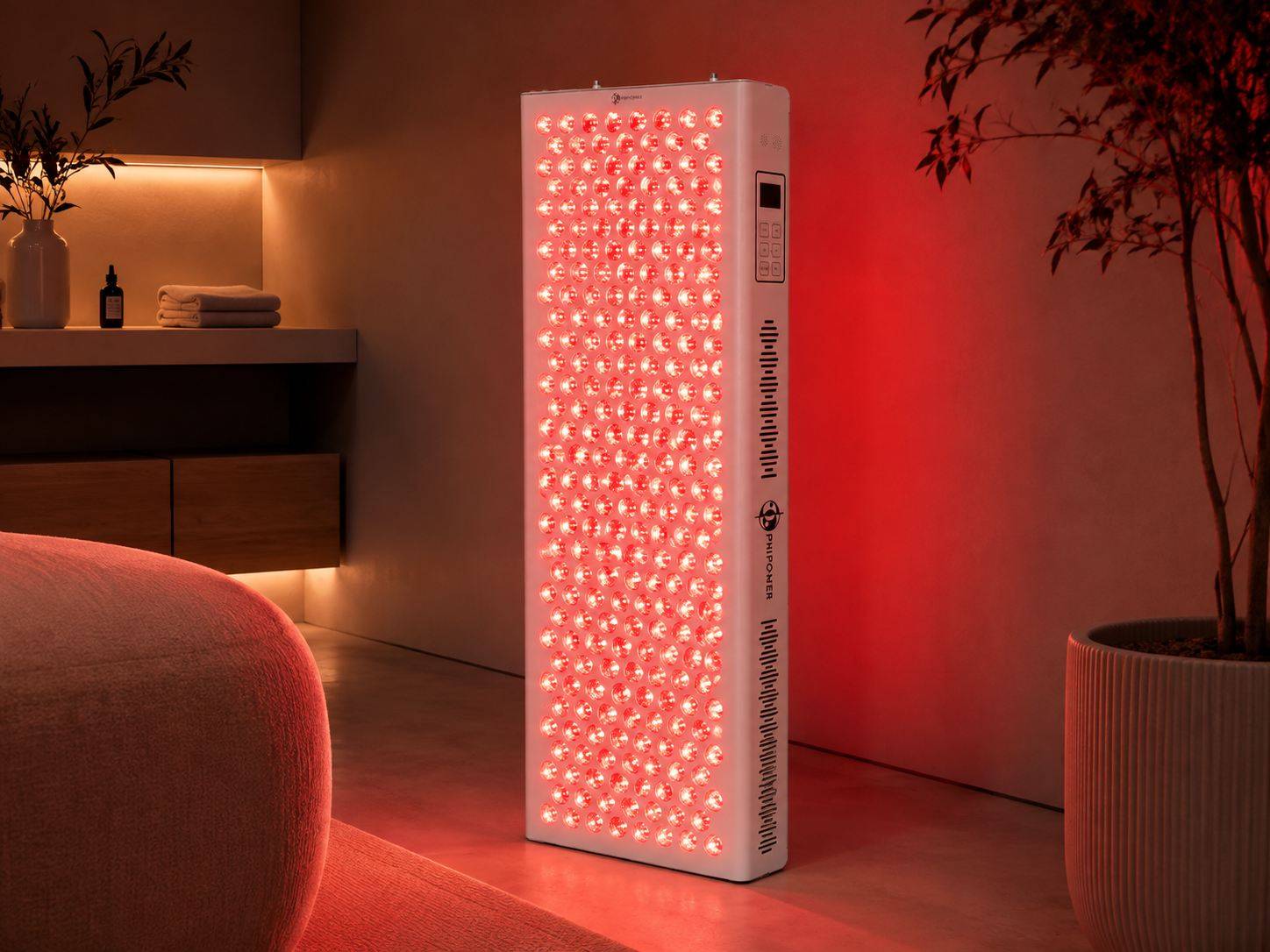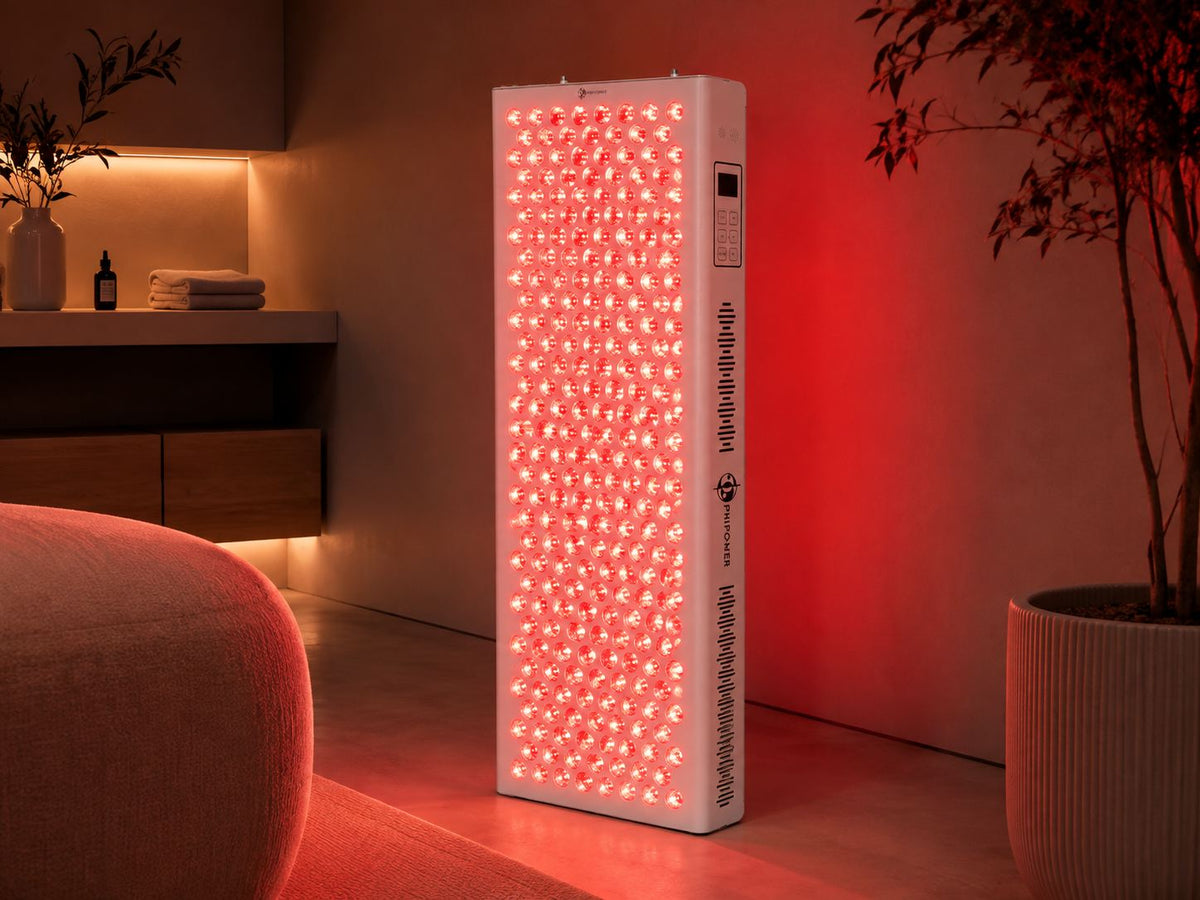
Stand in front of a red light therapy panel and the experience seems remarkably simple. Light on. A deep red glow fills the room. A few minutes later, the session is finished.
But behind that simplicity lies a rapidly developing field of research known as photobiomodulation: the use of specific red and near-infrared wavelengths to expose skin and underlying tissues to non-ionising light. Unlike ultraviolet, these wavelengths do not work by damaging tissue or creating a tan.
Two wavelengths appear again and again in that research: 660 nm deep red and 850 nm near-infrared. That is why Phipower combines both in its Full-Body Red Light Therapy Panel. But what is the difference? Which benefits are actually supported? And is a large panel worth the investment? Let's separate the science from the hype.
What is red light therapy?
Red light therapy is the use of red and near-infrared wavelengths for photobiomodulation — exposing biological tissue to non-ionising light with the aim of influencing cellular processes.
It is also called RLT, photobiomodulation, PBM, low-level light therapy and near-infrared therapy. Although these terms are used interchangeably, devices and research protocols differ enormously — and that matters. A study performed with one particular wavelength, intensity and dose does not automatically prove that every red light device produces the same effect.
In photobiomodulation, dose matters. So do wavelength, irradiance, exposure time, distance and treatment area. This is why we prefer to talk about red light as an evidence-informed wellness technology rather than promising miraculous results.
Why red and near-infrared light?
Visible light is electromagnetic energy, and different wavelengths interact differently with the substances they encounter. Shorter visible wavelengths such as blue light are strongly absorbed relatively close to the tissue surface. Moving into the red and near-infrared part of the spectrum changes that interaction.
Research measuring human tissue optics shows that wavelengths in the red-to-near-infrared region can penetrate biological tissues, although the amount reaching deeper structures varies strongly with tissue thickness, composition, wavelength and intensity. That makes this range particularly interesting for photobiomodulation — and explains why the combination of 660 nm + 850 nm has become so popular.
660 nm red light: the skin-focused wavelength
At 660 nanometres the light is clearly visible, and it is generally used when the primary target is the skin and more superficial tissue. Researchers have investigated red-light exposure for skin appearance, texture, fine lines, collagen-related processes and photorejuvenation.
A randomized clinical trial involving 137 women compared 660 nm red light with 590 nm amber light for periocular wrinkles; after ten treatments over four weeks the researchers reported improvement in wrinkle measurements with red-light photobiomodulation. Another controlled study with more than 100 treated participants reported improvements in complexion, skin roughness and ultrasound-measured collagen density after repeated red or red-to-near-infrared treatments. A more recent randomized, sham-controlled trial also investigated repeated 660 nm LED exposure for facial rejuvenation.
That does not mean every person will see dramatic cosmetic changes. But it gives 660 nm something valuable: a meaningful scientific basis for skin-focused photobiomodulation.
850 nm near-infrared: beyond visible red
850 nm is near-infrared light — you can barely see it. This occasionally confuses new users: the NIR LEDs may appear very dim even though they are switched on. Human vision ends roughly at the beginning of the infrared spectrum, but your eyes do not need to see the photons for tissue to interact with them.
Near-infrared wavelengths also behave differently in tissue than visible red. Experimental studies of human tissues show substantial wavelength-dependent differences in absorption and scattering, which is one reason longer wavelengths are frequently investigated for targets below the skin surface.
It is common to associate 660 nm with skin and superficial exposure, and 850 nm with deeper tissue exposure. But there is no fixed depth at which red suddenly stops and near-infrared begins. Penetration is gradual and depends on anatomy, skin, adipose tissue, muscle, distance and irradiance — and increasing tissue thickness substantially reduces transmitted light.
Why combine 660 nm and 850 nm?
Because your body is not made of one layer. Skin sits above connective tissue, muscles, joints and other structures — so a dual-wavelength panel offers a practical advantage.
660 nm when your ritual is primarily focused on the skin.
850 nm when you want near-infrared exposure.
Red and near-infrared together for a broader session.
Instead of buying one device for red and another for near-infrared, both channels are built into the 1500W Full-Body Red Light Therapy Panel — and each can be controlled independently.
How does red light therapy work?
Photobiomodulation does not work like a conventional medicine containing one active molecule. Photons interact with biological tissue, and researchers have proposed several mechanisms involving light-sensitive cellular processes, mitochondrial signalling, changes in redox state and downstream signalling pathways. One frequently studied target is cytochrome c oxidase, an enzyme involved in mitochondrial energy metabolism.
But it would be an oversimplification to say “red light enters your mitochondria and simply produces more ATP”. Biology is more complicated. Different doses can produce different responses, and photobiomodulation frequently shows a dose-dependent effect — more exposure is not automatically better.
Wavelength + intensity + distance + time = dose. And dose matters more than marketing wattage.
What does the evidence actually support?
Search online and you will encounter extraordinary claims: rejuvenated skin, removed wrinkles, regrown hair, boosted testosterone, melted fat, healed injuries, reversed ageing. Those claims should not all be placed in the same category — the evidence varies considerably.
Red light and collagen
Collagen gives skin much of its structural character, and changes in its organisation and quantity contribute to wrinkles as we age. In one controlled trial researchers used ultrasound to evaluate intradermal collagen and reported increased collagen density alongside improvements in skin roughness following repeated light exposure. That is more meaningful than simply saying “red light boosts collagen”: the results come from repeated, dosed sessions. Consistency matters.
Exercise and recovery: an honest picture
A small randomized crossover trial in athletes reported lower post-exercise creatine kinase after active 660/850 nm LED treatment compared with placebo. But an eight-week running study using exactly 660 and 850 nm found improvements over time with no statistically significant difference between active photobiomodulation and placebo on its main comparisons, and another placebo-controlled study found no meaningful advantage for inflammation, muscle damage, soreness or jump performance after sprint interval training.
So we will not promise that this panel makes your muscles recover faster. The accurate statement is: red and near-infrared photobiomodulation is actively studied for exercise and recovery, but results depend heavily on protocol and are not uniformly positive.
The overlooked factor: treatment area
This is one of the biggest differences between a small lamp and a full-body panel. Imagine exposing your face, then neck, shoulders, chest, abdomen, thighs, knees and calves. With a tiny device you spend much of the session repositioning the lamp.
The Phipower Full-Body Panel provides an illuminated surface of approximately 89 × 28 cm, allowing several areas to be exposed simultaneously depending on your position and distance. That makes photobiomodulation much easier to turn into a regular routine — and with almost every wellness technology, the device you actually use consistently is worth more than the theoretically perfect device left in a cupboard.
Why 300 LEDs
Both channels can be run alone or together, and the intensity of each is individually adjustable. Red light therapy should not be an all-or-nothing technology — control lets you build the session around your own ritual.
What does “1500W” actually mean?
This is an area where the industry often creates unnecessary confusion. The Phipower panel is described as a 1500W-class panel. That does not mean it continuously draws 1,500 watts from the socket — the designation refers to the nominal LED power class/configuration. Actual electricity consumption during use is approximately 500 watts.
That distinction matters because the number printed after “W” does not by itself tell you how much useful light reaches your body. What ultimately matters is the delivered optical exposure, which depends on LED efficiency, beam geometry, distance, illuminated area and treatment duration. Bigger wattage alone is not automatically better.
Continuous or pulsed near-infrared?
The panel adds one more adjustable parameter: 0–20 Hz NIR pulsing. At 0 Hz the near-infrared channel runs continuously; higher settings pulse the output. Pulsed photobiomodulation is an active field of experimentation, but no universal frequency has been scientifically established as “the best”. Continuous mode is the simplest starting point; experiment later if you want to.
How long should a session last?
There is no universal answer such as “exactly 12 minutes”. Dose depends on distance, intensity, body area, wavelength, tissue characteristics, frequency of use and purpose. A sensible beginner approach is to start conservatively: farther from the panel, with a short session — for example approximately five minutes per area at a moderate or low intensity — then observe your response before adjusting.
Closer means more concentrated exposure and usually more warmth; farther away produces broader, gentler exposure. There is no prize for standing as close as possible.
Photobiomodulation is not like filling a petrol tank. Research protocols specify dose for a reason, and excessively long or intense exposure can create unwanted warmth, temporary redness, dryness, headache or discomfort. Aim for consistent, comfortable exposure — not maximum exposure.
A simple full-body light ritual
Mount and protect
Hang the panel with the included system or use the optional stand, and wear the supplied eye protection.
Set distance & channel
Begin at roughly 45–90 cm and select RED, NIR or both at moderate intensity.
Stand and breathe
Use the time to meditate or disconnect from your phone; turn halfway if you want both sides.
Switch off, carry on
No creams, no cartridges, no subscription, no consumables. Just light.
Why full-body red light at home?
Professional photobiomodulation treatments can be useful when there is a specific clinical objective and appropriate supervision. But a different question arises when red light becomes part of a regular wellness routine: driving somewhere several times a week creates friction, and owning your own panel removes most of it.
A large home system lets you use red and near-infrared light before work, after training, while meditating, during an evening wind-down — whenever your routine allows. You are no longer buying a session; you are buying access to the technology every day.
Small lamp or full-body panel?
A small red light lamp makes sense when you primarily want to expose one specific area: face, knee, shoulder, hand. A full-body panel makes sense when you want red light to be a whole-body practice — a much greater surface exposed in a single position, instead of moving a small lamp repeatedly.
That difference becomes especially important if you plan to use the technology regularly. Convenience determines consistency, and consistency is essential: most photobiomodulation research investigates repeated exposure over several weeks, not a single spectacular treatment.
Is red light therapy safe?
Red and near-infrared photobiomodulation uses non-ionising light, which is fundamentally different from ultraviolet radiation. But “non-ionising” does not mean any device can be used without limits: light intensity matters, heat matters, eye exposure matters, and certain medical circumstances require additional caution.
Use the supplied eye protection, particularly when your face is directed toward the panel, and never stare directly into high-output LEDs. Anyone using photosensitising medication, living with a photosensitivity disorder or receiving treatment for a serious medical condition should discuss red light exposure with an appropriate healthcare professional first.
Frequently asked questions
Light is not magic. But it is biology.
Perhaps the most interesting thing about red light therapy is that there is no need to make it mystical. Light is energy. Your tissues interact with light. Scientists can vary wavelengths, intensity and exposure and measure what happens — some experiments produce promising results, others produce little or no meaningful difference. That is how science develops.
The opportunity is not to believe that red light solves every health problem. It is to recognise that photobiomodulation is a fascinating biological technology that can now be used conveniently at home: explore the technology, understand the evidence, build the ritual, observe your own experience.
Phipower red light therapy products are wellness and photobiomodulation devices. They are not intended to diagnose, treat, cure or prevent disease. Scientific results depend on wavelength, irradiance, exposure, treatment protocol and individual circumstances and cannot be interpreted as guaranteed outcomes from a consumer device.