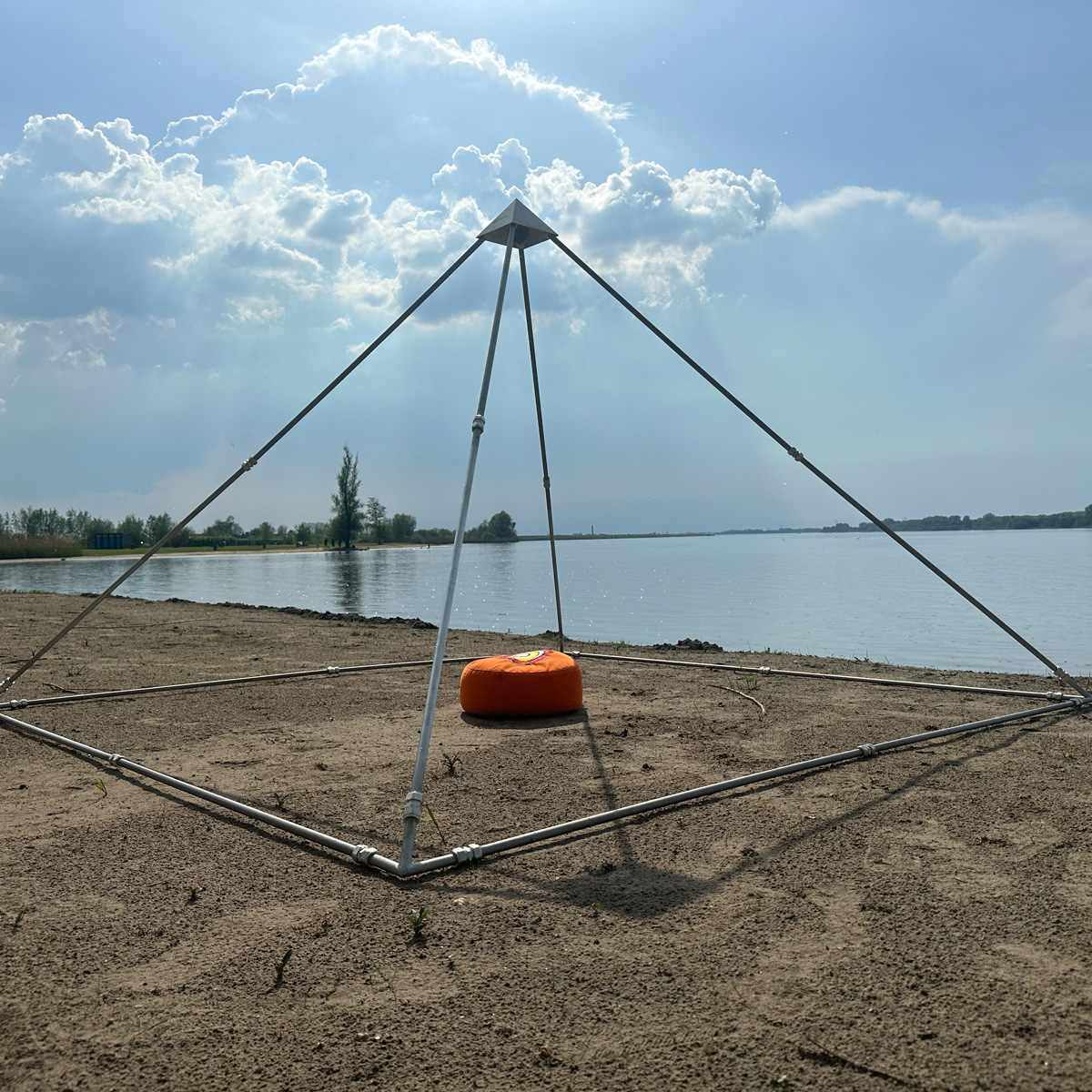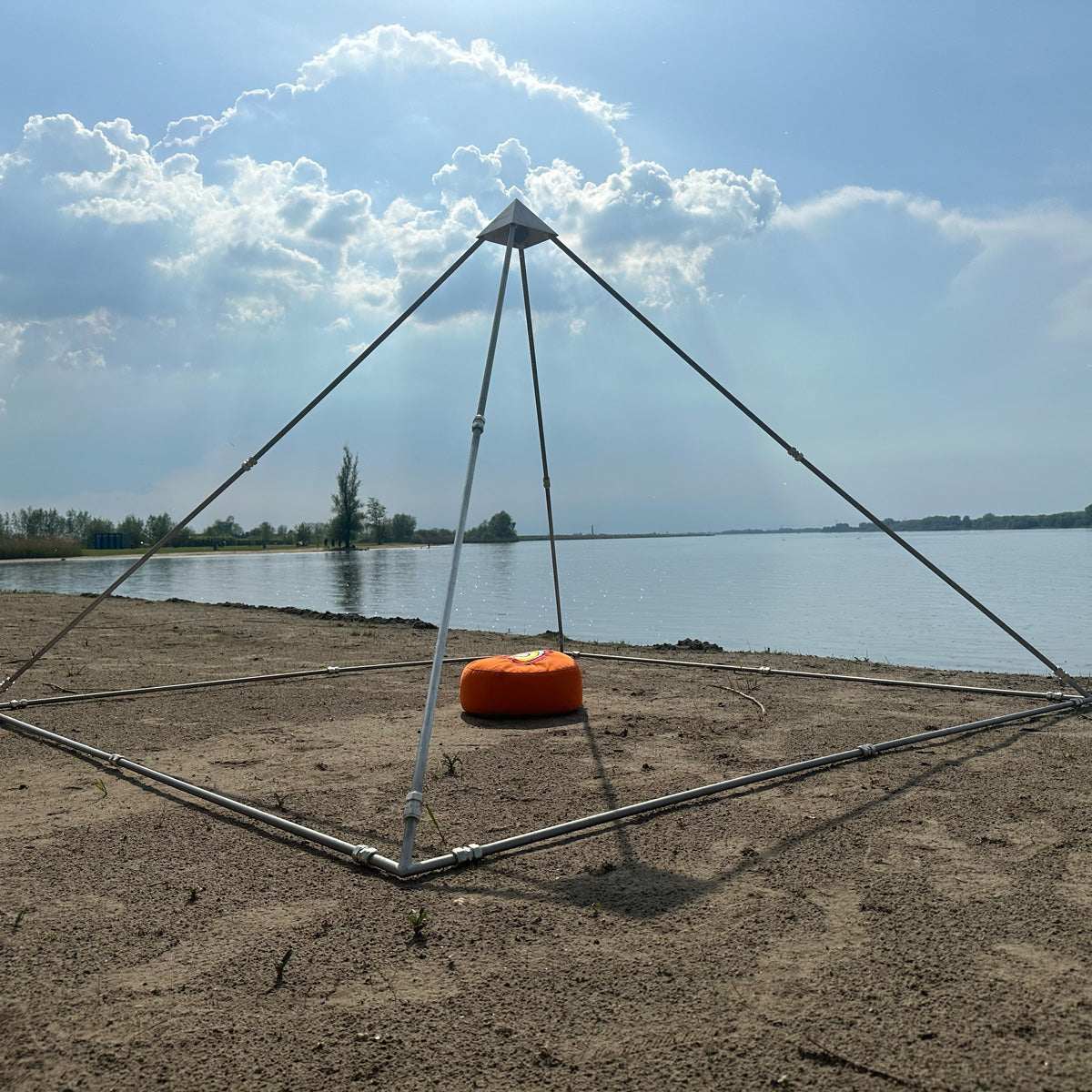
Your first pyramid meditation may feel deeply calm, subtly different — or completely ordinary. There is no single "correct" sensation. Some people notice warmth, tingling, stronger body awareness or a distinctive sense of space. Others simply find that the pyramid makes the meditation feel more intentional.
What does pyramid meditation usually feel like?
There is no universal pyramid-meditation experience. You may notice:
A quieter mental state as attention settles and external distractions decrease.
Breathing, pulse, muscle tension and posture may become more noticeable.
Subtle temperature sensations can become more prominent when you sit still.
Hands, feet, face or scalp may feel more vivid during focused attention.
The converging geometry can make the space feel more intentional or enclosed.
You may simply have a normal meditation session — which is completely fine.
What might happen during your first 15 minutes?
Orientation
You notice the frame, the apex, your posture and the fact that the space feels different from an ordinary room.
Settling
Breathing and muscle tension may become more noticeable as attention turns inward.
Absorption
If the mind settles, time may begin to feel slower or less important.
Integration
You may notice calm, spaciousness, restlessness, subtle sensations — or simply a steady meditation.
Why can the session feel calmer?
The most straightforward explanation is meditation itself.
Reduced movement, slower breathing, fewer external tasks and deliberate attention can all contribute to a calmer subjective state.
The pyramid may add another layer by making the space feel deliberate and separate from ordinary activity.
Why can the pyramid make the space feel different?
A meditation pyramid changes the visual environment around you. The four sides converge toward one apex, creating:
- a clear center;
- vertical visual direction;
- symmetry;
- a boundary without a solid wall;
- a distinctive ritual environment.
That spatial design alone can make a session feel more immersive.
What if you feel tingling?
Tingling is one of the sensations most often interpreted as "energy." But tingling can arise from ordinary factors such as:
- posture;
- pressure on nerves;
- circulation;
- relaxation;
- breathing changes;
- increased attention to subtle bodily signals.
"I noticed tingling during the session." That is a valid observation. The cause remains a separate question.
What if you feel warmth or coolness?
Temperature sensations often become more noticeable when the body is still.
Warmth may be influenced by room conditions, clothing, circulation, relaxation or expectation. Coolness may simply reflect less movement or local airflow.
Neither sensation is proof of a unique pyramid-generated field.
What if you feel pressure around your head or body?
Some meditators report pressure-like sensations around the forehead, scalp, chest or hands.
This can occur in many contemplative practices and may reflect muscle tension, breathing, focused attention or other ordinary sensory processes.
If the sensation is comfortable, observe it without forcing an explanation. If it becomes uncomfortable, change posture or end the session.
Can pyramid meditation change your sense of time?
Meditation can alter subjective time perception.
When you stop checking the clock and attention becomes absorbed, 15 minutes may feel surprisingly short — or unusually long.
This is a known feature of focused contemplative states and does not require a pyramid-specific mechanism.
Can it feel easier to focus inside a pyramid?
Possibly. The structure can act as a strong contextual cue: once you sit inside it, there is little ambiguity about what the next few minutes are for.
That ritual transition may help some people settle more quickly.
For the broader benefits discussion, read Meditation Pyramid Benefits.
What does "deeper meditation" actually mean?
People use the phrase loosely. It may mean:
- fewer distracting thoughts;
- less urge to move;
- greater absorption;
- more emotional quiet;
- stronger awareness of breathing or body sensation;
- a feeling that time passed differently.
These experiences can be meaningful, but they should not automatically be attributed to "pyramid energy."
What if you feel absolutely nothing unusual?
That may actually be the most useful first-session lesson.
A session can be valuable even if you feel no tingling, heat, pressure, visions or altered state.
Ask instead:
- Was it easier to sit down and practice?
- Did the geometry reduce distraction?
- Did you feel calmer afterward?
- Would you like to repeat the session?
How much does expectation influence the experience?
Potentially a lot. If someone has read that pyramid meditation should create energy, pressure or tingling, they may pay much closer attention to those sensations.
This does not mean the sensation is imagined. It means attention and interpretation can shape experience.
- Notice first.
- Describe the sensation simply.
- Avoid rushing to a mechanism.
- Compare across several sessions.
- Expect one dramatic effect.
- Search constantly for proof.
- Interpret every sensation as energy.
- Judge the product after one session.
Can the experience feel spiritual?
Yes, for some people.
The pyramid is a powerful cultural and symbolic form. Combined with silence, intention, sacred geometry or personal belief, it can create a strong sense of ceremony.
That spiritual meaning is personal and does not need to be converted into a scientific claim to be valuable.
What if you use crystals or the amethyst orgonite sphere?
The referenced Phipower design includes an amethyst orgonite sphere as a ritual and aesthetic element.
If crystals have personal meaning, they may make the session feel more intentional.
That is different from claiming that the crystal objectively amplifies a measurable healing field.
A simple first-session protocol
For detailed positioning and timing, see How to Use a Meditation Pyramid.
Try a 7-session pyramid meditation journal
One session is heavily influenced by mood, sleep, novelty and expectation. Seven repeated sessions give you a more useful picture.
Also note any sensations in neutral language: "warm hands," "less mind-wandering," "restless after 8 minutes," or "nothing unusual."
How to find out whether the pyramid changes your experience
Under the pyramid
Use the same meditation technique, duration and posture.
Without the pyramid
Use the same room and practice without the structure.
Alternate several sessions rather than comparing one special day with one ordinary day.
This cannot prove an energy mechanism, but it can tell you whether the structure adds practical or experiential value for you.
Do strong sensations prove "pyramid energy"?
No. A strong subjective experience and a physical-energy claim are different categories.
If you want to explore what has actually been measured, read Does Pyramid Energy Exist? Claims, Measurements & Evidence.
What does a good pyramid meditation session look like?
Not necessarily dramatic. A good session may simply mean:
- you sat down without resistance;
- you stayed with the practice;
- you felt physically comfortable;
- your attention returned when it wandered;
- you finished calmer or clearer;
- you want to practice again.
What might you notice after the session?
Some people report:
- greater calm;
- clearer attention;
- slower mental pace;
- more body awareness;
- a stronger desire to continue sitting quietly.
Others simply return to normal activity without any striking change. Both outcomes are normal.
Experience pyramid meditation yourself
The Phipower Meditation Pyramid is designed as a repeatable Great Pyramid-inspired environment for personal meditation, breath awareness and contemplative practice.
Frequently asked questions about the pyramid meditation experience
The bottom line
The most useful question is not "Did I feel energy?" but "Did this environment help me settle, focus and want to return to the practice?"
Notice the experience first. Interpret it later. And if the pyramid consistently makes meditation easier, more immersive or more meaningful for you, that practical value matters regardless of whether a special physical energy field is ever demonstrated.
The Phipower Meditation Pyramid is a wellness and meditation product, not a medical device. Subjective sensations such as warmth, tingling or pressure are not evidence that pyramid geometry diagnoses, prevents, treats or cures disease.