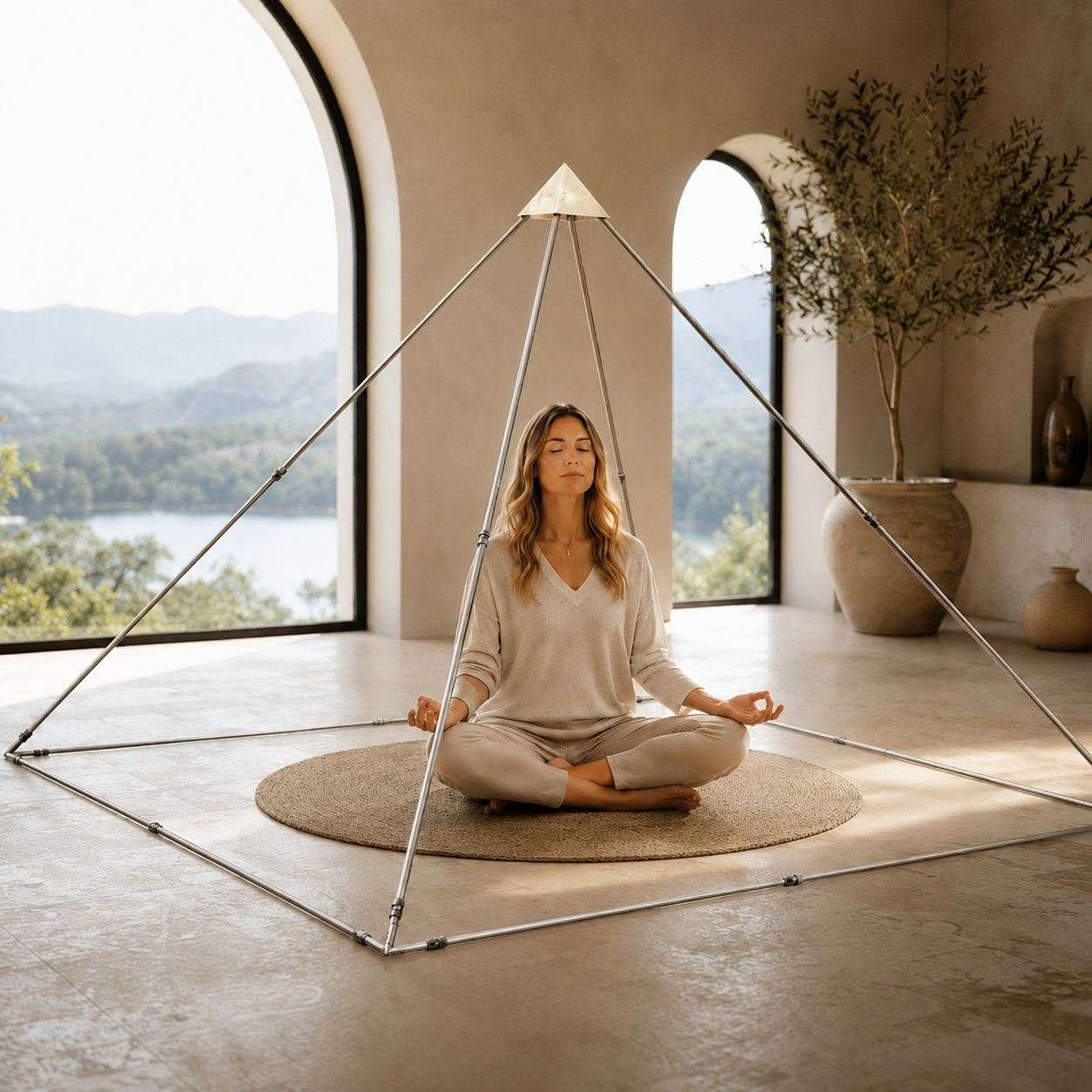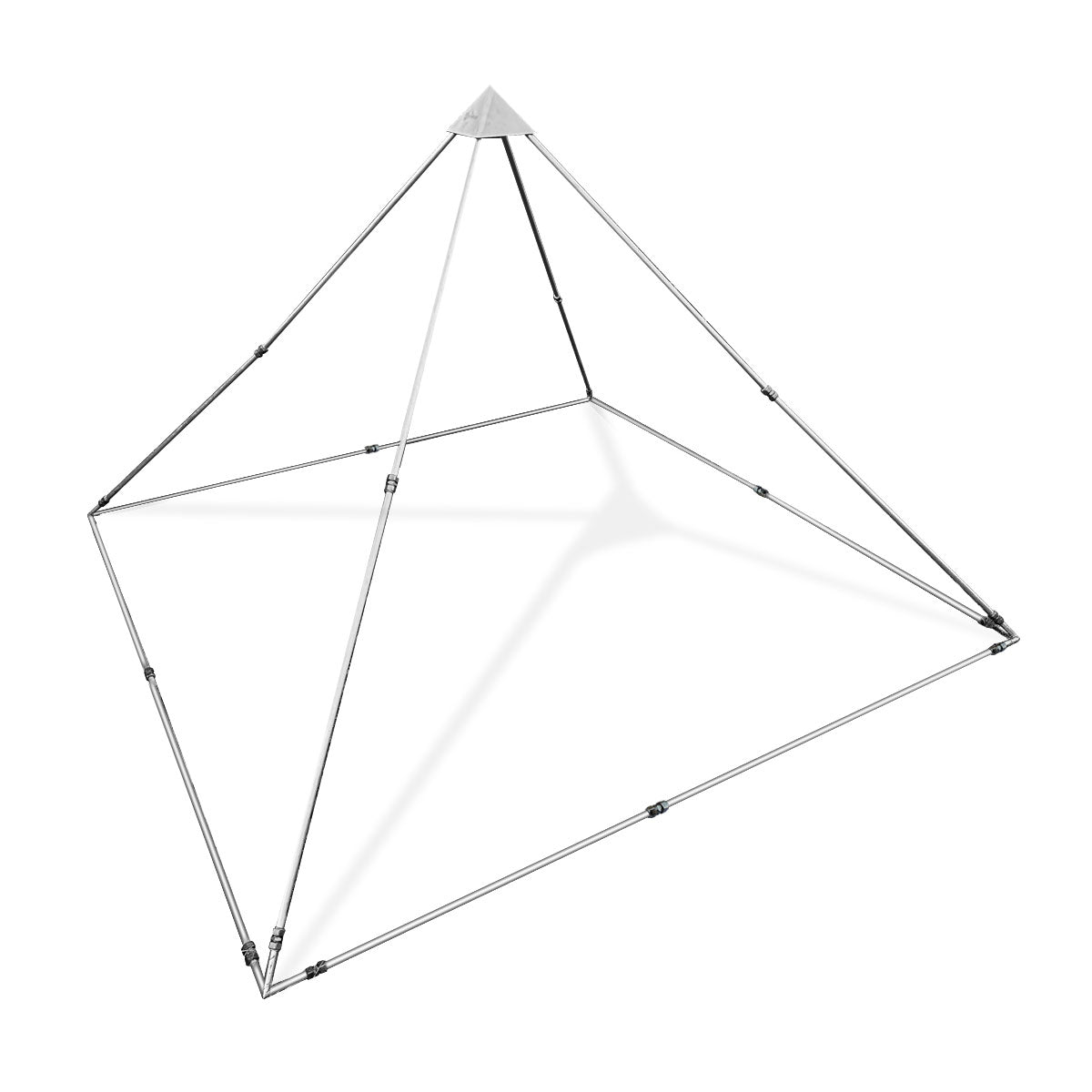
Pyramid meditation is simply meditation practiced inside or beneath a pyramid-shaped frame. You do not need a special belief system or advanced technique to begin. The pyramid creates a defined geometric environment; the meditation itself can be as simple as following your breath for ten quiet minutes.
What is pyramid meditation?
Pyramid meditation is a contemplative practice carried out inside, beneath or in close association with a pyramid-shaped structure.
The term describes the environment, not one fixed meditation technique. You can practice breath awareness, mindfulness meditation, mantra meditation, visualization, prayer or contemplation, body scanning, or open monitoring and silent sitting.
The pyramid gives the session a clear physical boundary and a strong geometric focal point.
How is pyramid meditation different from regular meditation?
The main difference is the setting. In ordinary meditation, you may sit on a cushion, chair or floor in any quiet space. In pyramid meditation, you place the same practice within a geometric frame.
Practice is defined mainly by attention, breathing, posture and mental technique.
The same practice is combined with a deliberately shaped physical and symbolic environment.
At present, there is not strong evidence that the pyramid shape creates an additional therapeutic effect beyond the meditation practice and the experience of the environment.
Why do people meditate under a pyramid?
People are drawn to pyramid meditation for different reasons.
A defined space
The frame can signal that a dedicated period of practice has begun.
Visual convergence
Lines rising toward the apex create a strong visual and spatial structure.
Repeatability
Entering the same structure can become part of a familiar meditation routine.
Sacred geometry
The pyramid can represent stability, ascent, balance or personal spiritual meaning.
Subjective experience
Some users want to compare how meditation feels inside and outside the structure.
A contemplative object
The frame can make a meditation corner feel more intentional and distinctive.
How to begin pyramid meditation in four steps
Your first 10-minute pyramid meditation
- Sit comfortably under the pyramid and allow your hands to rest naturally.
- Close your eyes or soften your gaze.
- Take three slower breaths without forcing them.
- Let the breath return to its natural rhythm.
- Notice where breathing is easiest to feel — nose, chest or abdomen.
- When attention wanders, gently return to that sensation.
- If you become curious about the pyramid or your surroundings, notice that too, then return to the breath.
- When the timer ends, remain still for a few moments before standing up.
Where should you sit inside the pyramid?
For a beginner, the simplest instruction is to sit roughly in the center of the base. This creates a balanced relationship with the four sides and leaves the geometry visually symmetrical around you.
Some pyramid traditions claim that particular points inside the structure contain stronger energy. Those claims are not well established scientifically. For actual practice, a relaxed spine, free breathing and a stable seat matter more.
What is the best posture for pyramid meditation?
There is no single required posture.
Cross-legged
Use a cushion if that makes the hips and back more comfortable.
Chair meditation
A chair is completely valid if floor sitting causes tension or pain.
Lying meditation
Possible if the pyramid size allows enough clearance and you can remain alert.
The goal is not to look "spiritual." The goal is to find a posture stable enough that your body stops demanding constant attention.
How long should a beginner meditate under a pyramid?
minutes
Best starting point for most beginners. Short enough to repeat regularly.
minutes
Useful once you can sit comfortably without constantly checking the time.
minutes
Better suited to experienced meditators who already enjoy longer sessions.
Ten minutes most days is usually more useful for building a practice than one very long session followed by a week of nothing.
Breath awareness: the easiest pyramid meditation for beginners
Breath awareness works well because it requires no equipment, mantra or visualization.
- Allow breathing to remain natural.
- Choose one place where you feel the breath clearly.
- Stay with one inhalation and one exhalation at a time.
- When the mind wanders, notice that gently.
- Return without judging yourself.
The pyramid does not change the basic skill: learning to notice where attention has gone and returning it deliberately.
Other beginner-friendly pyramid meditation techniques
Mantra
Repeat a short word or phrase quietly and return to it whenever attention wanders.
Body scan
Move attention slowly from feet to head, noticing sensations without trying to change them.
Visualization
Use light, the apex or another simple image as a focus for imagination.
Open awareness
Notice sounds, sensations and thoughts as they appear without choosing one permanent anchor.
Prayer
Use the pyramid as a quiet dedicated space for spiritual reflection or devotional practice.
Sound
Use humming, mantra or quiet sound if it helps settle attention rather than distract it.
Does the pyramid need to face north?
Some modern pyramid-meditation traditions recommend aligning one side with magnetic north. You can do this if it adds meaning and consistency to your practice, but beginners should not worry if their room does not allow perfect alignment.
A safe, quiet location that makes you want to meditate regularly is more important than exact compass alignment.
What is "pyramid energy"?
Pyramid-energy literature proposes that the geometry collects, concentrates or organizes a subtle form of energy. These ideas are often connected with concepts such as orgone, prana or life energy, cosmic energy, Earth energy, electromagnetic resonance and sacred geometry.
These concepts can be meaningful within spiritual traditions, but robust scientific evidence has not established a unique pyramid-generated healing field.
What might you feel during pyramid meditation?
Beginners sometimes pay very close attention to sensations during their first sessions. You may notice deep relaxation, warmth or coolness, tingling, a sense of quiet or spaciousness, heightened awareness of sound, changes in your perception of time — or nothing unusual at all.
Any of these experiences can occur during meditation. A sensation by itself cannot tell us whether the pyramid generated a special physical field.
What are the possible benefits of pyramid meditation?
The evidence-supported part comes primarily from meditation itself. Mindfulness and meditation interventions have been associated in research with improvements in perceived stress, anxiety and some aspects of well-being in certain populations. Results vary by meditation method, study design and comparator.
| Possible outcome | What can we responsibly say? |
|---|---|
| Relaxation | Common meditation goal and experience |
| Improved focus | Plausible through meditation practice |
| Reduced perceived stress | Supported in some meditation research |
| Pyramid amplifies the effect | Not established |
| Healing energy field | Not established |
| Disease treatment | Not an appropriate claim |
What does science say specifically about pyramid meditation?
The scientific literature on pyramid-specific meditation is much thinner than the literature on meditation itself. Small EEG studies and observational research have reported changes before and after meditation in pyramid environments. The major limitation is that those designs often do not isolate the geometry from the meditation practice, expectation, time or surrounding environment.
There is a reasonable basis for recommending meditation. There is not yet a strong basis for claiming that pyramid geometry adds a unique physiological or therapeutic effect.
For the deeper review, see the Meditation Pyramid pillar guide.
Five beginner mistakes to avoid
- begin with a short session
- prioritize comfortable posture
- use one simple meditation anchor
- keep the structure stable and safe
- notice your experience without forcing a conclusion
- waiting for dramatic sensations
- assuming tingling proves "energy"
- forcing long sessions
- treating meditation as medical care
- changing technique every few minutes
A simple 7-day pyramid meditation routine
| Day | Practice | Duration |
|---|---|---|
| 1 | Breath awareness | 10 minutes |
| 2 | Breath awareness | 10 minutes |
| 3 | Breath + short body scan | 12 minutes |
| 4 | Breath awareness | 12 minutes |
| 5 | Mantra or breath | 15 minutes |
| 6 | Your preferred method | 15 minutes |
| 7 | Repeat the method that felt most natural | 15 minutes |
After one week, ask a simple question: Did the structure make it easier for me to sit down and practice? That is a useful outcome even before asking whether geometry has any additional effect.
Begin with the Phipower Meditation Pyramid
The Phipower Meditation Pyramid is designed as a portable, repeatable meditation environment inspired by Great Pyramid / Cheops proportions and the 51.83° apex angle.
Scientific sources & evidence context
Useful context for general meditation and stress outcomes; it does not test pyramid geometry.
EEG research involving experienced meditators at Pyramid Valley International. Concerns meditation-related brain dynamics and does not isolate pyramid geometry as the causal variable.
Provides historical context for small pyramid-meditation studies and illustrates why controlled comparison designs are needed.
Frequently asked questions about pyramid meditation
The bottom line for beginners
You do not need to understand "pyramid energy" before you begin pyramid meditation.
Create a safe, quiet space. Sit comfortably. Choose one meditation anchor. Practice for 10–15 minutes. Repeat often enough to learn what the environment does for your own focus and consistency.
The pyramid can be a meaningful part of that practice as geometry, ritual and contemplative space. Whether it has an additional measurable physiological or energetic effect is a separate research question.
The Phipower Meditation Pyramid is a wellness and meditation product, not a medical device. This article is educational and does not claim that pyramid meditation diagnoses, prevents, treats or cures disease. Pyramid-energy interpretations are presented as traditions, hypotheses or subjective experiences unless supported by appropriate evidence.