The two categories start from a different signal philosophy.
A bioresonance session is often described as analyzing signals associated with the user and processing them. A Rife system normally begins with an oscillator, frequency list or sweep and sends a generated signal outward.
Bioresonance and Rife machines are not the same technology. Bioresonance is commonly presented as a measurement-and-feedback approach: the device supposedly receives frequency information from the body, analyzes or modifies it, then feeds a signal back. Rife-style systems are primarily signal generators that output predefined or programmable frequencies. Their evidence, hardware and regulatory claims therefore need to be evaluated separately.
For the broader Rife technology, start with the Complete Guide to Rife Machines →
What is bioresonance?
Bioresonance is an alternative-health approach built around the idea that the body produces electromagnetic or energetic signals that can be measured and interpreted.
Practitioners may claim that a device can:
- read frequency information associated with the body;
- identify "healthy" and "unhealthy" patterns;
- filter, invert or amplify selected frequencies;
- return a modified signal to the user;
- use the resulting information for assessment or therapy.
The UK ASA/CAP describes bioresonance in similar terms: devices are claimed to read energy wavelengths from cells and use those frequencies to provide health information or create a therapeutic "resonance."
ASA/CAP states that it has not seen robust evidence sufficient to support the broad diagnostic and disease-treatment claims it has reviewed for bioresonance devices.
What is a Rife machine?
A Rife machine is better described as a frequency-generation system.
The architecture usually starts with:
- an oscillator or digital generator;
- a selected frequency or frequency program;
- optional carrier/modulation;
- optional automatic sweep;
- an output stage;
- contact electrodes or plasma/RF delivery.
The machine does not need to "read" the user before it produces its output.
Simplified Rife signal path
For the detailed electronics, see How Does a Rife Machine Work?
The core difference: closed-loop idea vs open-loop generation
In engineering language, many bioresonance concepts resemble a measurement or feedback loop, while most Rife systems resemble an open-loop signal generator.
Input matters
The system is claimed to receive information from the user, process it and then use that information to determine or create the output.
Program matters
The system outputs a selected or preset signal whether or not the user has first been measured.
This distinction is more useful than simply asking whether both technologies "use frequencies."
Bioresonance vs Rife Machine: side-by-side
| Feature | Bioresonance | Rife-style system |
|---|---|---|
| Core philosophy | Measure/analyze/process body-associated signals | Generate selected frequency signals |
| Input from user | Often central to the claimed method | Usually not required |
| Diagnostic claims | Common in some systems/practices | Not inherent to frequency generation |
| Feedback/inversion | Common theoretical feature | Not usually central |
| Preset frequency lists | May be present | Common in programmable systems |
| Automatic sweep | Depends on system | Common in some systems |
| Carrier frequency | Depends on design | Used in some Rife architectures |
| Contact electrodes | Common | Common in contact Rife systems |
| Plasma/RF delivery | Not the defining model | Used in some Rife systems |
| Evidence base | Device/claim specific; broad diagnostic claims remain controversial | Device/claim specific; no blanket validation as a disease-treatment platform |
What is MORA bioresonance?
MORA is one of the best-known historical bioresonance concepts, associated with Franz Morell and Erich Rasche.
The name itself is commonly understood as combining parts of their surnames.
The traditional MORA concept is often described as:
Simplified MORA-style concept
This is conceptually quite different from a simple Rife frequency generator.
What about BICOM and other bioresonance systems?
Modern bioresonance products include a range of commercial device families, including systems marketed under names such as BICOM.
Capabilities vary substantially.
Some systems focus on practitioner-led testing and treatment programs, while others are packaged as consumer wellness devices.
The important rule is:
Just as "Rife machine" covers many architectures, "bioresonance" covers multiple hardware and software implementations.
Can bioresonance really "scan" the whole body?
Claims about whole-body scanning, allergy diagnosis, pathogen detection or organ-specific frequency abnormalities are common in parts of the bioresonance market.
Those are diagnostic claims.
Diagnostic claims require validation against accepted reference methods.
ASA/CAP's current guidance says that it has not seen evidence sufficient to support broad claims that bioresonance devices can diagnose existing or future medical conditions.
ASA has previously ruled that device conformity marking alone did not substantiate specific diagnostic or therapeutic claims made in advertising.
What does "frequency inversion" mean in bioresonance?
Some bioresonance theories propose that undesirable or "pathological" signals can be inverted and fed back to reduce them.
From a signal-processing perspective, inversion can be defined mathematically.
But there are two separate questions:
- Can a circuit invert or phase-reverse a measured electrical signal?
- Does that operation clinically neutralize a disease process in the body?
The first is an electronics question.
The second is a biomedical claim requiring evidence.
Real signal processing does not automatically validate the biological interpretation attached to it.
How is that different from a Rife frequency?
A Rife-style system normally starts with a target or generated frequency rather than a measured "pathological" signal from the user.
That target can be:
- a single frequency;
- a list of frequencies;
- a frequency sweep;
- a modulation frequency;
- a carrier/sideband architecture.
The historical concept of a Mortal Oscillatory Rate (MOR) belongs to this output-oriented side of the story.
Read Mortal Oscillatory Rate (MOR): What Did Royal Rife Mean?
Bioresonance is not the same as biofeedback
This distinction is important because the words sound similar.
Conventional biofeedback measures a recognized physiological variable and displays it so the user can learn to influence it.
Examples include:
- heart-rate variability;
- surface EMG muscle activity;
- skin temperature;
- electrodermal activity;
- EEG-based neurofeedback.
Those measurements have defined physiological meanings.
Bioresonance uses a different theory about body-associated frequency information and should not be described as synonymous with established physiological biofeedback.
Where do devices such as Healy fit?
Modern consumer frequency products sometimes combine terminology from:
- bioresonance;
- microcurrent;
- frequency programs;
- wellness;
- individualized analysis.
That makes category labels even less reliable.
For example, advertising regulators in the UK have reviewed claims around products marketed with bioresonance/cellular-healing language and found disease-treatment claims unsubstantiated where adequate evidence was not provided.
The correct approach is to evaluate the actual device, actual intended use and actual claim.
What does the research evidence look like?
The literature is mixed and much smaller than the marketing footprint of bioresonance might suggest.
There are individual published studies reporting positive outcomes in areas such as smoking cessation, depression and other conditions.
At the same time, regulatory advertising reviews have repeatedly found the evidence submitted for broad bioresonance diagnostic and therapeutic claims insufficient.
These statements can both be true.
Generate evidence for a defined protocol
A controlled study can test one device, one population and one outcome.
Validate the entire category
A study on smoking cessation does not prove that bioresonance diagnoses allergies, treats cancer or identifies pathogens.
For a high-trust website, claim specificity matters.
Is Rife better supported scientifically?
Rife machines have a similar category problem.
"Rife machine" can refer to:
- historical plasma equipment;
- contact frequency generators;
- audio-frequency systems;
- programmable software-driven devices;
- preset sweep devices.
One device cannot borrow evidence from another simply because both use frequencies.
Likewise, the existence of legitimate medical electric-field therapies does not prove consumer Rife systems as general disease treatments.
For the evidence distinction, see Rife Machine and Cancer: What Does the Evidence Actually Say?
Diagnosis is the biggest practical difference
If one sentence had to separate the two categories, this would be it:
"We can measure something about your body's frequency pattern and use it to guide the session."
"We generate this frequency, sweep or program and deliver it through this hardware."
That distinction also changes the regulatory and evidence burden.
A diagnostic claim needs evidence that the device can reliably identify what it says it identifies.
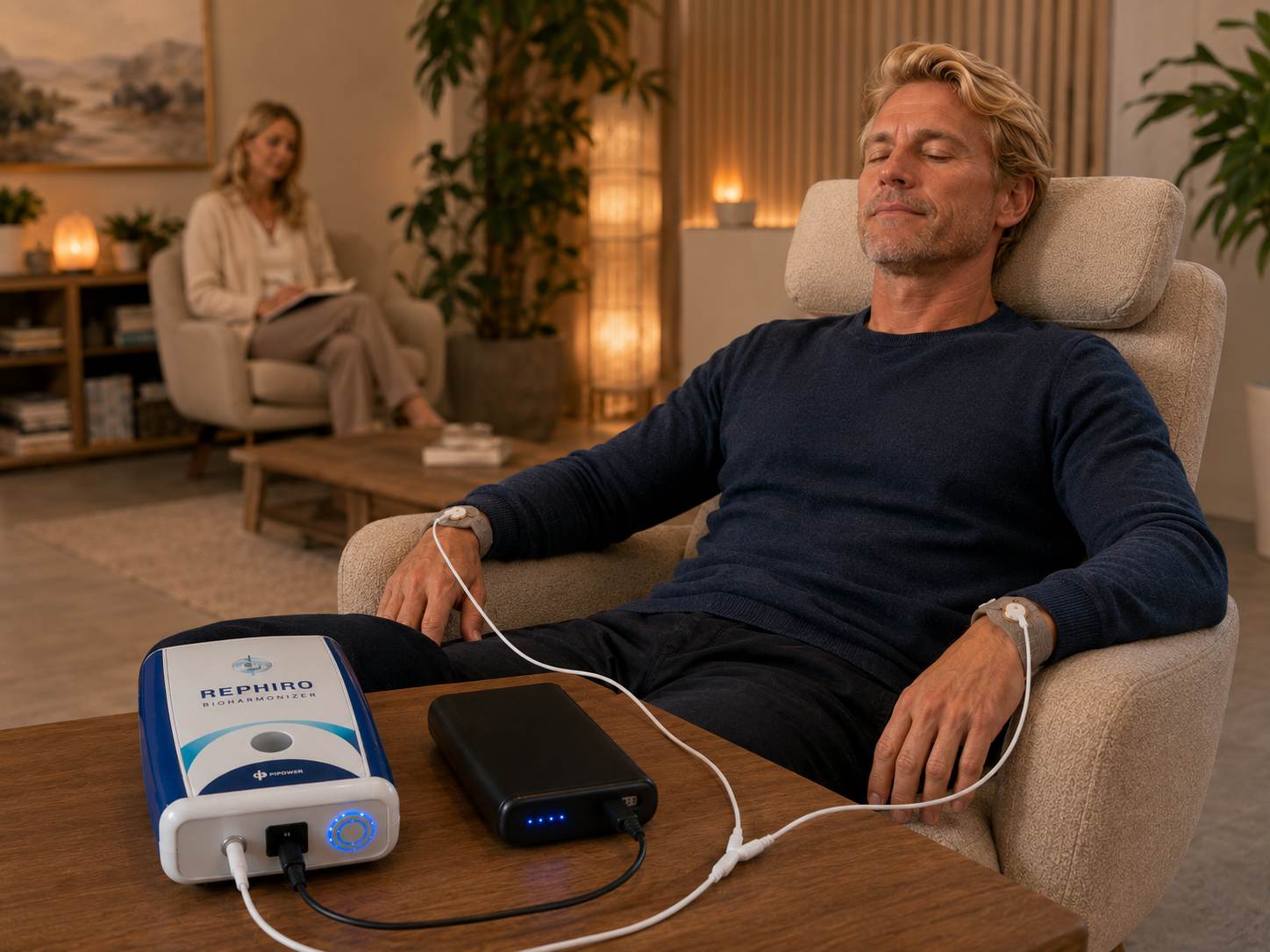
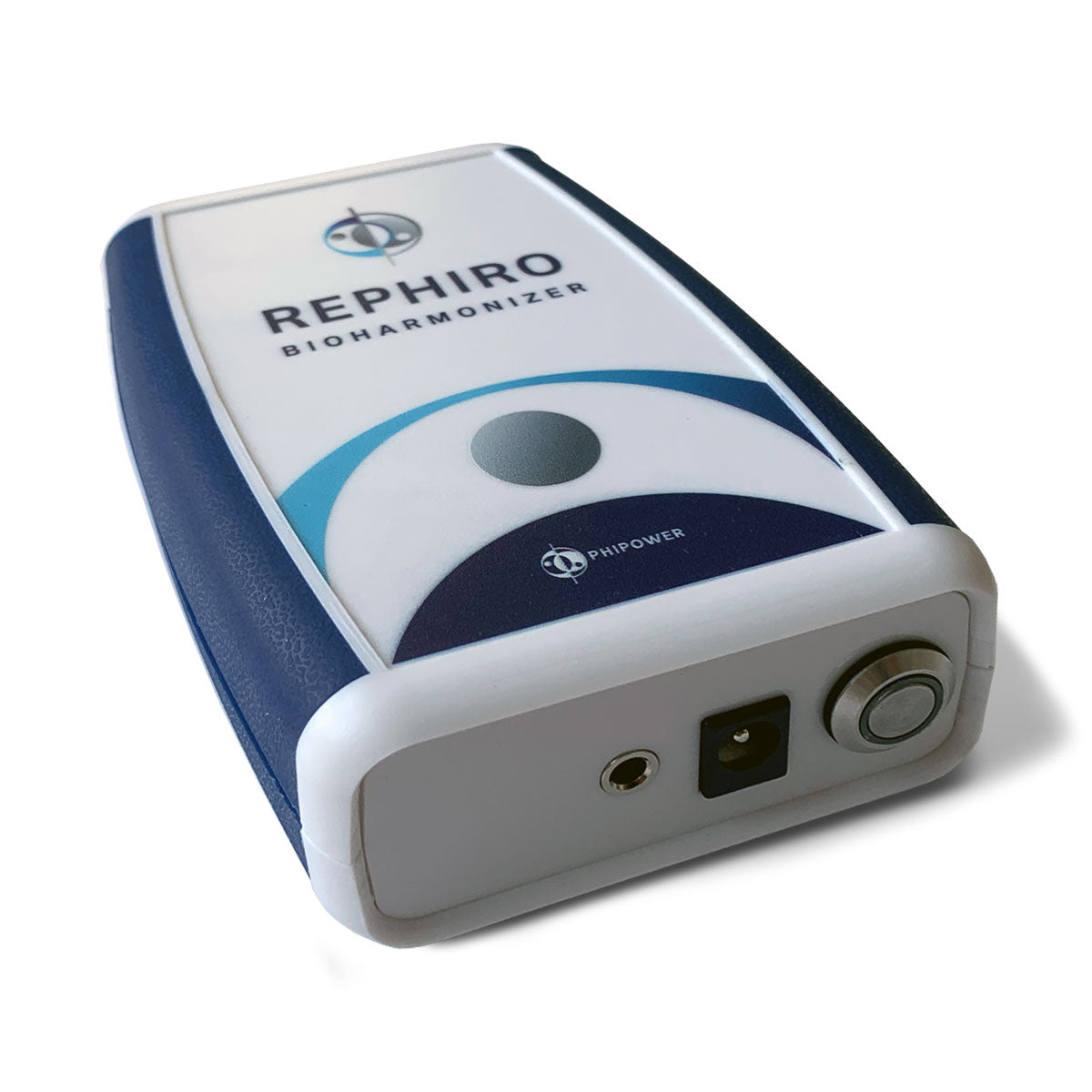
Where does Rephiro fit?
Rephiro is not a bioresonance diagnostic scanner.
It does not claim to:
- scan organs;
- detect allergens;
- identify pathogens;
- measure "pathological frequencies";
- generate a personalized diagnosis from the user's incoming signal.
Instead, its current specified architecture is:
~3.1 MHz
Preset high-frequency carrier.
0.1–150 kHz
Automatic lower-frequency sweep.
~14 Hz
Slower timing/gating layer.
Contact
Electrical signal delivered through conductive accessories.
This makes Rephiro a preset output-frequency device rather than a scan-and-feedback system.
Bioresonance vs Rephiro vs programmable Rife
| Bioresonance | Rephiro | Programmable Rife | |
|---|---|---|---|
| Body scan/input concept | Often yes | No | Usually no |
| Personalized feedback loop | Often claimed | No | Usually no |
| Preset output | Depends on device | Yes | Optional |
| Automatic sweep | Depends on device | 0.1–150 kHz | Often configurable |
| Carrier | Depends on design | ~3.1 MHz | Available in some systems |
| Manual frequency entry | Depends on system | No | Yes |
| Disease database | Common in some systems | No | Common in some systems |
| Diagnostic claims | Common in parts of the market | No | Not inherent |
Which type would suit which user?
Choose a genuine bioresonance system
If your primary interest is specifically the scan/input/feedback concept and you understand that diagnostic and treatment claims must be evaluated critically.
Choose Rephiro
If you want a compact output-frequency device with no diagnostic scan, software or manual frequency list.
Choose programmable Rife
If you want manual frequency entry, custom sweeps, waveform control or carrier/modulation experimentation.
This is a technology/usability comparison, not a ranking of medical effectiveness.
What claims should make you cautious?
High-risk claims in both categories include:
- "scans every organ in minutes";
- "detects every allergy";
- "finds hidden infections";
- "tells you which cancer you have";
- "neutralizes viruses";
- "replaces blood tests";
- "cures chronic disease through frequency correction."
For diagnostic claims, ask what accepted reference test the device was compared against.
For treatment claims, ask what controlled human clinical evidence exists for the exact device and indication.
What about regulation and advertising?
Bioresonance and Rife devices face the same general regulatory principle:
claims can determine regulatory obligations.
ASA/CAP's January 2026 guidance on bioresonance states that medical diagnostic/treatment claims require robust clinical evidence and appropriate conformity status.
For Rife products, the same broader intended-use logic applies under medical-device and advertising rules.
Read Is Rife Therapy Legal? FDA, FTC, EU & Regulatory Status
Seven common misconceptions
"Bioresonance is just another name for Rife."
No. The core scan/feedback concept is different from open-loop frequency generation.
"Both use electrodes, so the technology is the same."
Electrodes are only the interface. Signal generation, measurement and intended use can differ substantially.
"Bioresonance is the same as medical biofeedback."
No. Conventional biofeedback measures recognized physiological variables for training.
"If a device can electrically measure something, it can diagnose disease."
No. Diagnostic validity requires comparison with accepted reference standards.
"A CE-marked bioresonance device proves every advertised benefit."
No. Advertising authorities have explicitly rejected that logic for unsupported claims.
"Rephiro scans the user's frequencies and corrects them."
No. Rephiro is a preset contact-frequency output device.
"One positive bioresonance study validates all bioresonance claims."
No. Evidence must match the exact device, population, outcome and claim.
Sources & further reading
Current UK advertising guidance defining typical bioresonance claims and explaining the evidence requirements for diagnosis and treatment claims.
Recent ruling involving bioresonance/cellular-healing claims and the distinction between conformity marking and substantiation of specific efficacy claims.
Placebo-controlled double-blind study reporting a positive result for one defined application; included to show why individual studies should be distinguished from broad category claims.
Published study reporting outcomes with a specific bioresonance approach; again not evidence for unrelated diagnostic or treatment claims.
Central overview of Rife history, frequencies, machine types, evidence and hardware.
Framework for separating actual electrical measurement from biological interpretation.
Frequently asked questions about bioresonance and Rife machines
The bottom line
Bioresonance and Rife machines belong to neighboring parts of the frequency-technology world, but they should not be collapsed into one category.
Bioresonance: commonly framed as input → analysis/processing → feedback.
Rife machine: primarily frequency generation → output → contact or plasma/RF delivery.
Rephiro: a preset contact-frequency output system with approximately 3.1 MHz carrier, 0.1–150 kHz automatic sweep and ~14 Hz pulsing — not a diagnostic bioresonance scanner.
"Uses frequencies" is not a sufficient technology description. Ask whether the device measures, analyzes, generates, modulates or feeds back a signal — and what evidence supports the specific claim being made.
For the full Rife overview:
Rife Machine: The Complete Guide to Rife Frequencies, Technology & Devices →
This article is educational. Bioresonance diagnostic and treatment claims vary by device and provider and should not be generalized from individual studies. Phipower frequency products are wellness and lifestyle products, not medical devices, and are not intended to diagnose, prevent, treat or cure disease.