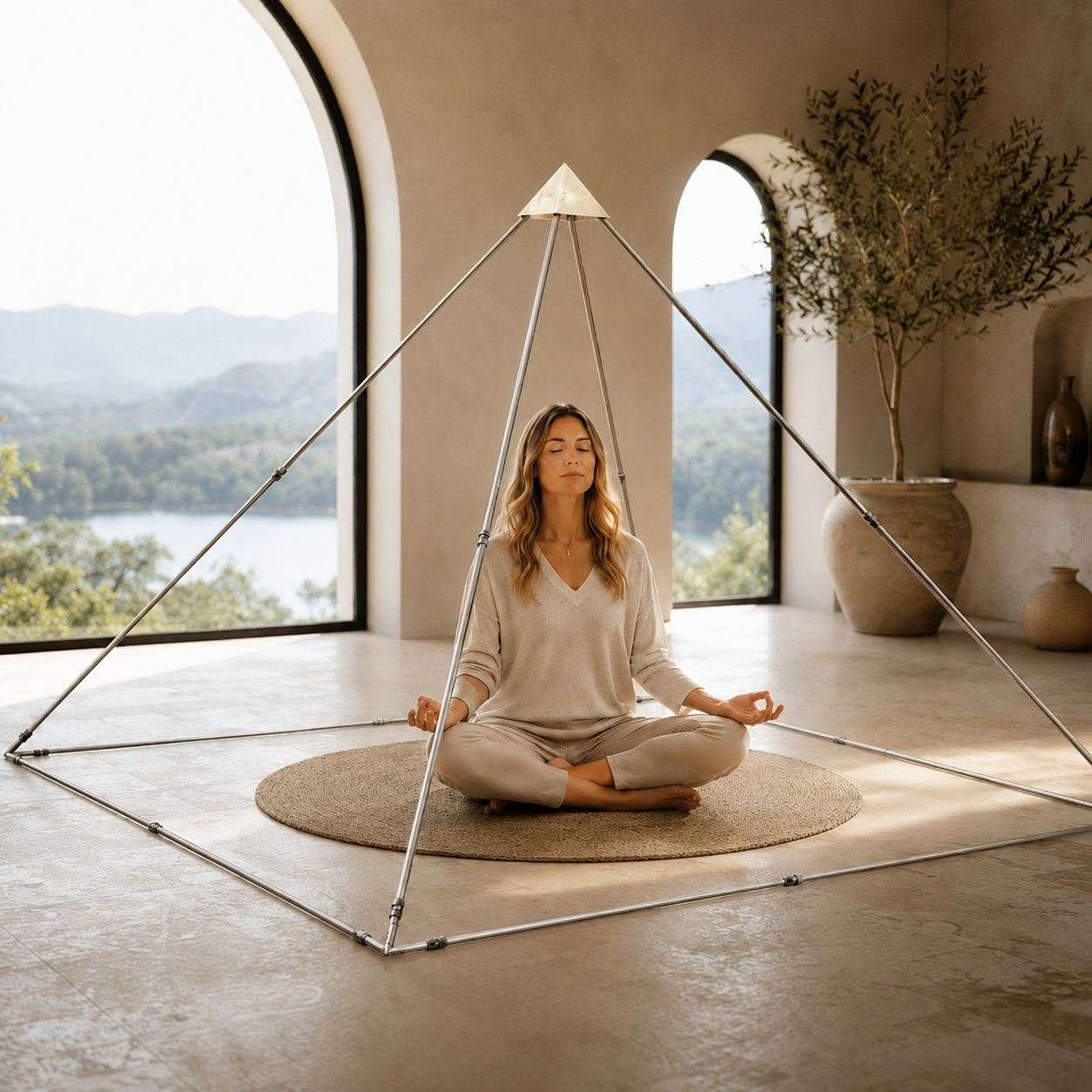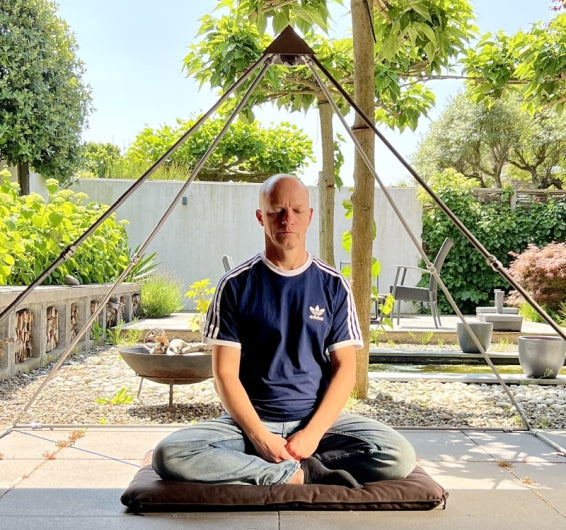
Using a meditation pyramid should feel simple, not mysterious. Set the frame up safely, choose a comfortable position, decide how long you want to meditate, and use a technique you already understand. The pyramid creates the environment; your meditation practice remains the core of the session.
How to use a meditation pyramid in five steps
Start with 10–15 minutes. Finish calmly, notice how the session felt, and repeat often enough to develop a real routine.
1. Choose the right place for your meditation pyramid
A good location makes practice easier before the session even begins.
Look for:
- a stable, level surface;
- enough floor space around the base;
- minimal foot traffic;
- comfortable temperature;
- low distraction;
- safe clearance above and around the frame.
The goal is to create a place that makes it easy to return to meditation regularly.
2. Assemble the pyramid securely
Before each session, especially after moving or transporting the pyramid, check the physical structure.
| Check | Why it matters |
|---|---|
| Connectors fully seated | Prevents movement or accidental separation. |
| Base sits evenly | Reduces rocking and keeps the geometry stable. |
| Apex connection secure | Keeps the upper structure centered and stable. |
| No damaged components | Avoid using a bent, cracked or unstable section. |
| Enough personal clearance | Prevents bumping the frame during entry, exit or posture changes. |
3. Where should you sit inside a meditation pyramid?
A practical starting point is to sit roughly in the center of the base.
This gives you a balanced relationship with the four sides and allows the apex to sit approximately above the center of the meditation space.
Centered seated position
Ideal for breath awareness, mantra, mindfulness and most beginner practices.
Chair position
Use a low or suitable chair if floor sitting causes tension. Comfort matters more than tradition.
Reclined position
Suitable for body scan, relaxation or contemplative rest, provided the frame has enough clearance.
Does your head need to be directly under the apex?
Some pyramid traditions describe a particular region beneath the apex as an energetic concentration point.
There is no robust evidence establishing one exact body position as biologically superior.
Use the apex as a visual and geometric reference, but do not sacrifice a natural spine, relaxed shoulders or free breathing just to place your head at one exact point.
4. Choose a posture you can actually maintain
Good meditation posture is stable, alert and relaxed.
Cross-legged
Use a cushion under the hips if the knees or lower back feel strained.
Chair
Keep both feet supported and let the spine remain upright without becoming rigid.
Lying down
Useful for body scan or relaxation; avoid it if you immediately fall asleep and want an alert practice.
What should you do with your hands?
There is no required hand position for pyramid meditation.
You can:
- rest the hands on the thighs;
- place them loosely in the lap;
- use a traditional mudra if it has meaning in your practice;
- hold nothing at all.
The best position is the one that lets the shoulders and arms relax.
5. Should the pyramid face magnetic north?
North alignment can be part of the ritual — but it is not required.
Some meditation-pyramid traditions recommend aligning one side with magnetic north. You can follow that convention if you enjoy it or want a repeatable setup.
Current evidence does not establish that north alignment creates a unique meditation, health or energetic effect.
6. How long should you meditate under a pyramid?
10–15 minutes
Long enough to settle without turning the session into an endurance exercise.
20–30 minutes
A good range once short sessions already feel comfortable and consistent.
30+ minutes
Appropriate when longer meditation is already part of your established practice.
There is no scientifically established pyramid-specific threshold at which the geometry suddenly becomes more effective.
How often should you use the pyramid?
Regularity matters more than intensity.
A practical weekly rhythm might be:
7. Which meditation technique should you use?
The pyramid does not require one special method.
Best all-purpose option for beginners. Notice breathing and gently return when attention wanders.
Repeat a word, phrase or sound and use repetition as the attention anchor.
Move attention through the body systematically and notice sensations without trying to change them.
Use the apex, light, geometric symmetry or another chosen image as part of the practice.
Observe sounds, thoughts and sensations as they arise without selecting one permanent anchor.
Use the pyramid as a dedicated setting for devotional or reflective practice.
A complete 15-minute pyramid meditation session
- Minute 0–2: settle your posture and allow breathing to become natural.
- Minute 2–5: place attention on the physical sensation of breathing.
- Minute 5–10: continue returning to the breath whenever attention wanders.
- Minute 10–13: widen attention to include the whole body and surrounding space.
- Minute 13–15: sit without trying to change anything, then end gradually.
Should your eyes be open or closed?
Either can work.
Eyes closed can reduce visual distraction.
Soft gaze can help maintain alertness and lets you use the pyramid geometry as part of the visual environment.
One option is to look briefly toward the apex at the start, then close the eyes once you settle.
Can you use sound, mantra or music?
Yes.
Sound can be used as the main meditation anchor or simply as background ambience.
- quiet instrumental music;
- mantra;
- humming;
- singing bowls;
- nature sounds;
- silence.
Keep the sound simple enough that attention does not become overloaded.
Should you set an intention before the session?
An intention can give the practice direction without turning it into a demand for a particular outcome.
Examples:
- "For the next 15 minutes, I will stay with my breath."
- "I will notice thoughts without following them."
- "This session is for quiet reflection."
- "I will approach whatever arises with curiosity."
Intentions work best when they describe how you want to practice rather than promising a medical or energetic result.
Can you use crystals or the orgonite sphere?
The referenced Phipower Meditation Pyramid includes an amethyst orgonite sphere as part of its symbolic design.
You may incorporate it into your ritual if it has personal meaning.
Treat crystals and orgonite as symbolic, aesthetic or contemplative elements. Claims that they produce a measurable healing or life-energy field are not established enough to present as fact.
What if you feel warmth, tingling or pressure?
Meditation can increase awareness of subtle body sensations.
If you notice warmth, tingling, pulse, pressure or a changed sense of space:
- notice it;
- avoid immediately explaining it;
- return to your meditation anchor;
- adjust position if uncomfortable;
- stop if the sensation becomes distressing.
A subjective sensation can be meaningful without proving a pyramid-specific physical mechanism.
How to use a meditation pyramid outdoors
Outdoor practice can be appealing because it combines the geometric structure with natural surroundings.
Use extra caution:
- choose level, firm ground;
- avoid strong wind;
- do not use during storms;
- keep the frame away from traffic or unstable terrain;
- do not leave lightweight components unsecured.
Compact or Large: does size change how you use it?
The referenced Phipower design can be configured in two sizes:
Approx. 77 cm high
More compact and easier to integrate into smaller spaces. Best suited to users who prioritize portability and a compact setup.
Approx. 140 cm high
Provides a more spacious physical environment and more flexibility in body position.
Choose based on available floor space and how you prefer to meditate — not on a claim that one size generates stronger energy.
What should you do before and after a session?
| Before | After |
|---|---|
| Check the structure | Sit quietly for a few seconds |
| Silence notifications | Notice your state without judging it |
| Choose one technique | Stand up slowly |
| Set a timer | Record a short note if you track sessions |
| Settle your posture | Leave the structure stable or store it safely |
Common mistakes when using a meditation pyramid
- use a stable setup;
- start with short sessions;
- keep your posture natural;
- use a technique you understand;
- allow experiences to be subtle.
- forcing the head beneath one "energy point";
- expecting dramatic sensations;
- using extremely long sessions as a beginner;
- treating tingling as medical evidence;
- using the pyramid as a substitute for healthcare.
How to test whether the pyramid helps your practice
If you want to know whether the structure adds value for you, compare it with the same meditation outside the pyramid.
- Use the same room.
- Use the same time of day where possible.
- Meditate for the same duration.
- Use the same technique.
- Alternate pyramid and no-pyramid sessions.
- Score calm, focus, comfort and willingness to repeat from 0–10.
This is not a clinical trial, but it is much more informative than judging after a single unusually strong session.
For the evidence context, read Meditation Pyramid Benefits: Experience, Claims & What Science Says.
The Phipower Meditation Pyramid — €299
Designed as a portable meditation environment inspired by Great Pyramid / Cheops proportions, the Phipower Meditation Pyramid is intended to make setup and repeated use straightforward.
Frequently asked questions about using a meditation pyramid
The bottom line
The best way to use a meditation pyramid is also the simplest:
Everything else — exact orientation, crystals, symbolic meaning or geometry-specific hypotheses — can remain optional layers around the core practice.
For beginners, start with What Is Pyramid Meditation?. For the broader science and architecture, return to the Meditation Pyramid pillar.
The Phipower Meditation Pyramid is a wellness and meditation product, not a medical device. This article provides practical and educational guidance and does not claim that pyramid geometry diagnoses, prevents, treats or cures disease.