Frequency therapy has become available for home use, but the science requires nuance
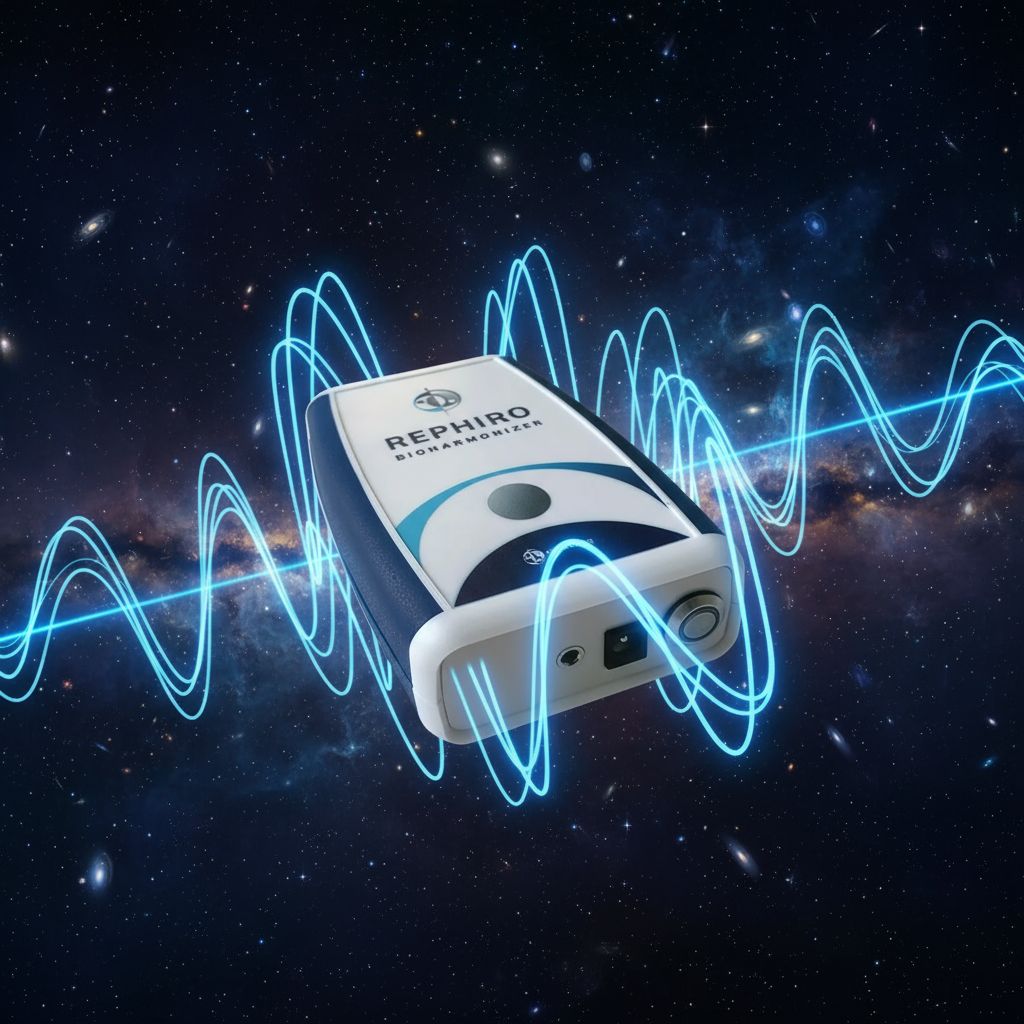
Frequency therapy builds on genuine principles of physics, such as frequency, modulation and electromagnetic interaction. There is also substantial biophysical research into the effects of electromagnetic fields on biological systems. However, this does not mean that every historical Rife frequency or wellness application has been clinically proven. The Rephiro Bioharmonizer is a compact, portable frequency generator for personal use and is not a medical device.
Depending on their form and intensity, electromagnetic fields can interact with tissue and charged particles.
Which frequencies produce relevant biological effects under which conditions.
That a consumer device can diagnose, treat or cure medical conditions.
How ninety years of ideas about electromagnetic resonance evolved from laboratory experiments into compact technology for home use.
From the laboratory to the living room
A frequency generator was once a large instrument with separate oscillators, amplifiers, cables and manually tuned circuits. Modern microelectronics can perform comparable signal functions in a device that fits in a hand or coat pocket. This is a clear technological advancement. However, reducing the size of the hardware does not tell us what a specific signal does in the body.
This is precisely why three levels must be distinguished. Physics describes how frequencies, electrical signals and modulation work. Biophysics investigates how living systems may respond to them. Clinical research must then demonstrate whether an application reliably benefits people. A plausible mechanism is therefore not automatically a proven treatment.
- Established: generally accepted physics or well researched medical electromagnetic applications.
- Hypothesis: a biological mechanism that is plausible or has been investigated experimentally, but has not been clinically established.
- Experience: a personal observation that may be interesting, but does not constitute evidence of effectiveness.
- Marketing: a product description or positioning statement, which is not the same as a scientific conclusion.
What is frequency therapy?
Frequency therapy is a broad wellness term for devices that deliver periodic electrical or electromagnetic signals. It covers a wide range of techniques. Some devices use contact electrodes, while others use coils or emitted fields. Waveform, voltage, current, power, pulse duration and session length can also vary considerably.
The term is sometimes mentioned alongside bioresonance, Rife machines and PEMF. These concepts are not entirely interchangeable. PEMF generally refers to pulsed electromagnetic fields. Bioresonance is a broader and less clearly defined commercial concept. A Rife machine generally refers to equipment inspired by the ideas of Royal Raymond Rife. You can learn more about this category and its historical background on the Rife machine page.
Frequency is only one component
Frequency is expressed in hertz, the number of cycles per second. However, two devices that both produce 100 Hz may still deliver very different signals. The waveform, amplitude, duty cycle, coupling with the body and duration of use are among the factors that determine actual exposure.
The popular idea that every organ, cell or microorganism has one unique health frequency is also too simplistic. Biological systems do display rhythms and electrical activity, but they are dynamic networks. Their behaviour changes with temperature, chemical environment, fluid balance, cell type and measurement method. A list of numbers is therefore not a biological map and certainly not a diagnostic tool.
What the tuning fork does and does not prove
The classic tuning fork experiment clearly demonstrates resonance: two nearly identical tuning forks can exchange energy when their natural frequencies match. This is established physics. However, the experiment does not prove that complex cells behave like uniform metal tuning forks, or that an external wellness signal can selectively disable an unwanted biological target. That step is a hypothesis requiring separate biological and clinical evidence.
The historical basis: Royal Raymond Rife
The history of Rife technology begins in the 1930s with Royal Raymond Rife, an American inventor and microscope builder. He is credited with advanced optical instruments, frequency generators and the concept of a “Mortal Oscillatory Rate”, a frequency at which, according to his theory, a microorganism would become structurally disrupted.
There are striking stories surrounding Rife about microscopes, laboratory observations and an experiment involving sixteen seriously ill patients in 1934. These stories are important within the Rife tradition, but the available historical documentation does not meet modern clinical research requirements. Among other things, it lacks clearly verifiable protocols, independent replications, control groups and complete patient data. The reported outcomes should therefore not be presented as proven cures.
| Subject | Cautious conclusion |
|---|---|
| Rife as an inventor | Historically documented. |
| Experiments with frequencies | Part of the historical record. |
| Unique destructive frequency for each pathogen | Historical hypothesis, not generally established clinically. |
| Curing serious conditions | Not supported by evidence meeting modern clinical standards. |
Stories about systematic suppression by industry or authorities must also be treated with caution. Conflicts, lawsuits and the loss of materials may be historically relevant, but do not in themselves prove that a medical effect was demonstrated. The strongest test remains independent reproducibility.
When encountering specific historical figures, it is therefore best to ask: where did this frequency come from, how was it measured and has the effect been independently replicated? Our explanation of Rife frequencies explores these questions in greater detail.
The Hoyland method: carrier, modulation and sidebands
Richard Hoyland is described in historical reconstructions as an engineer who worked on Rife equipment. His name has become particularly associated with amplitude modulation and sidebands. The underlying signal principle is well known in radio and communications engineering.
With amplitude modulation, the strength of a higher frequency carrier wave is adjusted according to a lower frequency modulating signal. When a carrier wave of 3,1 MHz is modulated with 2.000 Hz, an ideal spectrum analysis shows components around 3,098 MHz and 3,102 MHz. These are the lower and upper sidebands.
| Signal component | Example | Status |
|---|---|---|
| Carrier wave | 3,100 MHz | Measurable signal |
| Modulation frequency | 2.000 Hz | Measurable signal |
| Lower sideband | 3,098 MHz | Predictable from signal theory |
| Upper sideband | 3,102 MHz | Predictable from signal theory |
| Specific health effect | Depends on the application | Must be investigated biologically and clinically |
The formation of sidebands is therefore not speculation. The uncertainty begins with the biological interpretation. A richer spectrum does not automatically mean a stronger or more targeted wellness effect. Without information about dose, coupling and response, the number of frequency components says little about practical value.
What is meant by a pump wave?
Within the modern Rife community, the term pump wave is used for an additional low frequency rhythm or pulsation pattern. Its proposed function differs by manufacturer and may include rhythmic stimulation, signal modulation or support for signal transfer. The popular metaphor of a slow “freight train” delivering higher frequencies deep into the body is vivid, but it is not a complete description of the physics.
Penetration into tissue is not determined solely by frequency. Field strength, electrode geometry, conductivity, distance and signal shape also play a role. Claims about exact penetration depths must therefore be supported by measurement data from the specific device. For a more detailed technical explanation, read our guide to the Hoyland sideband method.
What happens during a session?
In a device with contact electrodes, an electrical connection is created between the generator and the skin. Depending on the design, very small currents may pass through superficial tissue. Coil systems generate a changing magnetic field that can induce electrical fields. These are established physical processes.
Biological tissue contains water, ions, membranes and electrically active structures. External signals can interact with these components. Whether such an interaction is noticeable, relevant or therapeutic, however, depends on the exposure. Interaction is not the same as effectiveness.
An electrical signal or field reaches the body. This can be measured technically.
Cells or tissues may respond to the exposure. This must be investigated for each signal.
The user may or may not notice a change. This can have several causes and does not prove that a treatment occurred.
Terms such as “harmonising”, “correcting” and “disrupting” are often used to describe possible effects. They may be useful as models, but should not be presented as established cellular mechanisms. In particular, the claim that a frequency can selectively destroy a pathogen while leaving healthy tissue entirely unaffected has not been clinically demonstrated for consumer devices.
What does the research actually say?
Electromagnetism has legitimate medical applications. Examples include MRI for imaging, nerve stimulation, certain forms of bone growth stimulation and specialised electromagnetic treatments under professional supervision. The success of these applications proves that the body can respond to electromagnetic stimuli. It does not automatically prove that every frequency list or home device can achieve the same results.
There is also experimental research into pulsed and amplitude modulated fields, cell proliferation, pain perception, inflammatory pathways and tissue repair. Results depend on the protocol and application. Small studies, laboratory research and animal models may justify further investigation, but they do not yet constitute general clinical confirmation.
One frequently discussed example is historical research from 1993 into frequency applications and arthritis. Our article about the 1993 arthritis study shows why study design, the control group, measurement methods and reproducibility are more important than a single striking conclusion.
| Type of evidence | What it can show | Main limitation |
|---|---|---|
| Signal measurement | Which frequencies and waveforms a device produces. | Does not demonstrate a health effect. |
| Laboratory research | Whether cells respond under controlled conditions. | A Petri dish is not a human body. |
| Small pilot study | Whether further research may be worthwhile. | Often includes few participants and limited controls. |
| Controlled clinical study | Whether a defined application works better on average than a comparison. | The result applies only to the protocol that was studied. |
| User experience | How someone personally experiences a session. | Does not control for expectations, chance or other changes. |
What about live blood analysis?
Before and after images from dark field microscopy can appear convincing, but they are sensitive to sample preparation, drying time, pressure on the coverslip, lighting and selection of the image area. Live blood analysis is therefore not a reliable method for proving that a frequency session has caused “detoxification”, improved circulation or recovery. At most, such images may raise a research question.
Practical experience: valuable, but not clinical evidence
Users describe a wide range of experiences, including relaxation during the session, a tingling sensation, temporarily increased body awareness, a change in perceived sleep quality or no noticeable effect at all. Such observations can be taken seriously without attributing more significance to them than the evidence supports.
A change after a session may be related to the signal, but it may also be associated with rest, expectations, hydration, natural recovery, a change in daily routine or concurrent treatments. A personal account therefore cannot establish what caused a change.
Herxheimer reaction: an important limitation
The Jarisch-Herxheimer reaction is medically recognised in connection with treating certain infections using antimicrobial medicines. Within frequency therapy, fatigue, headaches or temporary discomfort are sometimes also called “Herx” or “detox”. There is no convincing clinical evidence for this explanation in relation to frequency devices.
New or worsening symptoms should therefore not automatically be viewed as evidence that a session is working. Stop if you experience an unexpected reaction, review how the device was used and seek advice from a qualified healthcare professional if necessary. Serious or persistent symptoms require normal medical assessment.
- Choose one or two specific observations in advance, such as relaxation or sleep duration.
- Do not change your diet, supplements, training and session length at the same time.
- Record days when you do not use the device as well.
- Do not immediately interpret daily fluctuations as a pattern.
- Never use a personal experience as a substitute for diagnosis or treatment.
The technology: from a complex setup to a portable device
The most demonstrable breakthrough lies in the electronics. Digital signal processing makes it possible to generate frequencies and waveforms reproducibly. Microcontrollers can store programs, while more efficient components and batteries make the equipment portable.
| Then | Now | What this does mean |
|---|---|---|
| Separate analogue oscillators | Digital signal generation | More compact and repeatable output |
| Manual tuning | Preset programs | Simpler operation |
| Multiple separate modules | Integrated electronics | A less complex setup |
| Laboratory scale | Portable enclosure | Use outside a laboratory |
Miniaturisation makes technology more accessible, but it is not evidence of health effects. A modern chip can reproduce a historical signal more accurately without confirming the historical medical hypothesis.
The Rephiro Bioharmonizer in practice
The Rephiro Bioharmonizer was developed as a compact, portable frequency generator. Its approach is practical: to provide preset signals without requiring a laboratory setup or manual programming. The product is intended for personal wellness use and is not a medical device.
Designed for use without large pieces of separate equipment.
The user does not have to configure every signal parameter.
Not intended to diagnose, treat or cure a medical condition.
The term “Rife machine” describes the inspiration and technical category, not a proven therapeutic result. The same applies to references to sidebands or historical frequency lists. They describe how programs are constructed, but do not predict what an individual user will experience.
Getting started responsibly and practically
A calm and systematic approach makes it easier to distinguish how the device is used from what you experience. Always follow the instructions for the specific product. The steps below are general principles and not a medical protocol.
- Read the instructions first. Check the intended placement, session duration, intensity and maintenance instructions.
- Start conservatively. Choose a short session and a comfortable setting instead of immediately using the maximum setting or continuing for an extended period.
- Ensure good skin contact. Follow the instructions for electrodes or wearable accessories and do not use damaged components.
- Sit comfortably. A session can be combined with rest, quiet reading or breathing exercises.
- Record what you experience. Note the session duration, program and any changes without assuming a result in advance.
- Increase use only gradually. Greater intensity or more sessions do not automatically mean greater benefit.
- Stop if you experience discomfort. Unexpected, severe or persistent reactions are not a reason to continue.
When should you seek advice first?
Seek professional advice before use if you are pregnant, have epilepsy or serious health problems, or have an implanted electronic device such as a pacemaker or neurostimulator. Do not use frequency technology over damaged skin unless the instructions explicitly permit it. Never change medication or a treatment plan based on a wellness device.
What can you realistically expect?
Some users notice mild sensations during a session, while others feel nothing. Neither experience predicts whether the device has a meaningful effect. There is no reliable general timeline according to which fixed results should occur after one, two or twelve weeks. Marketing promises about guaranteed “detoxification”, recovery or increased immunity go beyond the available evidence.
Frequently asked questions
Not as a single general therapy. Electromagnetic interaction and certain medical applications have been well researched. Clinical evidence for many specific Rife frequencies and consumer programs is limited or absent.
This is a historical Rife hypothesis and a subject of experimental research. It has not been established that a portable consumer device can treat infections in the human body. Consult a doctor if you may have an infection.
No. A tingling sensation mainly indicates perceptible electrical stimulation at the skin. A stronger sensation does not automatically mean a greater wellness effect.
A wellness device should not replace conventional diagnosis or treatment. Discuss combined use with your healthcare provider if you are receiving treatment or taking medication.
This cannot be established from the reaction alone. Herxheimer reactions are recognised in connection with specific antimicrobial treatments. Applying this explanation to frequency therapy is anecdotal.
Conclusion: greater accessibility does not automatically mean proven effectiveness
The development of frequency technology is a fascinating journey. Ideas from the 1930s have been transformed by modern electronics into compact devices that can be used at home. The physics of signal generation, modulation and sidebands can be described clearly. It is also established that biological systems can respond to electrical and electromagnetic stimuli under certain conditions.
The remaining question is which signals provide a relevant and reproducible benefit in humans. For many Rife inspired applications, this has not yet been convincingly established. Historical accounts, laboratory results and personal experiences are not worthless, but they should not be combined into a level of medical certainty that does not yet exist.
A responsible approach therefore combines curiosity with clear boundaries: understand the technology, assess claims according to the type of evidence, use a device according to the instructions and leave medical decisions to qualified healthcare professionals. This allows frequency technology to remain what it can honestly be at present: an accessible wellness category with interesting historical roots and open scientific questions.
Want to explore frequency technology further?
View the Rephiro Bioharmonizer as a compact frequency generator for personal wellness use, or first learn more about Rife machines and the background of frequency programs. The Rephiro is not a medical device and does not replace diagnosis or treatment.