Hexagonal ice is real. Stable "hexagonal liquid water" is not established.
At ordinary pressure, familiar ice is ice Ih, a crystalline form with hexagonal symmetry. Liquid water retains local tetrahedral hydrogen-bond order and can transiently contain ring-like motifs, but experiments and modern simulations describe a dynamic and structurally diverse liquid — not a stable bulk lattice of permanent six-molecule hexagons. Claims that "hexagonal water" is automatically better absorbed or more hydrating therefore require evidence beyond a molecular drawing.
What do people mean by "hexagonal water"?
The term is used for two different concepts.
Hexagonal ice — ice Ih
The familiar solid form of water at ordinary pressure has a crystalline oxygen framework with hexagonal symmetry.
"Hexagonal liquid water"
Often portrayed as stable six-molecule rings or "small clusters" supposedly created by vortexing, magnets, minerals or light.
These two meanings should not be conflated.
Hexagonal ice is genuine crystallography
Ordinary frozen water at ambient pressure is known as ice Ih.
Its oxygen atoms form an extended tetrahedral hydrogen-bonded framework with hexagonal stacking symmetry. Each water molecule is locally coordinated through hydrogen bonding according to the well-known ice rules.
Modern atomic-resolution imaging continues to show the ordered nature of ice-Ih surfaces and the transition toward disorder as the surface premelts.
A hexagonal drawing is a good model for crystalline symmetry — not proof of a stable liquid cluster.
In ice, long-range order persists because the molecules occupy a crystal lattice. In liquid water, molecules continually exchange positions and hydrogen-bond partners.
Why tetrahedral water is not the same as hexagonal water
Water's most important local structural tendency is tetrahedral coordination.
A water molecule can donate approximately two hydrogen bonds and accept approximately two, naturally favouring four neighbours in roughly tetrahedral directions.
Hexagonal symmetry emerges at larger length scales in the crystal.
| Concept | What it describes | Where it is useful |
|---|---|---|
| Tetrahedral coordination | Local arrangement around a central water molecule | Liquid water and ice |
| Six-membered ring | A hydrogen-bonded loop involving six molecules | Some ice structures and transient/local motifs |
| Hexagonal crystal symmetry | Long-range repeating lattice symmetry | Ice Ih |
| "Hexagonal drinking water" | Marketing term with no single accepted structural definition | Requires case-by-case evidence |
What does liquid water actually look like?
Liquid water is structurally rich.
Modern experiments and simulations describe:
- strong local hydrogen bonding;
- tetrahedral tendencies;
- distorted first coordination shells;
- interstitial neighbours;
- ring- and chain-like motifs;
- temperature-dependent local structural fluctuations.
The phrase dynamic hydrogen-bond network is therefore much more accurate than a picture of fixed clusters.
For the foundation, see How Is Liquid Water Structured?
Do six-membered water rings exist?
Ring structures are real molecular motifs.
Different hydrogen-bonded ring sizes appear in computational descriptions of liquid and supercooled water. Some local structures resemble fragments or building blocks of crystalline ice phases.
But ring existence does not mean:
- the ring is permanent;
- six-membered rings dominate the entire liquid;
- the same six molecules remain together;
- the ring has a special hydration effect.
Liquid water can statistically contain a structural pattern without behaving like a solution of discrete, long-lived molecular "hexagons."
Liquid water contains many ice-like building blocks — not just hexagonal ones
A 2020 Nature Communications study used advanced machine-learning-supported simulations to examine local environments in liquid water.
The researchers found that liquid water contains local structural motifs related to the building blocks of multiple ice polymorphs, not simply one hexagonal phase.
This is exactly what we would expect from a structurally diverse liquid.
Choosing the prettiest six-membered ring from this structural diversity and calling it "the natural structure of healthy water" ignores the rest of the liquid's molecular landscape.
Five-membered rings can be important too
Water's locally favoured liquid structures do not have to be six-membered.
Simulation work by Russo and Tanaka identified locally favoured structures containing five-membered hydrogen-bonded rings, which can frustrate crystallization.
This is useful because it directly challenges the simplistic idea that "good liquid water = sixfold hexagons."
Liquid stability can involve motifs that are specifically not the geometry of the final ice crystal.
Even near-tetrahedral water is instantaneously asymmetric
Kühne and Khaliullin found that liquid water can remain approximately tetrahedral on average while individual hydrogen bonds show strong instantaneous asymmetry.
The local bond strengths fluctuate on timescales of hundreds of femtoseconds.
That helps reconcile two apparently different views:
- water can have strong average tetrahedral organization;
- its instantaneous local geometry can still be highly distorted.
This is a much more realistic description than rigid hexagonal clusters.
How long could a hexagonal cluster last?
This is where many wellness claims become physically difficult.
Hydrogen-bond configurations in liquid water rearrange extremely rapidly. Ultrafast spectroscopy observes structural interconversion on sub-picosecond timescales.
That does not mean every statistical correlation disappears instantly.
But it does mean that a claim such as:
"These exact six molecules remain locked in a hexagonal cluster for 24 hours."
would require extraordinary direct structural evidence.
What about "smaller water clusters"?
This phrase is often paired with hexagonal-water marketing.
The implied story is:
ordinary water = large clusters → processed water = small clusters → cells absorb them more easily.
Each arrow in that story needs verification.
What is a cluster?
A spectroscopy-derived correlation, a gas-phase oligomer and a transient liquid motif are not interchangeable.
How long does it exist?
Neighbour exchange and hydrogen-bond rearrangement occur ultrafast.
Why would cells prefer it?
Clinical hydration benefit must be measured, not inferred from a diagram.
Do cells absorb "hexagonal water" more easily?
There is no robust human clinical evidence establishing that a supposed hexagonal cluster arrangement makes drinking water cross cell membranes more efficiently.
Water transport in biology depends on:
- osmotic gradients;
- membrane permeability;
- aquaporin channels;
- electrolytes;
- vascular and renal regulation.
Moreover, water molecules entering a biological environment immediately interact with ions, proteins, lipids and other solutes.
The relevant water structure is recreated by the new environment.
Can vortexing create hexagonal water?
A vortex is real fluid dynamics.
It can alter mixing, pressure, gas exchange and bubble populations. These effects can last longer than a single hydrogen-bond configuration.
What has not been established is that ordinary vortexing creates a stable room-temperature hexagonal molecular lattice in bulk drinking water.
After vortexing, what measurable physical properties remain different after 1 hour, 6 hours and 24 hours?
That approach connects directly to the Structured Water Benefits evidence framework.
Can magnetic fields create hexagonal water?
Water and aqueous solutions can respond indirectly to magnetic fields under some experimental conditions, particularly where ions, particles, flow or interfaces are involved.
But the phrase "magnetized water becomes permanently hexagonal" is a much more specific molecular claim.
To establish it, researchers would need direct structural measurements before and after treatment, appropriate controls and a demonstrated lifetime of the proposed state.
Changes in pH, conductivity or scale formation alone do not prove a hexagonal molecular cluster.
Can light create hexagonal water?
Water absorbs and responds to electromagnetic radiation, especially in infrared vibrational bands.
Light can also affect temperature, photochemistry in dissolved substances and interfacial systems.
What cannot be assumed is:
light exposure → stable six-molecule clusters → better hydration.
Those are separate steps, each requiring its own evidence.
The LED Light and Water article therefore focuses on defined wavelengths and measured outcomes rather than the term "hexagonal."
Is EZ water hexagonal water?
Not automatically.
Gerald Pollack's exclusion-zone model is associated with an ordered interfacial-water interpretation, sometimes depicted as layered or honeycomb-like.
But particle exclusion near Nafion can also be explained in important experiments through ion exchange, concentration gradients and diffusiophoresis.
The molecular structure of the region is therefore a separate question from the existence of an optical exclusion zone.
Hexagonal ice vs "hexagonal liquid water"
| Feature | Hexagonal ice Ih | Room-temperature liquid water |
|---|---|---|
| Phase | Solid crystal | Liquid |
| Long-range order | Yes | No crystalline long-range order |
| Hexagonal symmetry | Yes | Not as a bulk crystal lattice |
| Hydrogen bonds | Relatively fixed network | Rapidly rearranging network |
| Ring structures | Part of repeating crystal topology | Transient local motifs of multiple sizes |
| Stable six-molecule cluster product | Not the relevant description | Not established |
Snowflakes are hexagonal — but that does not prove hexagonal drinking water
The sixfold symmetry of snowflakes is one of nature's most beautiful expressions of ice-Ih crystal symmetry.
That visible symmetry arises during crystallization as water molecules become organized into an extended solid lattice.
Melting destroys the long-range crystal order.
The resulting liquid retains local hydrogen-bond structure, but it is no longer a tiny liquid snowflake.
Are there proven health benefits of hexagonal water?
There is no robust clinical evidence showing that drinking water marketed as hexagonal water provides unique benefits such as:
- superior cellular hydration;
- higher energy;
- better nutrient transport;
- detoxification;
- antioxidant treatment;
- immune enhancement.
Those claims should be tested directly in humans using defined preparation methods and matched control water.
Seven common hexagonal-water claims — checked
| Claim | Evidence-based response |
|---|---|
| "Healthy water is naturally hexagonal." |
Oversimplified Ordinary ice is hexagonal; liquid water is structurally diverse and dynamic. |
| "Hexagonal means six H2O molecules." |
Not necessarily Hexagonal crystal symmetry is not synonymous with an isolated six-molecule cluster. |
| "Liquid water has no structure until treated." |
Incorrect Ordinary liquid water already has a hydrogen-bond network. |
| "Vortexing changes water." |
Yes, physically Flow, gases and bubbles can change. |
| "Vortexing creates stable hexagonal clusters." | Not established |
| "Smaller clusters enter cells better." | Not clinically demonstrated |
| "A hexagonal diagram proves superior water." |
No Diagrams illustrate hypotheses; measurements test them. |
What evidence would prove stable hexagonal liquid water?
A strong claim needs strong structural evidence.
Useful tools could include:
- X-ray scattering;
- neutron scattering;
- X-ray absorption/emission spectroscopy;
- Raman or infrared spectroscopy with appropriate modelling;
- NMR;
- time-resolved measurements after treatment;
- validated molecular simulations tied to experiment.
The experiment should compare treated and control samples under identical temperature, ionic composition and gas conditions.
ORP, pH, conductivity, a snowflake photograph, a crystallization pattern or a single "water cluster" number from an opaque instrument does not by itself establish a unique hexagonal molecular phase in liquid water.
What this means for Phipower
For the Phipower website, "hexagonal water" is worth explaining because people search for it and because it is closely associated with structured-water marketing.
But it should be handled as an evidence and terminology article, not as a product promise.
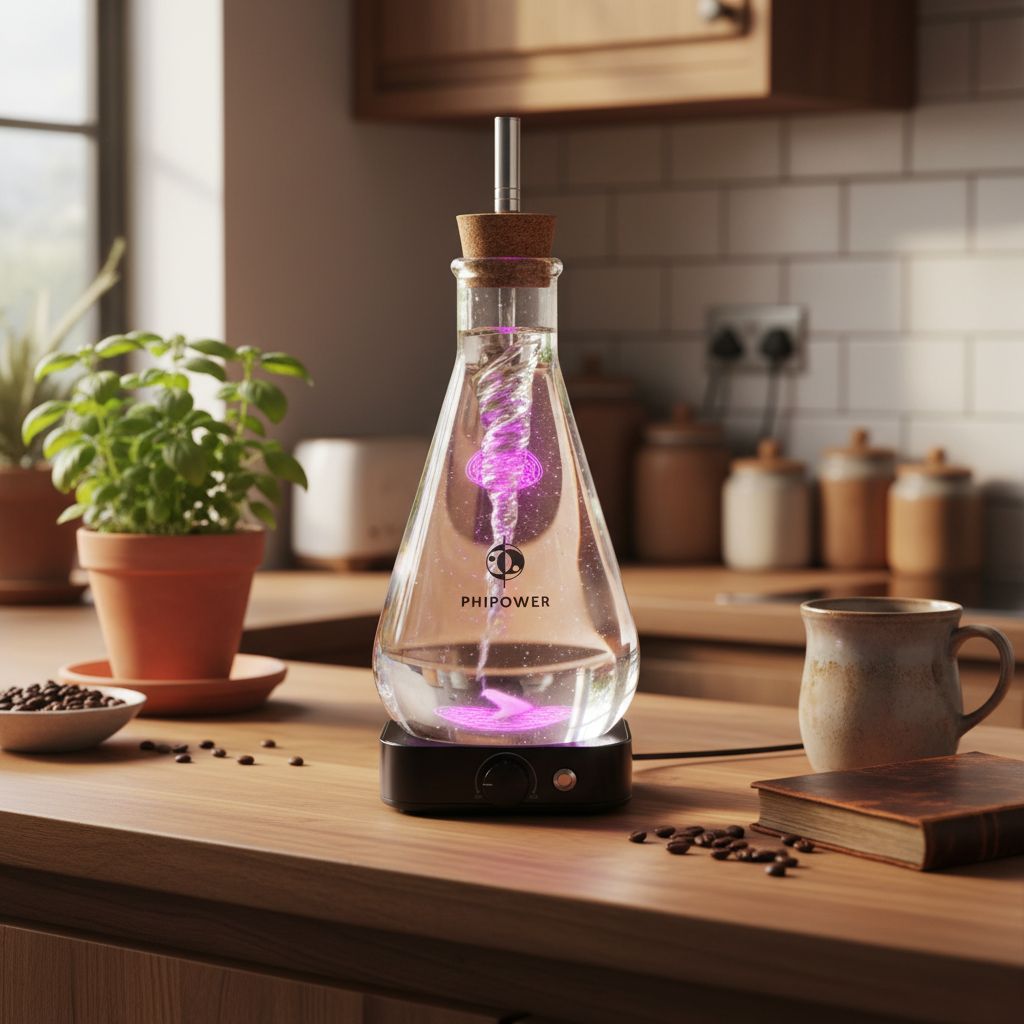
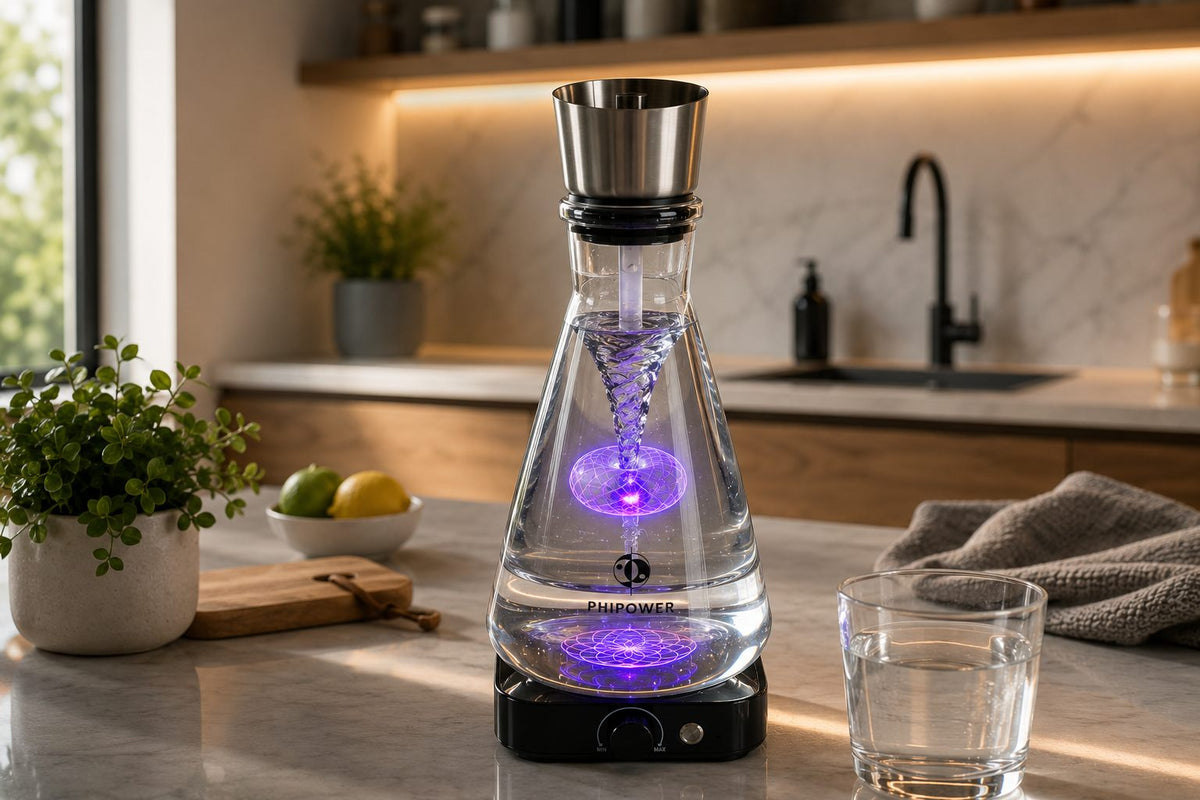
Phipower can safely describe the Water Vitalizer 2.0 by what it actually does:
- creates a visible adjustable vortex;
- uses a 2-litre borosilicate glass carafe;
- uses defined 405, 470, 660 and 850 nm light inputs;
- provides a repeatable water-preparation ritual;
- allows before/after physical measurements.
If future structural testing shows a reproducible molecular change, that result can be published with the method and raw data.
Hexagonal water: the evidence-based verdict
| Statement | Verdict |
|---|---|
| Ordinary ice Ih has hexagonal crystalline symmetry. | Yes |
| Liquid water has tetrahedral local organization. | Yes |
| Liquid water can contain transient ring motifs. | Yes |
| Six-membered rings are the only important liquid-water structure. | No |
| Bulk liquid water consists of permanent six-molecule clusters. | Not established |
| Vortexing permanently creates a hexagonal liquid phase. | Not established |
| Hexagonal water is clinically proven to hydrate better. | No robust evidence |
| Direct molecular measurement could test the hypothesis. | Yes |
Primary scientific sources & further reading
Imaging surface structure and premelting of ice Ih with atomic resolution — atomic-resolution work on the surface structure of ordinary hexagonal ice and its progressive disordering during premelting.
Ice Ic without stacking disorder — primary structural study distinguishing cubic ice from ordinary hexagonal ice Ih.
Liquid water contains the building blocks of diverse ice phases — advanced simulations showing that liquid water contains a diverse set of local ice-related structural motifs rather than one unique hexagonal liquid state.
Understanding water's anomalies with locally favoured structures — simulation study identifying locally favoured structures and five-membered hydrogen-bond rings in liquid water.
Instantaneous asymmetry in liquid water — shows how a near-tetrahedral average structure coexists with rapidly fluctuating asymmetric hydrogen-bond strengths.
Evidence of two distinct local structures of water — time-resolved optical study supporting heterogeneous local structural populations from ambient into supercooled conditions.
Frequently asked questions about hexagonal water
The bottom line
The word hexagonal belongs legitimately in water science — but mainly because ordinary ice Ih is a hexagonal crystal.
Liquid water is different.
It contains real short-range order, tetrahedral coordination, transient rings and local motifs related to multiple ice structures. Those structures fluctuate rather than forming one permanent molecular lattice.
"Liquid water contains transient ordered motifs" is good physical chemistry. "This bottle contains stable hexagonal clusters that hydrate cells better" is a product-specific claim that requires direct structural and clinical evidence.
For Phipower, this distinction makes the Structured Water pillar stronger rather than weaker: we can explain why water is scientifically remarkable without relying on a claim that has not been demonstrated.
Continue with Structured Water: The Complete Guide →, How Is Liquid Water Structured? → or EZ Water & H3O2 Explained →.
This article is educational and discusses the physical chemistry of liquid water and ice. Phipower water products are wellness and lifestyle products. Phipower does not claim that the Water Vitalizer 2.0 creates a stable hexagonal bulk-water phase or that a hypothetical hexagonal cluster structure diagnoses, prevents, treats or cures disease.