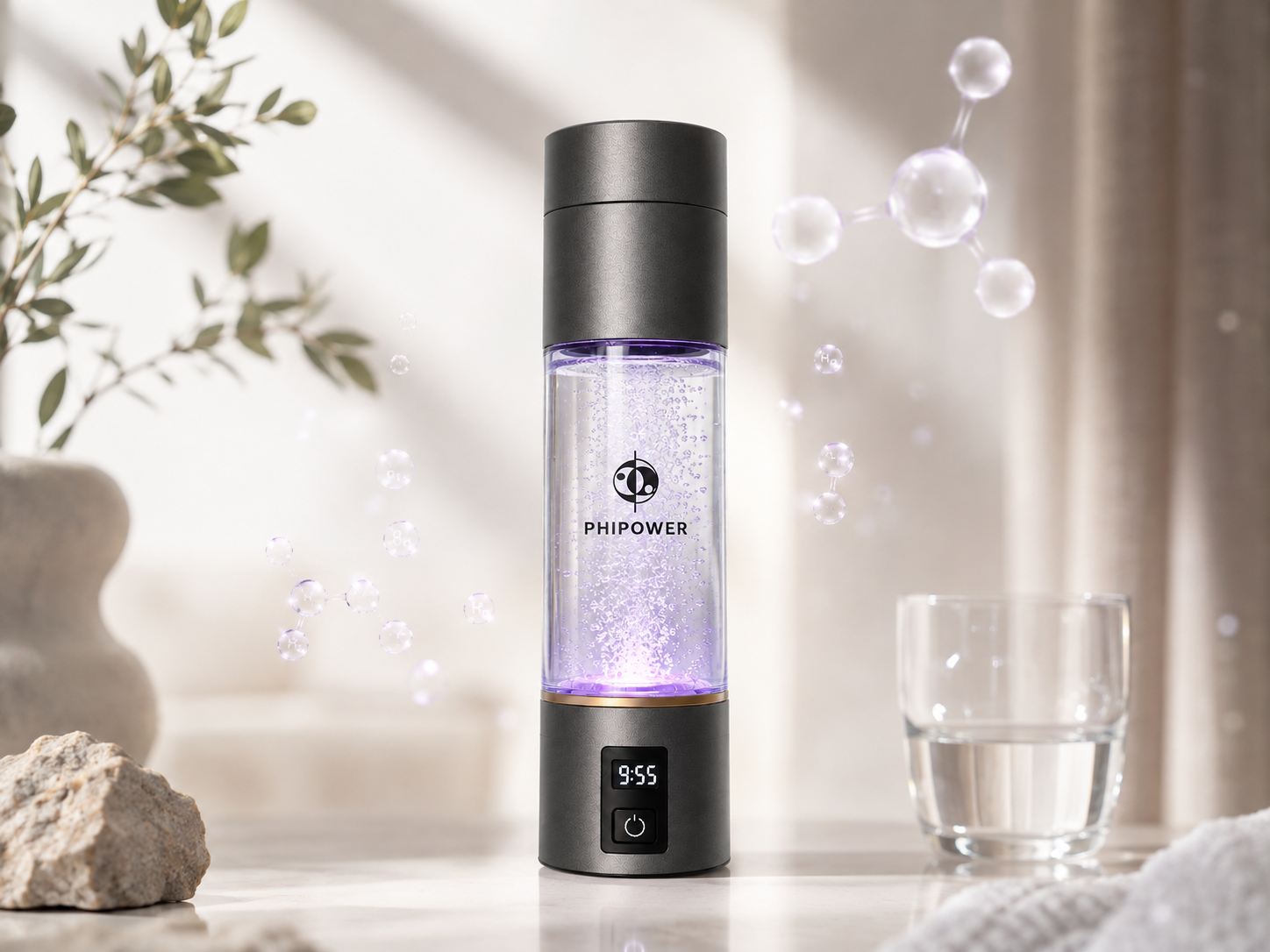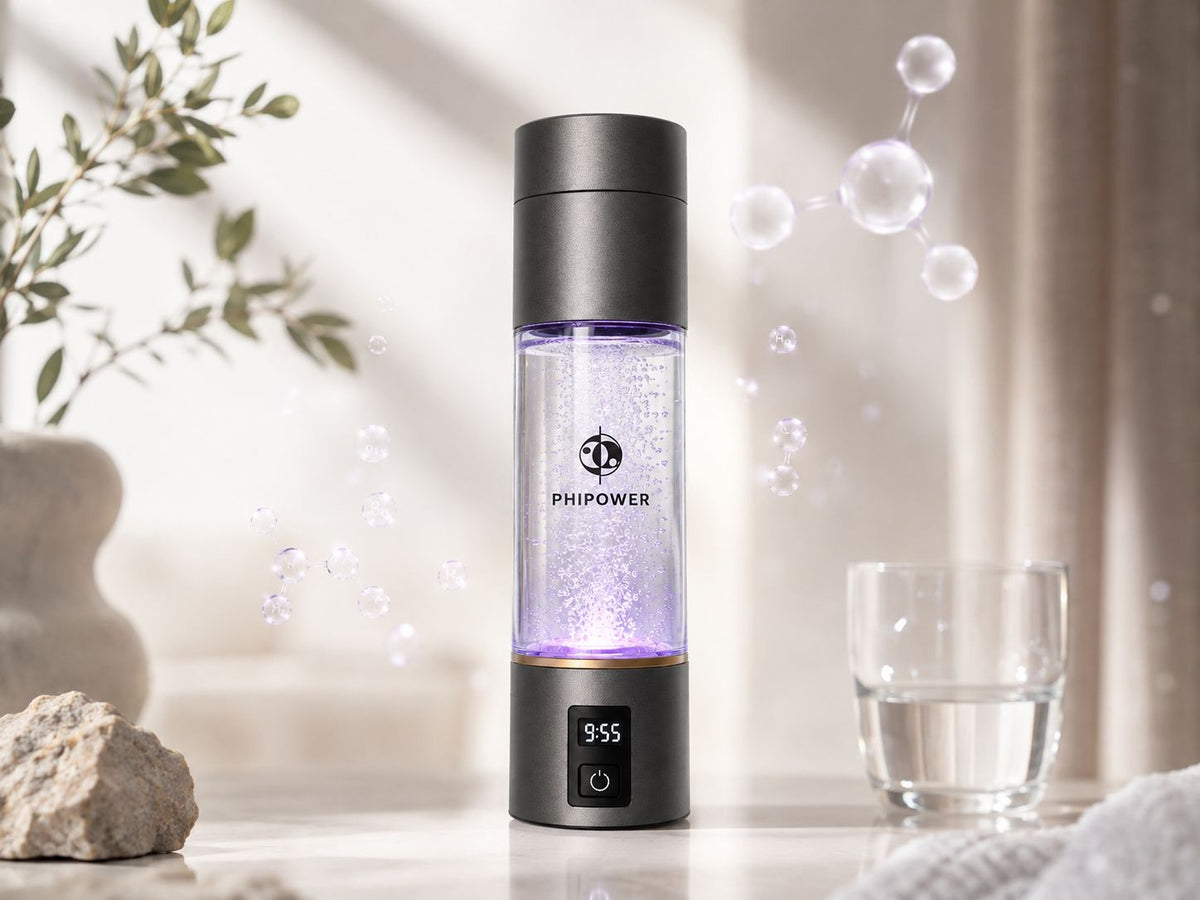
Drink molecular hydrogen dissolved in water — or inhale molecular hydrogen as a gas. Both methods are used in scientific research and both deliver the same molecule, H₂. But they differ dramatically in concentration, duration, convenience and the amount of hydrogen that can potentially be delivered.
If you are discovering molecular hydrogen for the first time, hydrogen-rich water is usually the easiest place to start. If you want longer sessions and a much higher continuous supply of H₂, inhalation is the more intensive option. And increasingly, you do not have to choose.
First: what is molecular hydrogen?
Molecular hydrogen is simply H₂: two hydrogen atoms bonded together. It is the smallest molecular gas, which matters because H₂ can diffuse rapidly through biological membranes and tissues. It is colourless, odourless and tasteless.
Do not confuse it with hydrogen peroxide, H₂O₂ — a reactive chemical compound. Hydrogen water means ordinary drinking water containing dissolved H₂ gas; hydrogen inhalation means breathing a controlled stream containing molecular hydrogen. Different delivery method, same molecule.
Why has H₂ attracted so much scientific interest?
Modern interest accelerated after researchers began investigating H₂ in oxidative-stress models. Since then molecular hydrogen has been studied in preclinical and human research involving oxidative balance, inflammatory signalling, metabolism, neurological conditions, cardiovascular health, exercise and recovery. A major review identified dozens of published human studies and more than 80 registered clinical trials.
Researchers stress that many studies remain small, protocols vary considerably, and molecular hydrogen has not become an established treatment for most of the conditions being investigated. There is a rapidly growing scientific field here — and an enormous amount of online exaggeration. We prefer the first.
How might it work?
You will often read that H₂ is simply “an antioxidant”. That is probably too simplistic. More recent research suggests a combination of redox signalling, inflammatory pathways, gene expression, mitochondrial function and cellular signalling rather than hydrogen neutralising every free radical it meets. The precise mechanisms remain an active area of investigation — which may help explain something unusual: very small amounts of H₂ have sometimes been associated with biological responses.
Method 1 · Drinking hydrogen-rich water
Hydrogen-rich water is ordinary water with molecular hydrogen gas dissolved into it. Nothing is added chemically. It still looks and tastes like water, and H₂ contains no sugar, flavouring or meaningful calories. A generator creates the hydrogen and dissolves it directly into the drinking water; the concentration is expressed in ppm or ppb — 1 ppm = 1,000 ppb, so 6 ppm = 6000 ppb.
Under normal atmospheric conditions hydrogen has limited solubility in water — around 1.6 mg/L at room temperature. Higher dissolved concentrations can temporarily be achieved using pressure or supersaturation, which is why high-concentration hydrogen water should be consumed soon after preparation.
H₂ does not stay in an open glass forever — it is extremely volatile and gradually escapes once exposed to the atmosphere. So the ritual is simple: generate → open → drink. Not generate in the morning and leave the glass on your desk until evening.
Once hydrogen-rich water reaches the digestive tract, dissolved H₂ can diffuse through tissues and enter circulation; some is subsequently detectable in the breath. Human research has shown it is absorbed and metabolised relatively rapidly. The greatest advantage is simply convenience — you do not sit connected to a machine, you just drink it.
Human trials have investigated oxidative stress, vascular function, quality of life, exercise and metabolic health. One randomized controlled trial in healthy adults used water containing 7 ppm H₂ and reported an improvement in a measure of peripheral endothelial function; another placebo-controlled trial with 1.5 litres per day found changes in antioxidant and immune-related measures but not significant improvements in every primary oxidative-stress parameter. A systematic review dedicated to hydrogen-rich water concluded the area is promising but that larger, more rigorous studies are still needed.
Method 2 · Inhaling molecular hydrogen
Instead of dissolving H₂ in water, you generate molecular hydrogen continuously and breathe it through a nasal cannula. Hydrogen reaches the lungs, diffuses across the alveolar interface and enters circulation — and because the generator keeps producing while you breathe, exposure can continue for the entire session.
Water provides a relatively short bolus. Inhalation provides continuous exposure. That capacity is one reason inhalation appears so frequently in clinical H₂ research: a broad review of human studies found inhalation to be the most represented route, followed by drinking hydrogen-enriched water. It also matters practically — you cannot keep increasing hydrogen-water intake without also drinking more fluid.
Drinking vs inhaling: the essential difference
In absolute capacity, a dedicated inhalation machine delivers vastly more H₂ gas than can be dissolved into a single bottle: up to 666 ml of H₂ per minute versus up to 6 ppm in a 270 ml drinking bottle. Those numbers cannot be compared as though they were absorbed doses — gas generated is not gas absorbed.
Not necessarily — and this is probably the most important conclusion here. With conventional nutrients we assume more dose = more effect. H₂ does not appear to be that simple: reviews have noted that drinking hydrogen-rich water can produce biological effects despite delivering far less total H₂ than gas inhalation. That proves neither route superior. It means the dose–response relationship is not yet understood well enough to reduce the decision to one number — so choose around how you intend to use hydrogen.
So which one should you choose?
Hydrogen Water Generator · up to 6000 ppb — €129
- fresh H₂ water in ~5 minutes
- PEM/SPE dual-chamber electrolysis
- portable and rechargeable, no cartridges
- inhalation cap and nasal cannula included
Best for first-time users, daily hydration, travel, and anyone who wants to try both routes without a large investment.
Discover the 6000 ppb generator →Hydrogen Inhalation Machine · 666 ml/min — €1,499
- 666 ml/min H₂ + 333 ml/min O₂, separate outlets
- 1.2-litre reservoir and digital timer
- TDS, temperature, low-water and tilt protection
- stainless bubble stick for hydrogen water too
Best for regular users, longer sessions, and wellness studios or recovery spaces.
Discover the inhalation machine →The distinction is not completely binary. The dedicated machine includes a stainless-steel bubble stick that lets hydrogen be bubbled through drinking water, so it covers both routes from the top down — while the compact generator approaches the same idea from the opposite direction, as a hydrogen water maker with an inhalation option included.
How long should an inhalation session last?
There is no universally established optimal wellness dose. Published studies have used widely varying concentrations and session durations, and reviews repeatedly identify inconsistent dosing and delivery systems as limitations in the field. For home use the sensible approach is conservative: start with short sessions and follow the instructions supplied with the device rather than assuming longer is automatically better.
That matters because a 2026 randomized crossover study in healthy women found a small reduction in average oxygen saturation during a 60-minute inhalation condition — the authors did not consider the difference clinically significant, but it is a reminder that newer controlled evidence should keep shaping how this technology is used.
A session itself asks nothing of you: connect the cannula according to the manual, sit comfortably and breathe normally. Read, meditate, work at your desk, listen to music or simply rest. That is why inhalation fits so naturally into an existing recovery or evening routine.
Is inhaling hydrogen safe?
Molecular hydrogen itself is non-toxic and clinical research to date has generally reported favourable tolerability. But there is an important difference between toxicity and flammability: hydrogen is combustible, with a flammability range in air of roughly 4.1–74% by volume.
So operate hydrogen equipment exactly as intended — in a well-ventilated room, well away from smoking, naked flames, candles, sparks or other ignition sources. Do not modify tubing or combine gas outlets yourself. More hydrogen is never worth compromising basic gas safety.
Does the oxygen outlet mean I inhale a mixture?
Not necessarily. Electrolysis naturally produces hydrogen and oxygen in roughly a two-to-one molecular ratio, so the dedicated machine produces 666 ml/min H₂ and 333 ml/min O₂ — but they leave through separate labelled outlets. For the standard H₂ ritual, use the designated hydrogen output and breathe normal room air alongside it. Never create your own combined gas configuration.
Tablets, alkaline water, ORP and ppb
Tablets. Dissolving tablets, often magnesium-based, are convenient when travelling. But a generator needs no consumables, lets you control when the water is made, and produces H₂ fresh immediately before drinking. The Phipower 6000 ppb generator uses rechargeable PEM/SPE technology rather than single-use tablets.
Alkaline water. Hydrogen concentration and pH are separate measurements — water does not need a high pH to contain molecular hydrogen. A hydrogen generator is designed to increase dissolved H₂; an alkaline ionizer is associated with pH and mineral-ion changes. Do not judge hydrogen products primarily by pH.
ORP. Oxidation-reduction potential may change when dissolved hydrogen is present, but it is not a reliable substitute for measuring H₂ directly. Two waters with similar ORP do not necessarily contain the same H₂ concentration — which is why we communicate concentration in ppb/ppm, not a dramatic negative ORP number.
Is 6000 ppb better than 1500 ppb? More H₂ is present in the same volume of freshly prepared water — that part is straightforward. What is not established is that four times the dissolved H₂ gives four times the biological effect. A higher-capacity device is better described as offering more H₂ available per serving, not guaranteed greater health effects.
Frequently asked questions
One molecule. Choose your ritual.
What makes molecular hydrogen unusual is not just the molecule — it is the flexibility of how you can use it. Prepare a bottle in the morning and drink it fresh. Carry a compact generator while travelling. Connect a cannula for a short session. Or sit beside a dedicated high-output generator and make H₂ part of your daily recovery routine.
Drink it when convenience matters most. Inhale it when continuous exposure becomes the priority.
Research does not currently justify saying that molecular hydrogen cures disease, reverses ageing or guarantees improved recovery. There are promising clinical findings, plausible mechanisms and numerous trials underway — alongside small samples and heterogeneous protocols. That is not a weakness of H₂; it is simply where the science stands, and it is exactly why the field is interesting.
Phipower molecular-hydrogen products are consumer wellness devices. They are not intended to diagnose, prevent, monitor, treat, alleviate or cure disease and do not replace professional medical care, medication or oxygen therapy. Molecular-hydrogen research is ongoing and reported study outcomes should not be interpreted as guaranteed results from a consumer device.