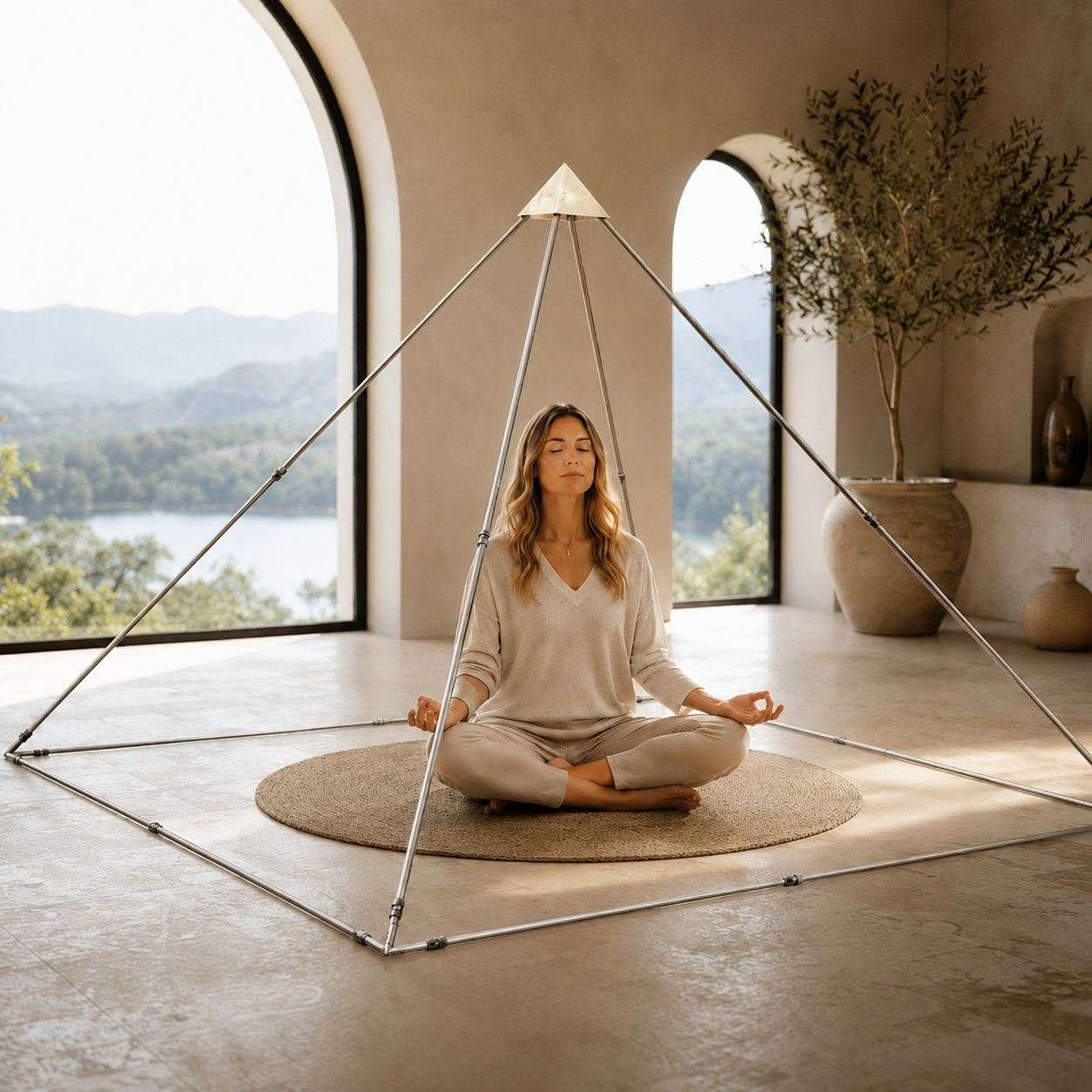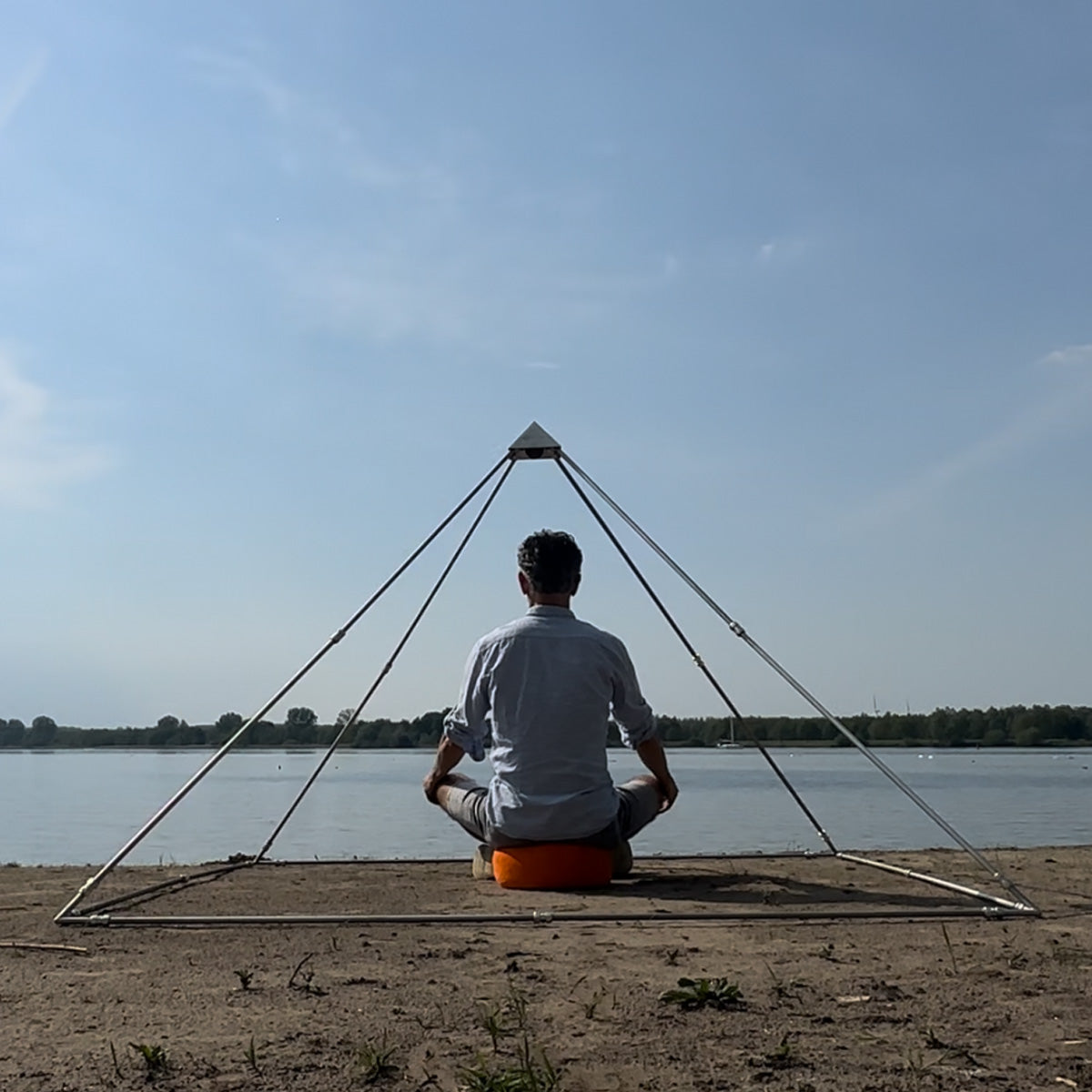
Can a meditation pyramid help you relax, focus more deeply or experience meditation differently? Possibly — but not every claimed benefit has the same evidence behind it. The clearest benefits come from meditation itself and from creating a dedicated contemplative environment. Claims of a unique healing or cosmic "pyramid energy" remain unproven.
What are the benefits of a meditation pyramid?
The answer depends on what kind of "benefit" you mean.
The most responsible Phipower position is therefore: enjoy the geometry and the experience, but keep meditation evidence separate from pyramid-energy claims.
1. The strongest benefits come from meditation itself
Meditation is not one single technique, but modern research has studied focused attention, mindfulness, mantra, open monitoring and related practices in many contexts.
A 2024 systematic review of 29 randomized trials in university students found that mindfulness-based stress reduction was associated with small-to-moderate improvements in perceived stress, anxiety and depression compared with controls.
A broad 2026 functional-neuroimaging meta-analysis across 34 primary studies and 700 individuals also found reproducible neural correlates across several meditation practices, while showing that different meditation styles engage partly different neural patterns.
Putting meditation inside a pyramid does not erase the established mechanisms of meditation. The breath, attention, posture, repetition and self-regulation still do the core work.
2. Stress reduction: supported for meditation, not yet for the pyramid
Stress reduction is one of the most commonly claimed meditation-pyramid benefits.
There is a reasonable evidence base for mindfulness-based practices reducing perceived stress in some groups. However, that does not tell us whether a pyramid adds anything beyond the meditation itself.
| Question | Current evidence |
|---|---|
| Can meditation reduce perceived stress? | Supported in multiple trials/reviews |
| Can a dedicated meditation environment help someone settle? | Plausible / experience-dependent |
| Does pyramid geometry reduce cortisol or stress beyond meditation? | Not established in robust human trials |
| Does "pyramid energy" neutralize stress? | Not established |
3. Focus and attention
Focused-attention meditation trains a simple skill: notice where attention has gone and return it to a chosen object such as the breath.
Neuroimaging and EEG research shows that focused-attention meditation is associated with changes in networks involved in attention, salience, self-referential processing and internal monitoring.
A 2026 high-density EEG study of experienced breath meditators found robust changes in EEG microstate dynamics during meditation compared with baseline rest and mental imagery.
The recordings were collected at Pyramid Valley International — but the experiment did not compare pyramid versus non-pyramid geometry. So it supports the meditation effect, not a pyramid-specific effect.
4. A dedicated environment may make meditation easier to start
A physical meditation pyramid can function as an environmental cue.
You assemble it, enter it and sit in a place that has one clear purpose. This can reduce the ambiguity of "I should meditate sometime" and turn it into a recognizable ritual.
Clear boundary
The frame separates meditation time from the rest of the room.
Visual symmetry
Four converging sides and one apex create a strong sense of structure.
Behavioural cue
Seeing the pyramid can remind you to practice.
Personal meaning
Symbolism can make a routine feel more significant and intentional.
These are plausible design and behavioural benefits. They should not be confused with claims about invisible energy fields.
5. Ritual can be a benefit in its own right
Ritual is sometimes dismissed because it is not a biochemical mechanism. That is too simplistic.
A ritual can organize behaviour, attention and expectation. If entering the pyramid helps you transition from daily activity into contemplative practice, that can be valuable regardless of whether the structure changes the electromagnetic environment.
Experience does not need an exaggerated explanation to be meaningful.
A person can genuinely feel calmer, more focused or more "inside" a practice when using a dedicated geometric space. The experience is real; the scientific question is what caused it.
6. Geometry may change the subjective experience of space
A pyramid is visually different from a square room or an open corner.
Its edges converge toward the apex, producing a strong upward orientation. Sitting near the center can create an unusually symmetrical relationship between body and structure.
This may influence where you direct your gaze, how enclosed the space feels, how strongly you perceive the center, how memorable the ritual becomes and how easily you associate the structure with meditation.
These are reasonable experiential hypotheses. Controlled comparison studies would be needed to quantify them.
7. Calm, relaxation and a sense of stillness
Many meditators describe calm or stillness during practice.
Focused breathing, reduced external stimulation, a stable posture and deliberate attention can all contribute to that experience.
The pyramid may help some users because it makes the setting feel more intentional, but calm should not automatically be attributed to a special pyramid field.
8. Warmth, tingling and other reported sensations
Legacy pyramid literature often treats bodily sensations as evidence of "energy." That interpretation is much stronger than the observation itself.
During meditation, heightened interoception can make ordinary signals more noticeable: skin temperature, pulse, pressure from posture, muscle release, tingling and subtle breathing movements.
If tingling occurs under the pyramid, the scientifically useful next question is whether it occurs more often than during the same meditation without the pyramid.
9. Does a meditation pyramid change brain waves?
Meditation can change EEG activity. That part is well established enough to study seriously.
What is not established is that the pyramid shape itself uniquely drives alpha, theta, gamma or microstate changes.
The 2026 Pyramid Valley study showed that focused-attention meditation reorganized EEG microstate dynamics in experienced practitioners. But because there was no geometry-control condition, it cannot tell us whether the pyramid environment added anything.
"Meditation changes measurable brain dynamics."
Not yet justified: "Pyramid geometry produces special brain-wave frequencies."
10. Does "pyramid energy" provide additional benefits?
Claims about pyramid energy commonly include amplifying cosmic energy, strengthening or harmonizing the Earth's magnetic field, balancing chakras, raising vibration, accelerating healing, preserving food or water, and increasing psychic sensitivity.
These claims are culturally interesting and meaningful to some spiritual practitioners, but they are not established enough to be presented as product facts.
11. What about the Earth's magnetic field?
Some pyramid traditions recommend aligning a side to magnetic north and propose that the structure interacts with the geomagnetic field.
Orientation can be used as a ritual convention. However, a lightweight meditation frame has not been shown in robust human research to strengthen the Earth's magnetic field or to produce health effects by doing so.
For Phipower, alignment should therefore remain an optional practice, not a therapeutic mechanism.
12. Does an orgonite or amethyst sphere add benefits?
The Phipower design includes an amethyst orgonite sphere as a symbolic accessory in the referenced configuration.
Amethyst, copper spirals and orgonite are widely used in contemporary spiritual and energy practices. Claims that these components generate measurable orgone or therapeutic life energy are not established by conventional science.
Use the sphere as an aesthetic, symbolic and ritual component. Do not claim it medically amplifies the pyramid.
13. Spiritual meaning can still be a real benefit
Not every valuable human experience is a medical endpoint.
For people who connect with sacred geometry, the pyramid may support contemplation, personal intention, spiritual reflection, prayer and a sense of symbolism or ceremony.
These benefits are best described in first-person or experiential language rather than disguised as scientific measurement.
14. What role does expectation play?
Expectation can influence subjective experience, attention and interpretation.
If someone believes a pyramid is a powerful contemplative symbol, entering it may immediately change how seriously they approach the session.
That does not mean the experience is "fake." It means that a good study needs to separate:
15. Can a meditation pyramid treat anxiety, pain or disease?
The Phipower Meditation Pyramid should not be positioned as a medical treatment.
Meditation-based interventions are used in health research and clinical programs, and some evidence supports improvements in anxiety, stress or depressive symptoms in particular populations. But that does not establish the pyramid structure as a treatment for those conditions.
| Statement | Phipower position |
|---|---|
| "Meditation may support stress management." | Reasonable with context |
| "Some users feel calmer under the pyramid." | Acceptable as subjective experience |
| "The pyramid treats anxiety." | Do not claim |
| "Pyramid energy accelerates healing." | Do not claim |
| "The pyramid strengthens immunity." | Do not claim |
16. Meditation benefits should be discussed together with safety
Meditation is often low risk, but it is not universally pleasant.
A systematic review of meditation-related adverse events found reports including anxiety, depression and cognitive or perceptual disturbances across a heterogeneous set of studies. Intensive practice, personal history and context can matter.
Begin with short, comfortable sessions and treat unusual sensations with curiosity rather than alarm.
Stop or shorten the session. People with significant psychiatric symptoms should seek appropriate professional guidance rather than using meditation as a substitute for care.
17. Evidence map: which pyramid benefits are strongest?
| Proposed benefit | Evidence level | Why |
|---|---|---|
| Dedicated meditation space | Strong practical case | Direct design function of the product. |
| Supports a meditation routine | Plausible | Environmental cueing and ritual may support adherence; Phipower-specific data would improve confidence. |
| Relaxation / stress regulation | Meditation-supported | Supported for meditation in multiple populations, but not isolated to pyramid geometry. |
| Attention / focused awareness | Meditation-supported | Focused-attention meditation has measurable neural correlates. |
| Deeper meditation specifically because of pyramid shape | Subjectively plausible | Needs a direct geometry-controlled trial. |
| Unique electromagnetic or cosmic-energy amplification | Unproven | No robust causal human evidence. |
| Healing or disease treatment | Unsupported claim | Would require medical evidence that does not currently exist. |
18. How to get the most practical benefit from a meditation pyramid
- Use it regularly. The pyramid is more useful as a repeated cue than as a one-off novelty.
- Keep the meditation simple. Breath awareness or a mantra is enough.
- Prioritize comfort. Do not force posture for the sake of geometry.
- Start with 10–20 minutes. Build duration only if the practice remains useful.
- Record your experience. Note focus, calm, distraction and willingness to return.
- Compare occasionally. Practice the same meditation without the pyramid and notice whether there is a consistent difference.
For a first session, read What Is Pyramid Meditation? A Beginner's Guide.
19. A simple personal experiment: pyramid vs no pyramid
You can test the subjective value for yourself without pretending the result is a clinical trial.
After each session, score 0–10 for ease of settling, focus, calm, mind-wandering, physical comfort and desire to repeat the practice.
This does not prove an energy mechanism, but it can tell you whether the structure adds value to your meditation routine.
20. How Phipower could test pyramid-specific benefits properly
Because the Meditation Pyramid is a Phipower product, first-party research can be much stronger than generic marketing claims.
Useful outcomes could include subjective calm and focus, meditation adherence, heart-rate variability, respiration rate, EEG in collaboration with qualified researchers, and environmental electromagnetic measurements if a specific field claim is being tested.
measure first, claim second. And publish null findings too.
The Phipower Meditation Pyramid
The Phipower Meditation Pyramid is designed to create a repeatable geometric meditation environment inspired by Great Pyramid / Cheops proportions.
Scientific sources & evidence context
Systematic review of 29 randomized trials in university students; reported reductions in perceived stress, anxiety and depression. Supports meditation-related benefits, not pyramid-specific effects.
Meta-analysis of 34 primary studies and 700 individuals across focused attention, open monitoring, mantra and loving-kindness meditation.
High-density EEG study of experienced breath meditators recorded at Pyramid Valley International. Demonstrates meditation-related microstate changes but does not isolate pyramid geometry.
Found consistent involvement of default-mode, salience and executive-control networks in focused-attention meditation.
Systematic review providing a balanced safety context: meditation can occasionally be associated with distressing experiences.
Frequently asked questions about meditation pyramid benefits
The bottom line
The best case for a meditation pyramid is stronger when we do not exaggerate it.
Meditation itself can support psychological well-being and attention in some populations. A pyramid creates a distinctive, intentional environment that some people may find helpful for focus, ritual and consistency.
That pyramid geometry creates a proven healing field, amplifies cosmic energy, strengthens the Earth's magnetic field or treats disease.
That leaves a compelling Phipower proposition: a beautifully defined contemplative space, inspired by pyramid geometry, combined with transparent evidence and a willingness to test what users actually experience.
The Phipower Meditation Pyramid is a wellness and meditation product, not a medical device. This article is educational and does not claim that pyramid geometry diagnoses, prevents, treats or cures disease. Meditation research is not evidence of a pyramid-specific therapeutic effect.