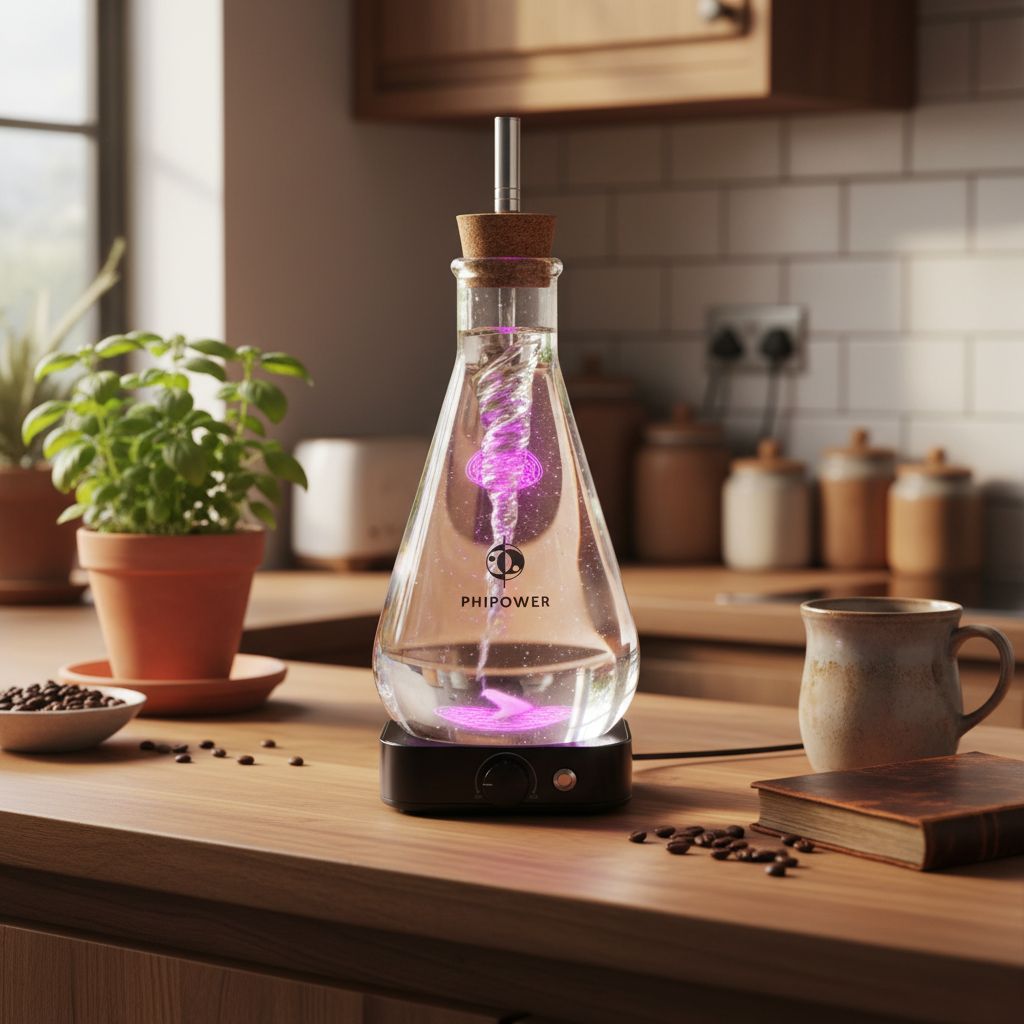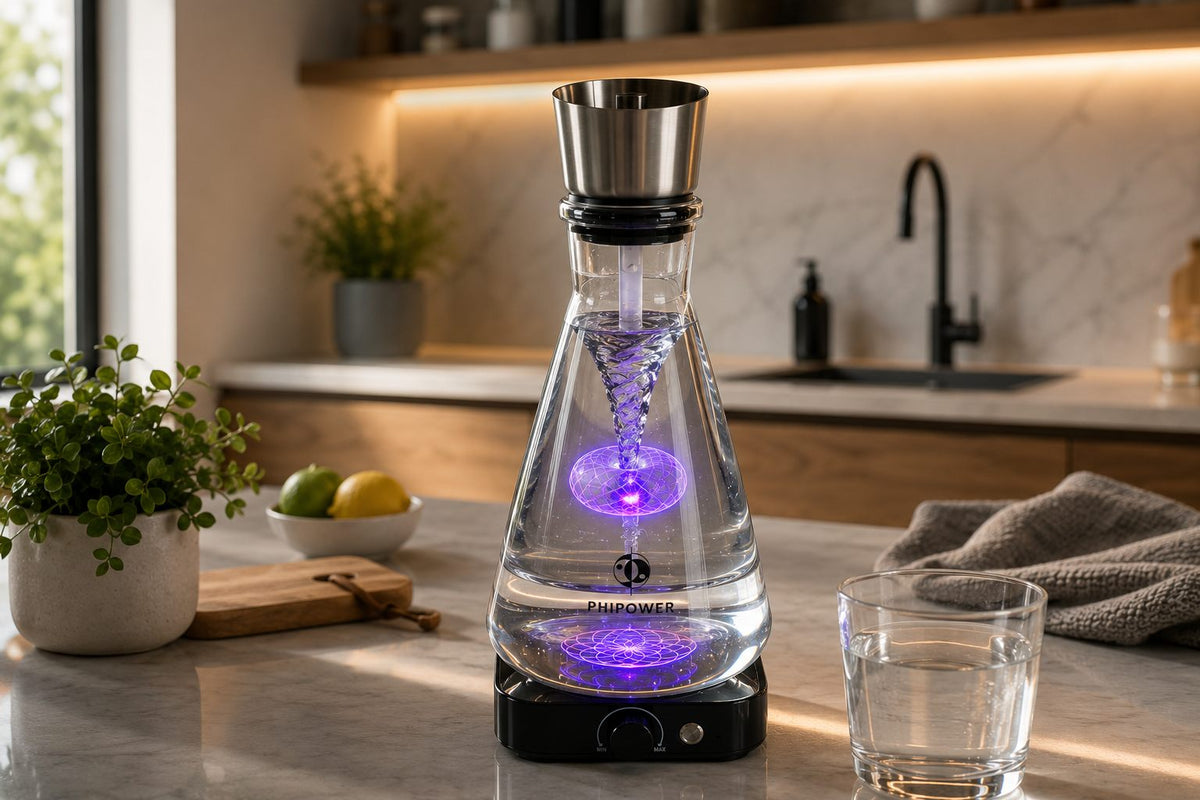
Vortex water is a preparation method — not a separate chemical substance.
When water rotates around an axis, angular momentum creates a swirling flow. The process can improve mixing and, depending on design, influence gas transfer and bubble size. Industrial swirl-flow devices deliberately use these effects to generate microbubbles and enhance gas–liquid mass transfer.
What is vortex water?
Vortex water is water made to rotate in a spiral or swirling pattern around a central axis. You can create one by stirring water in a glass, mechanically with a magnetic stirrer, or in an engineered swirl chamber.
The visible funnel is only one part of the flow. Beneath the surface, water moves in a three-dimensional pattern involving rotation, vertical circulation and shear.
How does a water vortex work?
A vortex begins when water receives angular momentum. In an open vessel the rotating liquid develops a pressure gradient and the free surface can dip toward the centre.
These are conventional fluid-dynamic effects. Swirling flows are used in engineering precisely because they can intensify mixing and gas–liquid contact.
What vortexing definitely changes

| Property | What happens during vortexing |
|---|---|
| Velocity | Strong rotational motion and velocity gradients |
| Mixing | Enhanced transport through the vessel |
| Pressure | Spatial pressure differences develop |
| Air–water interface | The interface can be renewed continuously |
| Gas entrainment | Air can be drawn into the liquid in some designs |
| Bubbles | Shear can reduce bubble size in engineered systems |
Can vortexing create microbubbles?
Yes. Swirl-flow microbubble generators are established engineering systems. Experimental studies show that liquid flow, gas flow and geometry influence bubble size and mass-transfer performance.
A 2022 study in the Journal of Water Process Engineering reported that a swirl-flow microbubble generator produced smaller and more uniform bubbles than an orifice-type generator, while higher liquid flow increased oxygen mass transfer.
An industrial microbubble generator is not automatically equivalent to a countertop vortex carafe. The mechanism is relevant; the actual bubble size and concentration must be measured in the specific device.
The 2024 vortex–swirl study: a useful bridge
English and Kamp studied water before and after treatment in one vortex–swirl system. They reported a large population of smaller microbubbles around approximately 1 μm, temporarily elevated dissolved oxygen, a small pH shift and relaxation of the effects over several hours.
A vortex can leave a measurable after-effect after the visible rotation stops without requiring a claim that H₂O molecules have been permanently locked into a new phase.
Does vortex water contain nanobubbles?
Sometimes it might, but the word nanobubble should only be used after measurement. ISO maintains dedicated terminology and standards for fine and ultrafine bubbles. A visible vortex is not proof of a stable sub-micrometre bubble population.
Read Nanobubbles in Water: The Science Behind Vortex-Generated Fine Bubbles →
Can vortexing increase dissolved oxygen?
Potentially, yes. If the vortex renews the air–water interface or entrains air, oxygen transfer can increase. The outcome depends on starting oxygen saturation, temperature, air contact, flow geometry, duration and bubble size.
Does vortexing permanently restructure water molecules?
Water already has a connected hydrogen-bond network, and that network is highly dynamic. Ultrafast experiments have measured hydrogen-bond structural responses on femtosecond timescales followed by thermalization on the picosecond scale.
A claim that vortexing locks bulk water into one unique geometry for hours requires direct structural evidence. Flow itself does not prove this.
Vortexing is not the same as hydrodynamic cavitation
A vortex is rotating flow. Cavitation occurs when local pressure falls low enough for vapour cavities to form and collapse. Strong engineered vortices can contribute to cavitation, but an ordinary visible vortex in a carafe should not automatically be described as hydrodynamic cavitation.
Vortex water vs structured water vs vitalized water
| Term | Best definition |
|---|---|
| Vortex water | Water prepared by rotational or swirling flow |
| Structured water | Broader discussion of molecular, interfacial or mesoscale organization |
| Vitalized water | Phipower's practical wellness category using vortexing and other defined inputs |
| Nanobubble water | Water containing a measured ultrafine-bubble population |
That makes Vitalized Water the practical subpillar under the broader Structured Water pillar.
Can vortex water taste different?
It can plausibly taste or feel different because dissolved gases, fine bubbles, temperature and recent mixing can influence sensory properties. The best way to verify this is with blinded coded samples.
A useful Phipower experiment would compare untreated water with 5-, 15- and 30-minute vortex samples.
Does vortex water hydrate better?
There is no robust human clinical evidence showing that vortexed water consistently hydrates healthy people better than ordinary safe drinking water because of a special molecular structure.
The demonstrated physics — flow, gas transfer and bubble formation in suitable systems — should be kept separate from health claims requiring clinical testing.
Clockwise or counter-clockwise?
From a fluid-dynamics perspective, both directions create valid vortices. The direction changes the sign of rotation, not the basic physics. Claims that one direction uniquely energizes water are not established by conventional water science.
How long should water be vortexed?
Establish the vortex
Enough to create stable rotation and mixing.
Phipower routine
A practical standardized preparation time for repeatability.
Compare durations
Testing 5, 15 and 30 minutes can reveal whether measurable effects scale with time.
The dedicated article How Long Should You Vortex Water? examines this question in depth.
How to create vortex water at home
- Use safe drinking water in a clean container.
- Create a stable rotating flow without excessive splashing.
- Keep volume, speed and time consistent if you want repeatable results.
- If testing an effect, compare with untreated water under the same conditions.
The next article in this subcluster will be How to Vitalize Water at Home.

How the Phipower Water Vitalizer 2.0 creates vortex water
The Water Vitalizer 2.0 combines a 2-litre borosilicate glass carafe with adjustable magnetic stirring of approximately 500–3000 rpm. It also uses defined 405, 470, 660 and 850 nm LED inputs and a Golden Triangle crystal chamber as a symbolic/ritual element.
The strongest scientific positioning is simple: describe exactly what the product does, then measure what changes.
What Phipower should measure next
Because the Water Vitalizer 2.0 is an own Phipower product, it can generate original research. Compare untreated water with 5-, 15- and 30-minute vortexing and measure dissolved oxygen, temperature, pH, conductivity, bubble-size distribution, time decay at 1/6/24 hours and blinded taste differences.
First-party measurements are more defensible and differentiating than repeating generic claims about “vortex energy.”
Vortex water claims: what is established?
| Claim | Verdict |
|---|---|
| A vortex is real fluid dynamics. | Yes |
| Vortexing increases mixing. | Yes |
| Swirl-flow systems can generate microbubbles. | Yes |
| Swirl-flow can enhance gas–liquid mass transfer. | Yes |
| Every vortex creates nanobubbles. | Not established |
| Vortexing permanently creates hexagonal bulk water. | Not established |
| Vortex water hydrates humans better. | Not established clinically |
Scientific sources & further reading
Time-resolved study reporting approximately 1 μm bubbles, dissolved-oxygen changes and relaxation over hours in one vortex–swirl system.
Experimental study of bubble size and oxygen mass transfer in a swirl-flow microbubble generator.
Experimental and numerical study of bubble dynamics and flow geometry.
Frequently asked questions about vortex water
The bottom line
Vortex water does not require a mysterious explanation. The vortex itself is a real physical process that changes how water moves, mixes and interacts with gases.
Vortexing is real fluid dynamics. Persistent effects such as dissolved gases and bubble populations are measurable. Permanent molecular restructuring and superior health effects should be treated as separate hypotheses requiring direct evidence.
Vortex water therefore works perfectly as the practical entry point into the Vitalized Water subpillar, while deeper molecular questions remain with the Structured Water pillar.
This article is educational. Phipower water products are wellness and lifestyle products and are not intended to diagnose, prevent, treat or cure disease.