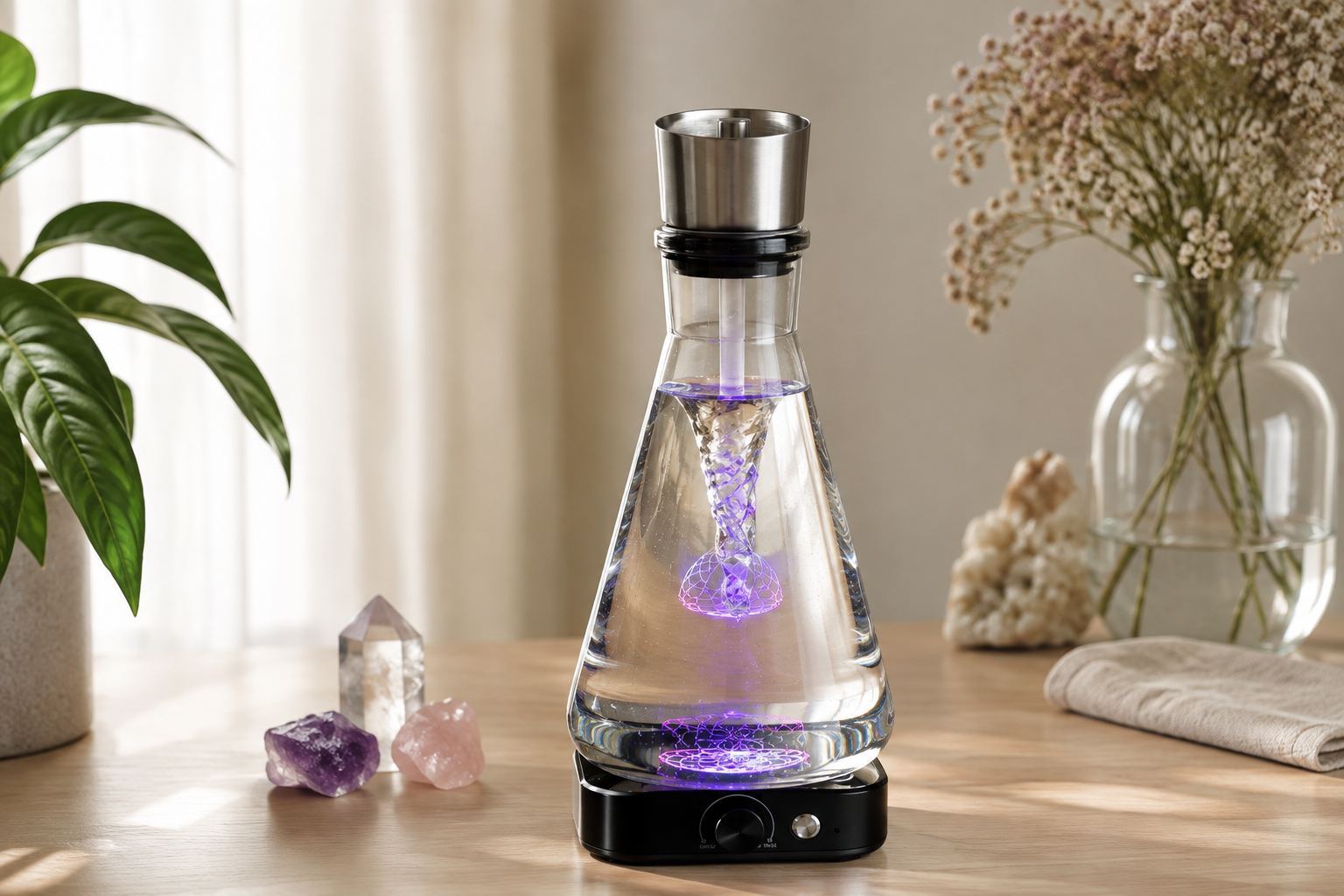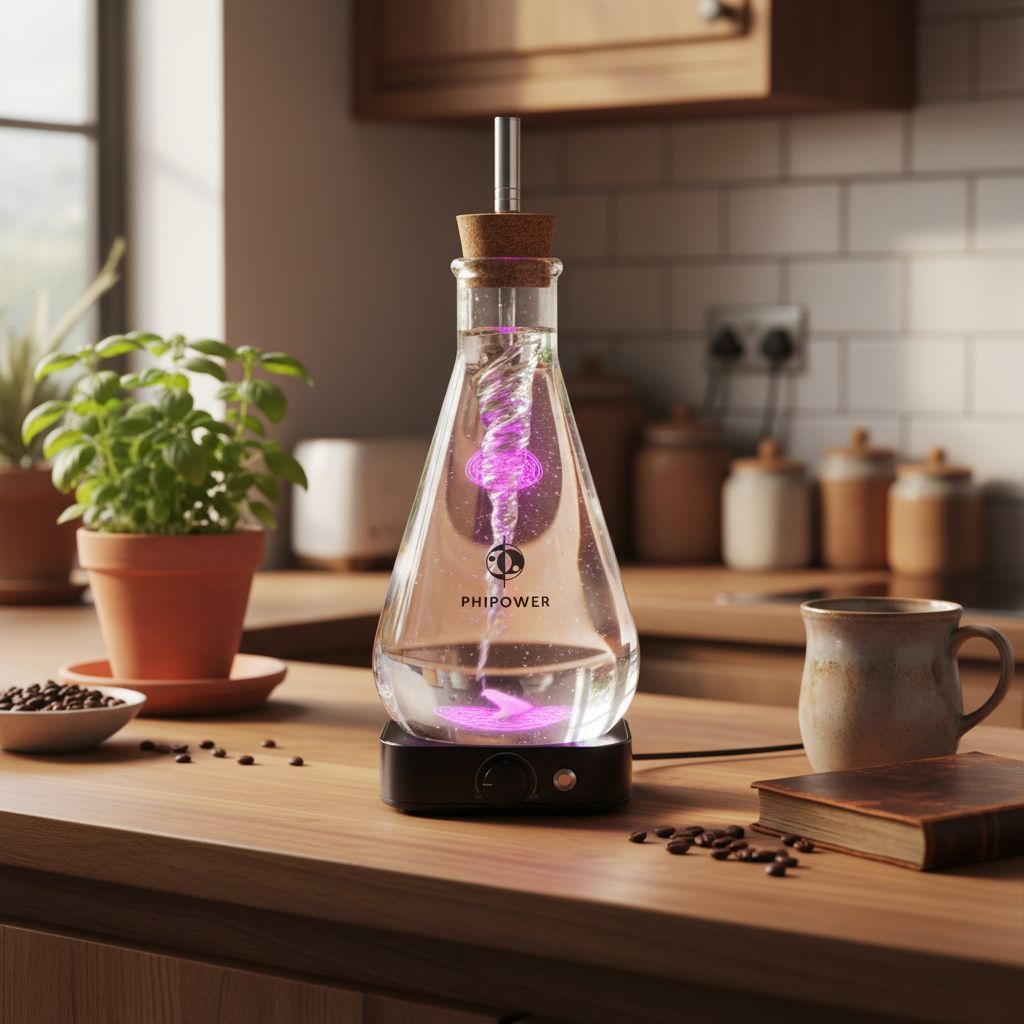
Use approximately 15 minutes as your standard home routine.
Why 15 minutes? Because it is a practical middle ground: comfortably longer than the time needed to establish strong rotational mixing, yet short enough for daily use. It also creates a standardized treatment window for future testing. We do not claim that minute 15 represents a proven molecular transformation.
The practical answer: 15 minutes
For daily use with the Phipower Water Vitalizer 2.0, we recommend approximately 15 minutes of vortexing.
This recommendation is about consistency and convenience. It is not based on a claim that water suddenly becomes “vitalized” at exactly 15:00 minutes.
What measurable property changes between 0, 5, 15 and 30 minutes — and how long does that difference remain after vortexing stops?
5 vs 15 vs 30 minutes
minutes
A useful minimum comparison point. The vortex and active mixing are already established, but cumulative gas-transfer or bubble effects may still be evolving.
minutes
The Phipower standard: practical, repeatable and useful as a central reference point for future testing.
minutes
Useful for finding out whether longer treatment adds anything or simply reaches a plateau.
Why treatment time can matter
Vortexing is a continuous physical process. While it runs, several variables may evolve:
- mixing and homogenisation;
- renewal of the air–water interface;
- gas exchange;
- bubble formation and breakup;
- temperature;
- equilibration with the surrounding atmosphere.
Some effects can build with time, while others approach a steady state. That is why longer cannot automatically be translated into better.
What the 2024 vortex–swirl study tells us about timing
A 2024 study by English and Kamp examined water before and after processing in a specific vortex–swirl system. The researchers reported a substantial fine-bubble population together with transient changes in water properties including dissolved oxygen and pH.
Importantly, the study followed the water after processing and described relaxation over time rather than a permanently altered liquid.
Do not stop measuring when the vortex stops. Measure the decay curve afterwards.

What happens in the first 5 minutes?
The main fluid-dynamic transition occurs quickly: still water becomes rotating water. Once a stable vortex is present you already have strong flow, velocity gradients, mixing and a continuously renewed surface.
Depending on geometry and speed, the vortex may also entrain air and create smaller bubbles.
So five minutes is not “too short” to make vortex water in the literal physical sense. Read What Is Vortex Water? →
Why 15 minutes is the Phipower standard
There are four practical reasons:
- Repeatability: users can reproduce the same preparation every day.
- Convenience: it fits easily into a home routine.
- Experimental value: it is a useful midpoint between 5 and 30 minutes.
- Honest positioning: it gives a clear protocol without inventing an unmeasured activation threshold.
That is stronger than claiming an exact “activation time” without direct evidence.
Is 30 minutes better than 15 minutes?
Possibly for some parameters, but not automatically. If gas exchange, bubble concentration or another physical variable approaches equilibrium, the extra 15 minutes may add little.
Longer stirring can also change temperature slightly, creating a new variable.
The useful experiment is whether a 30-minute sample differs meaningfully from a 15-minute sample after controlling for temperature and water source.
Why molecular structure does not give us a 15-minute rule
Liquid water is already highly structured through a dynamic hydrogen-bond network. But local arrangements continually reorganize.
Ultrafast structural research has directly observed hydrogen-bond responses on femtosecond-to-picosecond timescales. That makes a simple model in which a specific molecular cluster becomes permanently “locked” after exactly 15 minutes physically unsupported without direct structural measurements.
Bubble effects can operate on much longer timescales
Fine bubbles are a more plausible mechanism for post-vortex persistence than one fixed hydrogen-bond cluster. Fine- and ultrafine-bubble technology is a recognized engineering field with standardized terminology.
| Phenomenon | Relevant timescale |
|---|---|
| Visible rotational vortex | Stops within seconds after stirring ends |
| Individual hydrogen-bond arrangement | Ultrafast molecular timescale |
| Micrometre-scale bubble population | Potentially minutes to hours, system-dependent |
| Engineered ultrafine-bubble dispersion | Can persist much longer under suitable conditions |
| Dissolved-gas equilibration | Minutes to hours depending on conditions |
For deeper detail, see Nanobubbles in Water →
How long do vortex effects last after you stop?
There is no single answer because “the effect” is not one variable.
The visible vortex collapses and bulk rotation slows.
Larger bubbles rise, burst or dissolve; temperature may still differ slightly.
Some fine-bubble or dissolved-gas differences can continue to relax in appropriate systems.
A persistence claim should specify exactly what was measured.
Should you drink vortexed water immediately?
For a practical routine, drinking freshly prepared water soon after vortexing is reasonable. If treatment changes gas content or bubble populations, those differences are logically most likely to be strongest close to the processing period.
This is not a medical rule, and there is no evidence that water becomes “dead” after a fixed number of hours.
Time is only one variable
Two people can both vortex for 15 minutes and still expose their water to quite different conditions. Important variables include vessel shape, water volume, stirring speed, vortex depth, starting temperature, mineral content, air exposure and stir-bar geometry.
That is why a repeatable device is useful: it allows time to be tested while other variables remain more consistent.
How fast should you vortex water?
Do not simply chase maximum rpm. The practical goal is a stable, well-developed vortex without excessive splashing or loss of stir-bar control.
The Phipower Water Vitalizer 2.0 has an adjustable magnetic stirrer of approximately 500–3000 rpm. The useful setting is the one that creates a stable visible vortex for the chosen water volume.
Control temperature when comparing treatment times
Temperature influences gas solubility, viscosity and water's molecular behaviour. If the 30-minute sample is warmer than the 5-minute sample, part of any observed difference may come from temperature rather than treatment time.
Record temperature at the start and immediately after every treatment duration.
Do the LEDs change the ideal treatment time?
Possibly, but light should be treated as a separate experimental variable. The Water Vitalizer 2.0 uses 405, 470, 660 and 850 nm LEDs.
A clean test compares vortex only with vortex + light while keeping water source, volume, starting temperature, vortex speed and the 15-minute duration the same.
Clockwise or counter-clockwise: does it change the time?
Both directions produce rotational flow. Conventional fluid dynamics does not establish a different “vitalization time” for clockwise versus counter-clockwise motion.
If direction is to be investigated, it should be isolated as its own variable.
The Phipower 0 / 5 / 15 / 30-minute test
This would be the most valuable first-party experiment for the Water Vitalizer 2.0:
For each sample measure temperature, dissolved oxygen, pH, conductivity and — ideally — bubble-size distribution. Then repeat selected measurements after 1, 6 and 24 hours. A blinded taste test can be added separately.
Timing claims: what can we say today?
| Statement | Verdict |
|---|---|
| Five minutes can create a clear physical vortex. | Yes |
| Fifteen minutes is a reasonable standardized home routine. | Yes — practical |
| Exactly 15 minutes is required for molecular restructuring. | Not established |
| Thirty minutes must be better than fifteen. | Not established |
| Some post-vortex physical effects can relax over hours. | Supported in specific systems |
| All vitalization lasts 24 hours. | Too broad |
| The ideal time can be tested on the Water Vitalizer 2.0. | Yes |
Recommended Water Vitalizer 2.0 routine
- Fill the clean 2-litre borosilicate carafe with safe drinking water.
- Set the stirrer until a stable visible vortex forms.
- Run the system for approximately 15 minutes.
- Use the integrated lights if they are part of your normal routine.
- Drink the freshly prepared water according to normal hydration needs.
This gives every user a simple and consistent protocol while leaving room to refine it later with Phipower's own measurements.
Scientific sources & standards
Time-resolved research on a specific vortex–swirl system and its fine-bubble-related transient water properties.
Primary research illustrating the ultrafast dynamics of liquid-water hydrogen bonding.
International terminology standard for fine-bubble technology.
2024 amendment to the fine-bubble terminology standard.
Primary study on swirl-flow microbubble generation, bubble diameter and oxygen mass transfer.
Frequently asked questions about vortex time
The bottom line
If you want one practical number, use 15 minutes.
The next step is to test the Water Vitalizer 2.0 at 0, 5, 15 and 30 minutes and let the data show whether treatment time changes anything meaningful.
Continue with Vitalized Water, What Is Vortex Water? or How to Vitalize Water at Home.
This article is educational. Vitalized or vortexed water is a wellness concept, not a medical treatment. Phipower does not claim that a specific vortex duration creates a permanent molecular water phase or produces medical benefits.