Where did this frequency come from?
A number can come from a historical Rife record, a later practitioner list, a calculated database, a harmonic conversion, a user-created program or proprietary software. Those categories should never be treated as interchangeable.
A Rife frequency database is an organizational tool, not a clinically validated treatment manual. Modern systems such as Spooky2 can contain tens of thousands of programs from multiple historical, calculated and custom sources, while GB4000 focuses more on programmable channels and direct frequency entry. The value of the software is control and repeatability; the presence of a disease name beside a frequency does not prove that the frequency treats that disease.
What is a Rife frequency list?
A Rife frequency list is a collection of numerical frequency values associated with named targets. Entries may contain a condition or organism name, one frequency or a sequence, dwell times, source notes and sometimes waveform or modulation information.
The phrase suggests one authoritative master list. In reality, there are many.
Many modern values were compiled, converted, calculated or added decades later.
Where do Rife frequencies come from?
Rife-era records
Values linked to original laboratory notes, MOR records, Beam Ray-era material and later reconstructions.
Practitioner lists
Collections such as CAFL-style lists and later compilations that expanded beyond surviving original records.
Software-generated values
Some modern systems derive programs from DNA/base-pair, molecular-weight or proprietary mathematical methods.
A fourth category is custom: users can create their own programs.
Original MOR records are not the same as modern program lists
Royal Raymond Rife's historical Mortal Oscillatory Rate (MOR) concept is often used to give modern databases historical continuity. But the relationship is not one-to-one. Historical material includes RF-range values and equipment-specific considerations, while modern software may show low frequencies, harmonics, converted values, later additions and calculated programs.
Read Mortal Oscillatory Rate (MOR): What Did Royal Rife Mean?
How Spooky2 software organizes Rife frequencies
Spooky2 represents the database-heavy end of modern Rife software. As of August 2026, its official website advertises 60,000+ frequency programs. Its current download page lists a July 2026 installer containing software, databases, drivers and support files.
The software can also run in Test Mode without physical generators.
Spooky2's documentation states that Test Mode uses virtual generators. Browsing a program is not the same as producing a physical output signal.
Programs, presets and databases in Spooky2
Spooky2 software hierarchy
What databases are inside Spooky2?
Spooky2's official software tour describes DNA, Base Pairs, Molecular Weight and Main databases, plus custom data. Its Main database names sub-databases including:
HC · KHZ · RIFE · ALT · CUST · BFB
Spooky2 also describes DNA, BP and MW collections as methods developed by its own team. Those are modern calculated database approaches, not original Rife lists.
A source label helps with provenance. It does not tell you that every entry has been clinically validated.
What is CAFL?
CAFL is a later frequency-list tradition widely encountered in modern Rife software and online compilations. It should not be presented as if every value were copied directly from Royal Raymond Rife's original notebooks.
For SEO and trust, a high-quality frequency article should always identify the source family beside the number when that source is known.
Custom programs: the most overlooked source
Modern software often lets users add their own values. Spooky2 supports custom programs, and GB4000 supports programmable channels.
That means a polished on-screen entry may be factory supplied, historically sourced, calculated, downloaded from another user or manually entered minutes earlier.
Always ask who created the program and from what source.
How does GB4000 handle frequencies?
GB4000 follows a different philosophy. Its current manufacturer pages emphasize direct programmable frequency generation rather than a software-first database.
Current specifications describe:
- frequency generation up to 20 MHz;
- a current 3.1 MHz RF carrier;
- 2,000 programmable channels;
- up to 48 frequencies per channel;
- computer-programmable software;
- single or multiple-frequency operation;
- up to eight simultaneous frequencies in specified ranges;
- sweep and gating/pulsing capabilities.
GB4000 documentation says the hardware can be operated directly; its software is useful for programming and restoring stored channels.
Spooky2 vs GB4000 vs Rephiro
| Feature | Spooky2 | GB4000 | Rephiro |
|---|---|---|---|
| Main philosophy | Database + presets + software control | Programmable generator channels | Preset sweep architecture |
| Advertised storage/database scale | 60,000+ programs | 2,000 channels | No disease database |
| Custom entry | Yes | Yes | No |
| Carrier | Mode/hardware dependent | Current specs: 3.1 MHz | ~3.1 MHz |
| Automatic sweep | Configurable | Available | 0.1–150 kHz preset |
| Software required | Central to ecosystem | Optional for many operations | No |
| Best fit | Database/software users | Hardware programmers | Simple preset use |
Does entering the same frequency make two systems equivalent?
No. If two systems are both set to 10,000 Hz, you still need to compare waveform, amplitude, current, carrier, gating, duty cycle, simultaneous-frequency mixing, delivery method and load behavior.
The displayed number is one parameter, not the whole signal.
Why do frequency lists disagree?
Common reasons include different source traditions, harmonics, RF-to-audio conversions, transcription choices, calculated databases, device-specific assumptions and later practitioner additions.
Different lineages
RIFE, CAFL, ETDFL and proprietary lists can disagree.
Harmonics & conversions
One target may be represented by related values in another architecture.
Calculated programs
Modern algorithms can create values absent from historical records.
A disease name in software is not a medical authorization
A program may be named after cancer, Lyme disease, arthritis or another condition. That label does not mean FDA clearance, EU medical-device intended purpose or clinical validation.
Spooky2's own legal notice states that its systems are not FDA-approved medical devices and are intended as experimental electronic devices rather than for diagnosis or treatment of disease.
What is frequency software genuinely good at?
Save exact settings
Repeat programs without recreating every parameter from memory.
Search large datasets
Thousands of values can be tagged, sorted and compared.
Automate complex sequences
Control dwell times, sweeps, generators and modes.
The risk of huge databases: false precision
A polished database can make every entry look equally established. Decimal precision can also create false confidence.
Target: Example Condition
Frequency: 1234.56 Hz
Source: unclear
1234.56 is not more biologically valid than 1235 merely because it has more decimal places.
10 questions to ask before trusting a Rife frequency list
| # | Question |
|---|---|
| 1 | What is the original source? |
| 2 | Are the units clearly stated: Hz, kHz or MHz? |
| 3 | Is the number direct output, carrier, modulation, sideband or pulse rate? |
| 4 | What waveform is used? |
| 5 | What amplitude/current or field strength is intended? |
| 6 | What delivery method is assumed? |
| 7 | Has the real hardware output been measured? |
| 8 | What evidence links the value to the named target? |
| 9 | Who added the entry? |
| 10 | Is version history available? |
Why Rephiro deliberately avoids a disease-frequency database
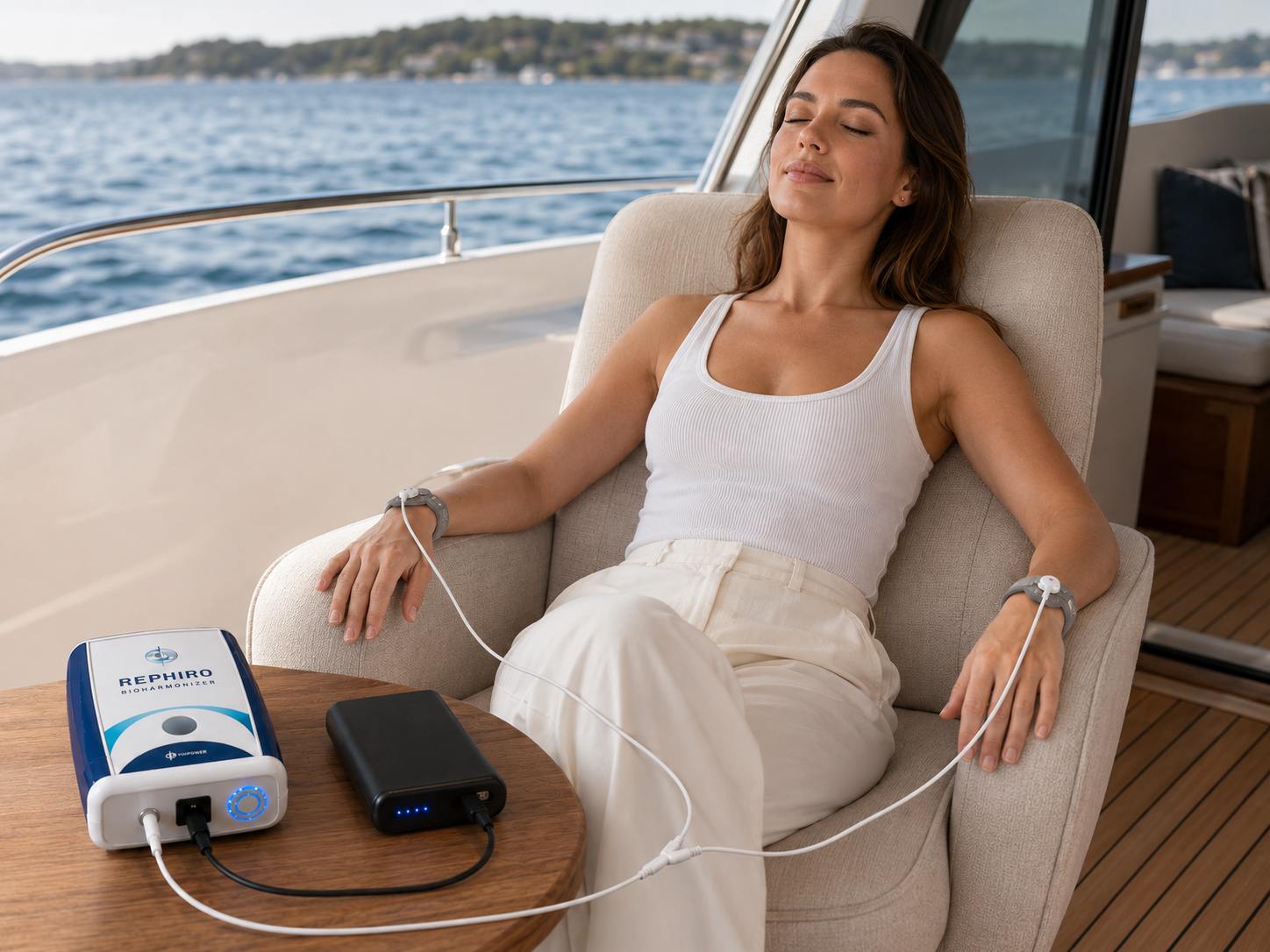
Rephiro follows a different philosophy. Instead of asking the user to choose a disease-labelled program, it uses a preset architecture:
~3.1 MHz
Preset high-frequency carrier.
0.1–150 kHz
Automatic lower-frequency sweep.
~14 Hz
Slower timing/gating layer.
None required
No disease-labelled program selection.
This is less flexible than an advanced programmable system — intentionally so.
Which approach fits you?
Large database system
Best if you want to search programs, compare lists and build custom sequences.
Programmable generator
Best if you want direct control of channels, sweeps, gating and output.
Preset sweep system
Best if you want to avoid software, databases and manual frequency selection.
Software settings should be verified at the physical output
A screen can say 3.1 MHz, but the technical question is what the connected hardware actually produces under a defined load. Measure frequency, waveform, carrier, modulation, harmonics, sidebands, voltage/current and sweep timing.
Official product sources & further reading
Current official download page listing the July 2026 installer, databases, guides and support files.
Official description of Programs, Presets, Control and named database families/sub-databases.
Company statement that its systems are not FDA-approved medical devices and are intended as experimental electronic devices.
Current manufacturer description of programmable channels, software, carrier and multi-frequency capabilities.
Manufacturer specifications for frequency range and programmable features.
Frequently asked questions about Rife frequency software and databases
The bottom line
Rife frequency software can be sophisticated and genuinely useful for organization, repeatability and hardware control. But software sophistication should not blur the most important distinction:
a database entry is information — not clinical proof.
When evaluating any Rife frequency list, ask three questions:
Where did the number come from? What signal does the hardware actually generate? What evidence supports the claimed biological effect?
Separate frequency provenance, measurable electronics and health evidence. They are three different questions.
Rife Machine: The Complete Guide to Rife Frequencies, Technology & Devices →
This article is educational and compares software/database architectures. Program names and frequency-list entries do not establish medical efficacy. Phipower frequency products are wellness and lifestyle products, not medical devices, and are not intended to diagnose, prevent, treat or cure disease. References to third-party systems are for comparison and do not imply affiliation or endorsement.