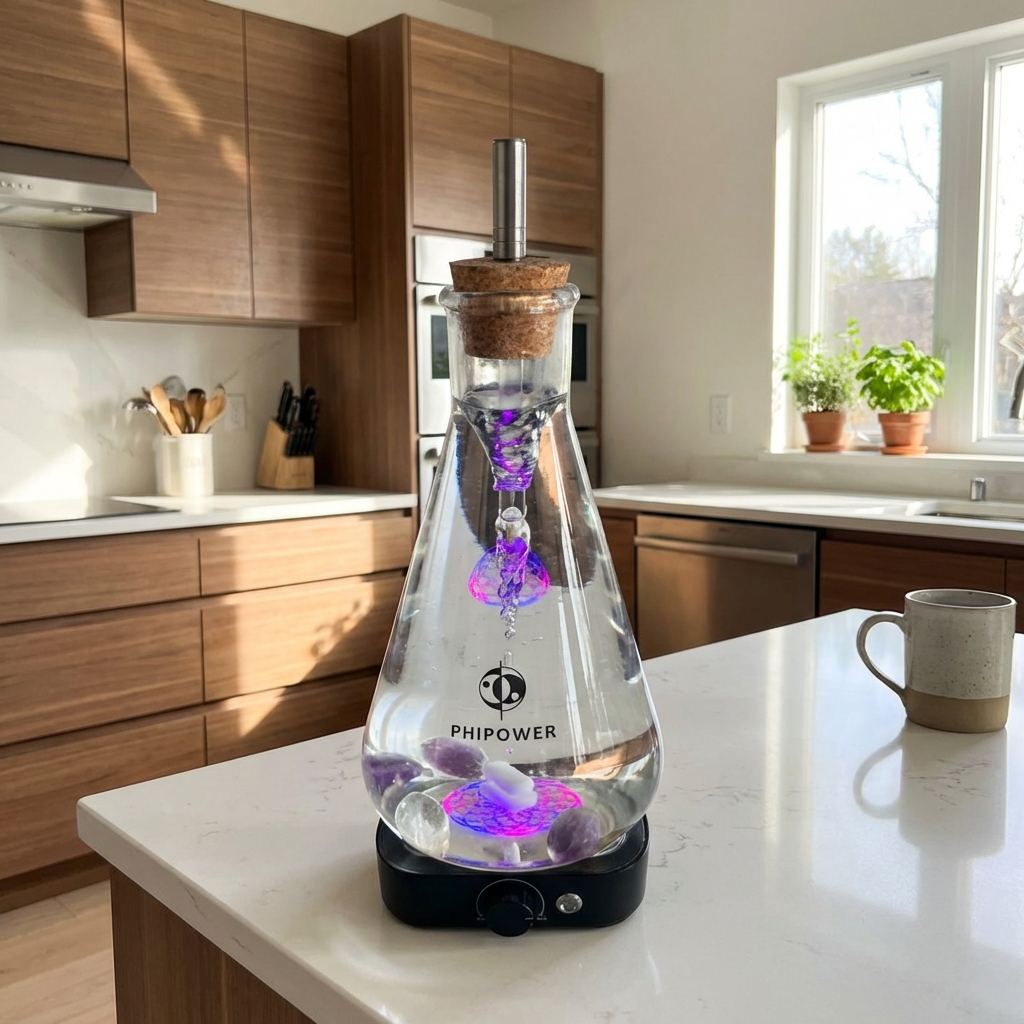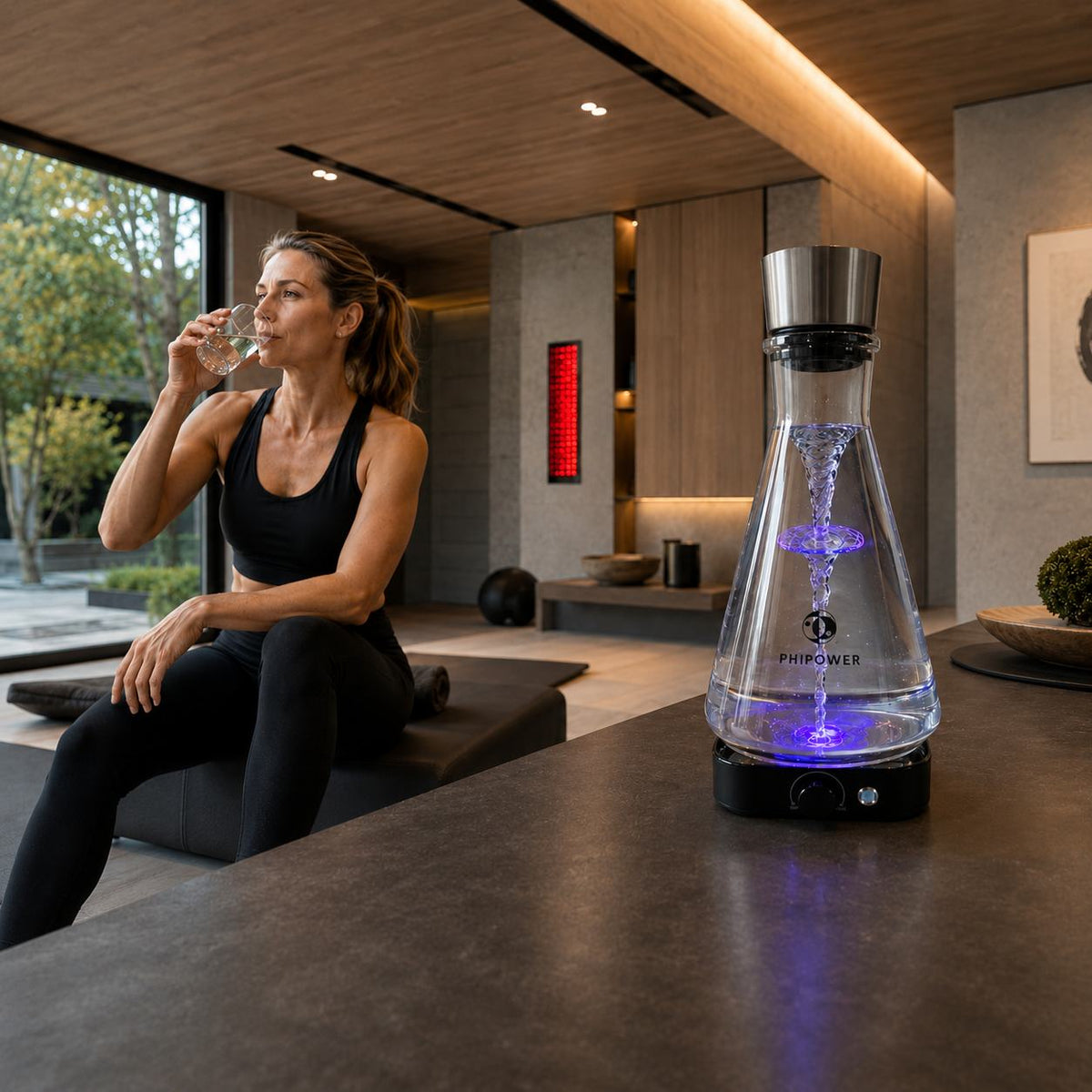
Structured water is a hypothesis about how water is organized. Vitalized water is a practical set of home methods people use, including vortexing.
They overlap — a vortex may plausibly influence local structure — but keeping the words separate keeps our claims honest and specific.
The core difference
A scientific hypothesis
A claim about how water molecules are physically arranged — hydrogen-bond networks, EZ water at hydrophilic surfaces, hexagonal ice-like domains, nanobubbles.
A practical wellness category
A set of home methods — vortexing, light exposure, mineral balance, crystals — used with the intention of improving water quality or experience.
Why Phipower keeps these terms separate
- Scientific clarity: structured-water hypotheses can be discussed and cited on their own merits, without borrowing credibility from ritual practices.
- SEO clarity: search intent differs — people researching “EZ water” want physics, people researching “how to vitalize water” want a routine.
- Commercial clarity: the Water Vitalizer 2.0 is sold as a practical vitalizing device, not as a device that has proven it restructures water at the molecular level.
What “structured water” refers to
In the structured-water literature, several distinct physical ideas get grouped under one popular label:
- the dynamic hydrogen-bond network present in all liquid water;
- EZ water and the H3O2 hypothesis near hydrophilic surfaces;
- proposed hexagonal, ice-like local arrangements;
- fine and ultrafine bubble populations (nanobubbles);
- and the broader question of whether any of this changes measurable water behaviour.
Read the full explainer: Structured Water →
Isn't all water “structured” already?
Yes, in the sense that liquid water always has a dynamic hydrogen-bond network. The open scientific question is whether specific interventions create a distinct, more ordered or longer-lived structure than ordinary water — not whether structure exists at all.
What belongs under Structured Water
What “vitalized water” refers to
Vitalized water is an umbrella term for home methods used with the intention of improving water — historically including vortexing, light exposure, mineral dosing, crystal placement and intention-setting rituals.
It is a practice category, not a single measurable physical state. Read the flagship guide: Vitalized Water →
What belongs under Vitalized Water

Where the two ideas actually meet: vortexing
Vortexing is the clearest bridge between the two concepts. It is a vitalized-water method (a practical home technique) that may also plausibly influence structured-water variables such as fine-bubble populations, gas exchange and local hydrogen-bond dynamics.
That overlap is exactly why we treat vortexing carefully: it is real fluid dynamics, but a claim that it produces a permanently “structured” water phase goes beyond current direct evidence.
Where the Water Vitalizer 2.0 fits
The device is positioned as a practical vitalizing tool that uses well-understood physical mechanisms — vortex mixing and defined light exposure — without overstating what those mechanisms prove about water structure.
Side-by-side comparison
| Structured water | Vitalized water | |
|---|---|---|
| Nature of the term | A scientific hypothesis about molecular arrangement | A practical wellness practice category |
| Typical evidence base | Physics & materials-science research | Anecdote, tradition, some overlapping physics |
| Core question | Is water arranged differently after treatment? | Does a method improve water quality or experience? |
| Example topics | EZ water, hexagonal water, nanobubbles | Vortexing, light, minerals, crystals |
| Where vortexing fits | A possible mechanism worth studying | The most common practical method |
| Phipower's role | Explains the research honestly | Sells a device to run the practice |
Are they ever the same thing?
Not exactly, but they can describe the same water at the same time. Freshly vortexed water is “vitalized” because of the method used to prepare it, and it may also carry some structured-water-relevant properties (like a temporary fine-bubble population) worth studying as a separate physical question.
What does the evidence actually support?
For a full breakdown of what structured-water research does and does not currently establish, see Structured Water Benefits →.
Nanobubbles: the clearest physical bridge
Fine-bubble technology is one of the more measurable, standardized physical phenomena connecting vortexing to structured-water discussions. See Nanobubbles in Water →.
EZ Water: a surface phenomenon, not a bulk-water claim
The EZ water / H3O2 hypothesis specifically concerns water immediately adjacent to certain hydrophilic surfaces — it is not, by itself, a claim about bulk water vortexed in a glass carafe. See EZ Water & H3O2 →.
Hexagonal water: often conflated with vitalization
“Hexagonal water” claims are frequently marketed alongside vitalization products, but they refer to a distinct, more specific structural hypothesis. See Hexagonal Water →.
Terminology at a glance
| Term | What it means here |
|---|---|
| Structured water | Hypothesized non-random molecular arrangement |
| Vitalized water | Water prepared with an intentional home method |
| Vortex water | Water processed through rotational mixing |
| EZ water | Exclusion-zone water at hydrophilic surfaces |
| Nanobubbles | Ultrafine gas bubbles with distinct persistence |
Why we don't merge these keywords
| Keyword intent | Owning content |
|---|---|
| “What is structured water” | Structured Water pillar |
| “How to vitalize water” | Vitalized Water pillar |
| “EZ water” | EZ Water & H3O2 article |
| “Vortex water benefits” | What Is Vortex Water? |
| “Vitalized vs structured water” | This article |
Language we use — and language we avoid
Which page should you read next?
The physics, the hypotheses, and what current research does and doesn't establish.
A practical routine you can start today with the Water Vitalizer 2.0.
A suggested reading path
- Start with Vitalized Water for the practical overview.
- Read What Is Vortex Water? to understand the mechanism.
- Check How Long Should You Vortex Water? for a practical routine.
- Go deeper with Structured Water for the underlying science.
- See the evidence in Structured Water Benefits.
- Explore the specific hypotheses: EZ Water, Hexagonal Water and Nanobubbles.
Scientific sources
The dynamic, ultrafast nature of hydrogen bonding in liquid water.
Time-resolved fine-bubble and transient-property research on vortex-treated water.
Foundational research on the exclusion-zone (EZ water) hypothesis.
Internal summary of what current structured-water research does and does not support.
Frequently asked questions
The bottom line
Structured water is a scientific hypothesis about molecular arrangement. Vitalized water is a practical category of home methods. Vortexing is the clearest bridge between the two — a real physical process that may plausibly touch on structured-water-relevant variables, without proof of a permanent molecular restructuring.
Continue with Vitalized Water, Structured Water or How Long Should You Vortex Water?
This article is educational. It compares terminology and current scientific understanding; it is not a medical claim, and Phipower does not claim the Water Vitalizer 2.0 has been scientifically proven to permanently restructure water at the molecular level.