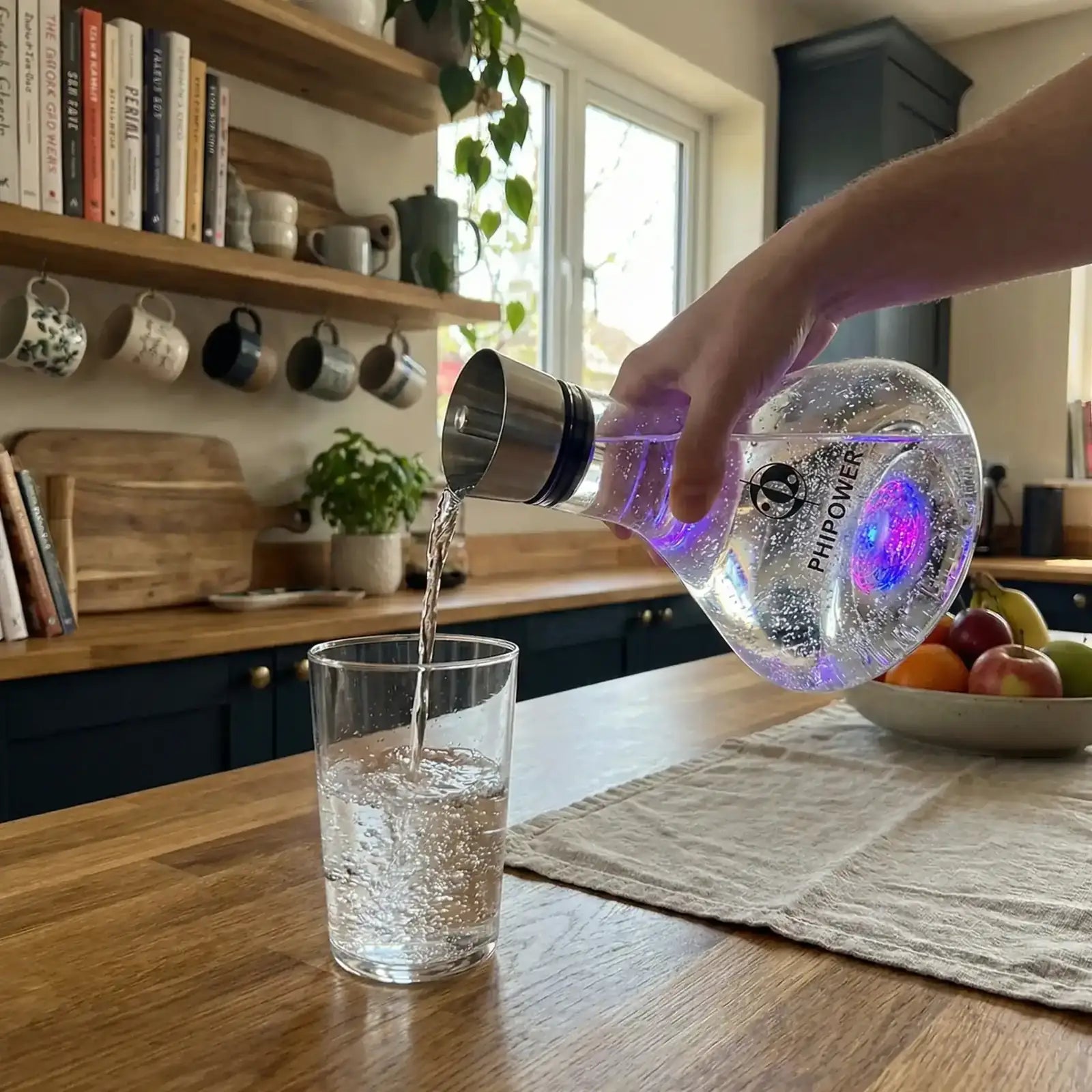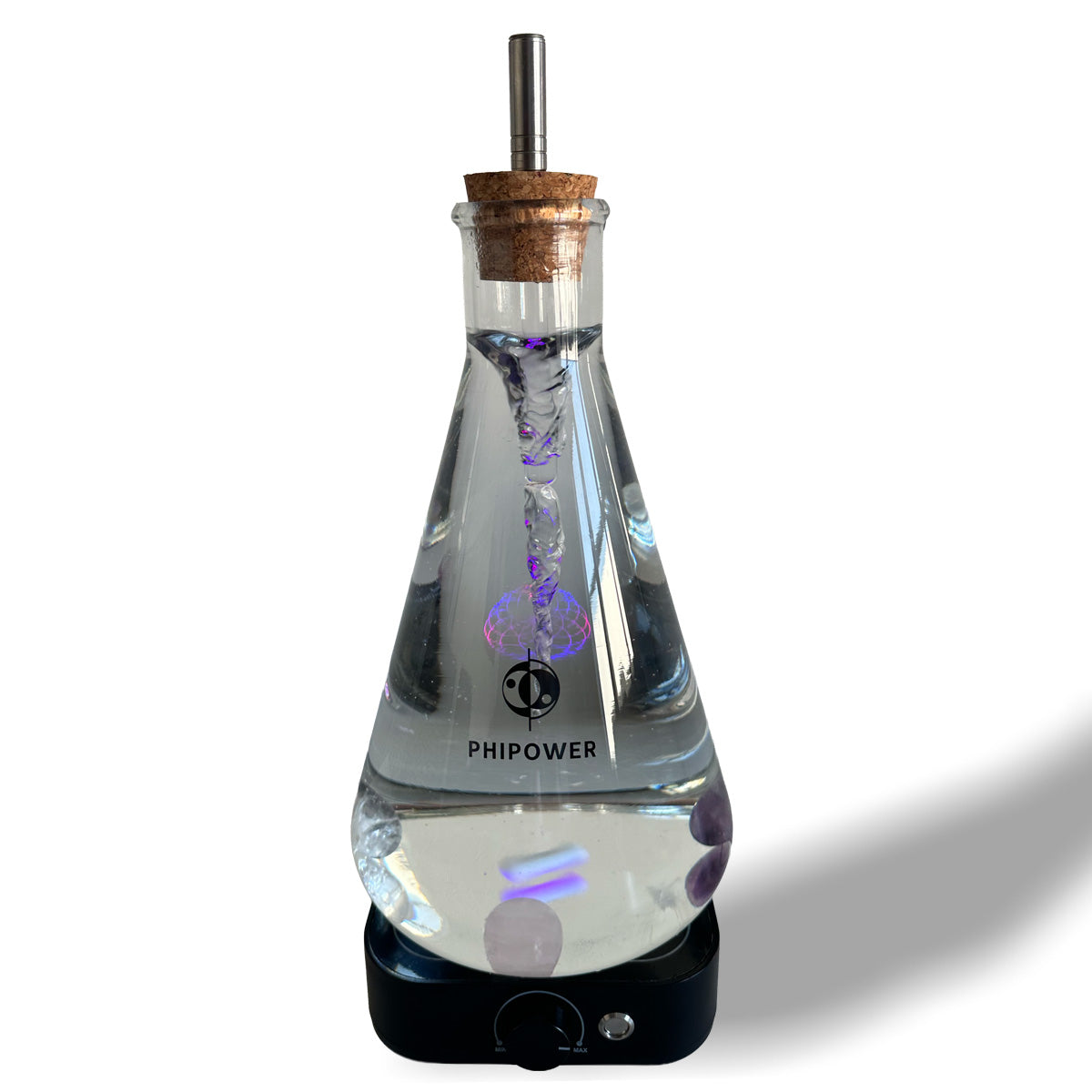
Vortexing can create fine bubbles. "Nanobubbles" should only be claimed after measurement.
ISO fine-bubble terminology defines ultrafine bubbles as smaller than 1 μm. A 2024 vortex–swirl study found a large population of roughly 1 μm microbubbles plus transient dissolved-oxygen and pH changes. That supports a real fine-bubble explanation for some post-vortex effects — but not the claim that every vortex creates stable nanobubbles.
What exactly is a nanobubble?
Fine-bubble science defines bubbles by size and measurable physical properties. ISO terminology treats ultrafine bubbles as smaller than 1 μm. Many research papers use "bulk nanobubble" for much smaller populations, often around tens to hundreds of nanometres.
A tiny-looking bubble is not automatically a nanobubble. Size and concentration have to be measured.
Why nanobubbles are scientifically interesting
Very small bubbles provide a large gas–liquid interface relative to their volume. That makes fine bubbles useful in aeration, water treatment, flotation, cleaning, aquaculture, irrigation and other mass-transfer applications.
The engineering concept is straightforward: more interface and longer gas residence time can change how efficiently gas transfers into water.
The surprising part: some nanobubble dispersions persist for weeks
Classical diffusion theory predicts rapid dissolution of tiny bubbles because their internal pressure is high. Yet engineered nanobubble dispersions can persist much longer.
A 2023 study of air nanobubbles still detected a substantial bubble population after eight weeks. Concentration fell by about 74%, average size increased, and zeta potential became less negative. The dispersion was persistent — but not static.
Nanobubbles evolve over time
A 2021 study of CO₂ bulk nanobubbles found that bubble concentration decreased while surviving bubbles became larger. The authors interpreted the process as Ostwald ripening: gas moves from smaller bubbles through the liquid into larger ones.
A post-treatment sample can retain a bubble population while its physical state continues to change.
Can vortexing create fine bubbles?
Yes. Vortex and swirl flow can entrain gas, create shear and pressure variations, and break gas domains into smaller bubbles.
In 2024, English and Kamp studied a specific vortex–swirl device and reported a large population of smaller microbubbles around 1 μm, together with transient changes in dissolved oxygen and pH.
For the full picture on vortex physics, gas transfer and molecular structure, read What Is Vortex Water? Science, Vortexing & How It Works →
What the 2024 vortex–swirl study actually found
| Measured feature | Reported result | Correct interpretation |
|---|---|---|
| Bubble population | Large population around ~1 μm | Fine/microbubble formation in that device |
| Relaxation time | ~2.4 h in DI water; ~3.6 h in filtered tap water | Post-flow effect was transient |
| Dissolved oxygen | Elevated immediately, then declined | Gas transfer changed measurably |
| pH | Small downward shift | Water chemistry changed slightly |
| Human health outcome | Not tested | No hydration or therapeutic claim follows |
Why this does not prove every vortex creates nanobubbles
The study used one geometry and one measurement setup. Roughly 1 μm also sits near the microbubble/ultrafine-bubble boundary.
The 2024 study demonstrates that a specific vortex–swirl system generated fine bubbles and transient water-property changes. It does not prove that every vortex device creates a stable sub-200-nm nanobubble dispersion.
Fine bubbles and dissolved oxygen
Small bubbles can improve gas–liquid mass transfer because they provide high interfacial area and may remain suspended longer than coarse bubbles.
A 2025 Scientific Reports study of air submicrobubbles reported rapid dissolved-oxygen increases under its test conditions, with only a modest decline after the generator stopped.
This is useful engineering evidence — but it is not automatically evidence of a health benefit.
More dissolved oxygen in water is not the same as oxygenating your body
Human oxygen delivery is dominated by the lungs, hemoglobin and circulation. More dissolved oxygen in a glass of water does not by itself establish higher blood oxygen, better athletic performance or increased mitochondrial oxygen delivery.
What is zeta potential?
Many nanobubble dispersions show a negative electrokinetic potential. A same-sign surface charge can contribute to dispersion stability by reducing close approach and coalescence.
The 2023 stability study found negative zeta potentials that became less negative as the bubbles aged.
Zeta potential tells us about electrokinetic behaviour. It does not prove that every nanoscale scattering object in a sample is a gas bubble.
How do scientists measure nanobubbles?
Nanoparticle Tracking Analysis
Tracks Brownian motion of individual scattering objects to estimate size and concentration.
Dynamic Light Scattering
Estimates hydrodynamic size from fluctuations in scattered light; larger scatterers can bias results.
Confirm gas vs particles
Filtration, degassing and complementary methods help distinguish bubbles from dust or colloids.
The measurement trap: particles can masquerade as bubbles
Water samples can contain mineral particles, organic matter, dust, plastic fragments and residues from glass or tubing. Light-scattering instruments detect objects — they do not automatically identify them as gas-filled bubbles.
Strong nanobubble work therefore uses controls and preferably more than one analytical method.
Could fine bubbles change taste or mouthfeel?
Possibly. Dissolved gases and fine bubbles can influence freshness, texture and aroma release. The appropriate Phipower test would be a blinded triangle test using coded untreated and vortexed samples.
Do nanobubbles improve human hydration?
There is currently no robust human clinical evidence showing that nanobubble-containing drinking water hydrates healthy people better than matched ordinary safe water.
Strong fine-bubble physics can coexist with weak evidence for a specific hydration claim.
How nanobubbles fit into Structured Water science
| Phenomenon | Scale | Typical persistence |
|---|---|---|
| Hydrogen-bond configuration | Molecular | Femtoseconds to picoseconds |
| Interfacial water | Surface-dependent | While interface and conditions persist |
| Ultrafine/nanobubble | <1 μm; often tens–hundreds nm in studies | Potentially days or weeks in engineered dispersions |
| Vortex-generated microbubble | Micrometre range | Minutes to hours, condition-dependent |
This makes bubble populations a plausible explanation for some post-vortex changes that last much longer than an individual hydrogen-bond configuration.
Does the Phipower Water Vitalizer 2.0 create nanobubbles?
At this stage, that should be treated as a testable hypothesis, not as a confirmed product specification.
The device creates a visible adjustable vortex, so fine-bubble generation is plausible. But Phipower should directly measure bubble size, number concentration and time decay before using "nanobubble water" as a product claim.
The Phipower nanobubble test I would run
- Prepare one batch of source water and split it into identical samples.
- Keep one untreated control; vortex others for 5, 15 and 30 minutes.
- Measure temperature, dissolved oxygen, pH and conductivity immediately.
- Send coded samples for NTA or another suitable ultrafine-bubble method.
- Include filtered and degassed controls to help identify non-gas particles.
- Repeat at 1 h, 6 h and 24 h.
- Repeat the complete experiment on at least three independent days.
Publishing the method, raw data and negative results would create original Phipower research that most structured-water websites do not have.
Eight nanobubble claims — checked
| Claim | Verdict |
|---|---|
| Ultrafine bubbles below 1 μm are a recognized technical category. | Yes |
| Engineered nanobubble dispersions can persist for days or weeks. | Yes |
| Vortexing can generate fine bubbles. | Yes |
| Every visible vortex creates nanobubbles. | Not demonstrated |
| Fine bubbles can influence gas transfer. | Yes |
| Nanobubbles prove permanent molecular restructuring of H₂O. | No |
| Nanobubble water hydrates humans better. | Not established clinically |
| The Water Vitalizer can be tested directly for bubble generation. | Yes |
Primary scientific sources & standards
International terminology standard, with a 2024 amendment.
Standardized handling of ultrafine-bubble dispersions.
Primary time-resolved vortex study reporting ~1 μm bubbles, dissolved-oxygen changes and pH changes.
NTA/DLS study following air nanobubbles for up to eight weeks.
Ageing study documenting decreasing concentration and increasing bubble size.
Controlled generation of N₂, O₂ and CO₂ bulk nanobubbles.
Recent primary study of bubble size, zeta potential and dissolved oxygen.
Frequently asked questions about nanobubbles and vortex water
The bottom line
Nanobubbles are one of the strongest scientific concepts available to the structured-water field because they are physical, measurable and technologically useful.
But they should not become the next vague buzzword. Specific vortex systems can create measurable fine-bubble populations, while the Phipower Water Vitalizer itself still needs direct bubble-size testing before "nanobubble water" becomes a defensible product claim.
Continue with Structured Water: The Complete Guide →, Structured Water Benefits → or How Is Liquid Water Structured? →.
This article is educational and discusses fine-bubble physics and water engineering. Phipower does not currently claim that the Water Vitalizer 2.0 produces a verified nanobubble concentration unless and until it is tested with suitable methods. Phipower water products are wellness and lifestyle products and are not intended to diagnose, prevent, treat or cure disease.