
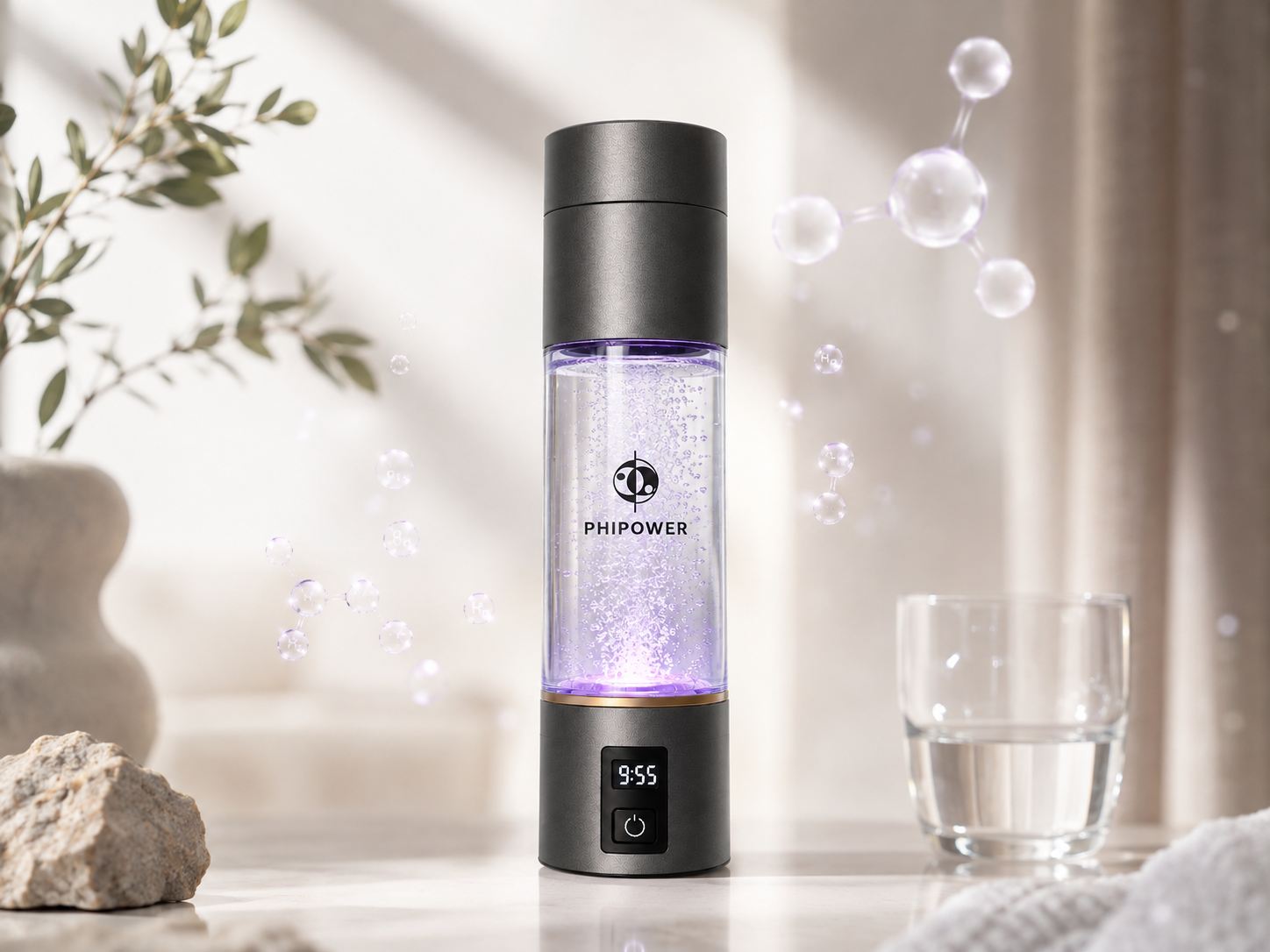
What is hydrogen water?
Hydrogen water, also called hydrogen-rich water (HRW), is ordinary drinking water containing additional dissolved molecular hydrogen gas (H₂).
Unlike the hydrogen atoms already chemically bound within water molecules (H₂O), dissolved molecular hydrogen exists as separate H₂ molecules within the liquid.
This distinction is important.
Every glass of water contains hydrogen as part of H₂O, but this does not mean that ordinary drinking water contains a meaningful concentration of free molecular hydrogen.
Hydrogen-rich water is produced by introducing additional H₂ into drinking water, usually through electrolysis, controlled gas dissolution or hydrogen-generating tablets.
The resulting water generally looks, smells and tastes like ordinary drinking water. What makes it different is a measurable physical property: the concentration of dissolved H₂.
Molecular hydrogen has attracted considerable scientific interest because researchers are investigating its potential influence on oxidative stress, inflammatory signalling and cellular regulation.
However, hydrogen water should not be confused with a scientifically proven medical treatment. Although some experimental and clinical studies have produced interesting results, many proposed health benefits still require stronger evidence.
This guide explains how hydrogen water works, what current research suggests, how concentrations are measured and what to consider when choosing a hydrogen water maker.
Hydrogen water: three essential facts
- Hydrogen water contains measurable H₂ gas. Its concentration can be expressed in parts per million (ppm), parts per billion (ppb) or milligrams per litre (mg/L).
- Molecular hydrogen is being investigated scientifically. Research includes potential effects on redox signalling, oxidative stress, exercise-related outcomes and metabolic markers.
- More hydrogen does not automatically mean better health outcomes. A higher concentration means more dissolved H₂ in the same volume of water, but the optimal exposure for specific biological effects has not been established.
How does hydrogen water work?
To understand hydrogen water, we first need to understand molecular hydrogen.
The difference between H₂O and H₂
Water has the chemical formula H₂O: two hydrogen atoms chemically bonded to one oxygen atom.
Molecular hydrogen has the formula H₂: two hydrogen atoms bonded to each other, forming a small gas molecule.
When H₂ dissolves in water, it does not turn into a new form of H₂O. Instead, the water contains additional dissolved gas molecules.
This process is similar in principle to dissolving other gases in liquids, although each gas has different physical properties and solubility.
What happens when you drink hydrogen-rich water?
After hydrogen-rich water is consumed, dissolved H₂ may be released within the gastrointestinal tract, absorbed and distributed through the body.
Research has demonstrated that molecular hydrogen can enter biological tissues and is eventually eliminated, largely through exhalation.
Scientists are investigating whether this exposure influences cellular processes. The main areas of interest include:
- Oxidative stress and redox balance.
- Cellular antioxidant defence pathways.
- Inflammatory signalling.
- Mitochondrial regulation.
- Metabolic processes and physiological responses.
The precise mechanisms remain under investigation.
It is also important to distinguish between hydrogen entering the body and a demonstrated health benefit. The presence of molecular hydrogen in the body does not automatically establish that drinking hydrogen water improves health.
Why is molecular hydrogen scientifically interesting?
Modern biomedical interest in H₂ expanded after a 2007 study by Ohsawa and colleagues, published in Nature Medicine.
The researchers investigated molecular hydrogen in experimental models of oxidative injury and reported protective effects under the conditions studied.
This helped stimulate further research into whether H₂ could influence biological processes associated with oxidative stress.
Since then, scientists have examined several possible mechanisms.
1. Oxidative stress and antioxidant research
Oxidative stress describes an imbalance between the formation of reactive chemical species and the body's ability to regulate them.
Reactive oxygen species (ROS) are not always harmful. They also participate in essential immune and signalling processes.
Early hydrogen research proposed that H₂ might interact with certain highly reactive radicals.
More recent research suggests that possible biological effects may also involve indirect influences on cellular signalling and antioxidant defence systems.
Molecular hydrogen should therefore not simply be described as a universal antioxidant that neutralises every damaging molecule.
2. Inflammatory signalling
Inflammation is a normal biological response to injury, infection and cellular stress.
Some experiments suggest that molecular hydrogen may influence pathways associated with inflammatory regulation. These include signalling systems connected with NF-κB and Nrf2.
However, laboratory findings involving these pathways do not prove that drinking hydrogen water treats inflammatory conditions in humans.
3. Mitochondria and cellular regulation
Mitochondria are involved in cellular energy production and metabolic regulation.
Researchers have investigated potential connections between H₂ exposure, mitochondrial signalling and the body's response to cellular stress.
The evidence is still developing, and the exact biological mechanism has not been fully established.
For a wider introduction to these mechanisms and other hydrogen delivery methods, explore our overarching Molecular Hydrogen (H₂) Knowledge Guide.
Hydrogen water benefits: what does the science actually say?
Search online for hydrogen water benefits and you will find claims involving energy, recovery, inflammation, metabolism, ageing and general health.
Some claims are based on genuine scientific studies. Others go far beyond what those studies can demonstrate.
The most useful approach is to examine the evidence by research area.
Potential effects on oxidative stress
Several human studies have measured biomarkers associated with oxidative stress after hydrogen-rich water consumption.
Some have reported changes in selected markers. Others have found limited or statistically nonsignificant differences.
Different studies also use different hydrogen concentrations, water volumes, intervention periods and outcome measurements.
Consequently, the current evidence does not establish that hydrogen-rich water consistently reduces harmful oxidative stress in all users.
Exercise performance and recovery
Hydrogen-rich water has been investigated in athletes and physically active individuals.
Some controlled trials have reported changes in exercise-related biomarkers, fatigue measurements or particular performance outcomes.
For example, a 2025 randomised, double-blind, placebo-controlled study involving elite athletes reported favourable changes in several selected measures after hydrogen-rich water consumption.
However, the study population was specialised, and the researchers disclosed commercial interests involving molecular hydrogen. Results from individual studies cannot be assumed to apply to everyone.
Larger independent trials are needed to determine whether hydrogen water provides reproducible improvements in exercise performance or recovery.
Metabolic health
Researchers have also studied hydrogen water in relation to glucose regulation, cholesterol levels and other metabolic markers.
A systematic review and meta-analysis published in 2026 evaluated 13 randomised controlled trials involving 757 participants, primarily adults with overweight, obesity or metabolic conditions.
The analysis found small average reductions in total cholesterol and LDL cholesterol.
However, the authors considered the changes clinically modest and insufficient to recommend hydrogen-rich water as a lipid-lowering treatment.
The findings should not be generalised to all healthy individuals.
This is an example of why scientific context matters: a statistically detectable effect is not necessarily a meaningful clinical benefit.
Ageing and longevity
Oxidative stress and cellular signalling play roles in the biology of ageing.
This has encouraged researchers to explore possible connections between molecular hydrogen and age-related biological processes.
However, there is currently no convincing clinical evidence that drinking hydrogen-rich water reverses ageing, extends human lifespan or reliably prevents age-related diseases.
What is the overall scientific conclusion?
A 2024 systematic review entitled Hydrogen Water: Extra Healthy or a Hoax? evaluated 25 studies.
The authors concluded that preliminary results justified further investigation, while emphasising the need for larger and more rigorous clinical research.
More recent reviews continue to discuss possible mechanisms and early clinical findings, but the evidence remains uneven across health outcomes.
Hydrogen-rich water is a legitimate subject of scientific investigation, but its proposed medical and wellness benefits should not be presented as universally proven.
How is hydrogen water made?
Several methods can introduce molecular hydrogen into drinking water. The most common are electrolysis, direct gas dissolution and hydrogen-generating tablets.
1. Electrolysis-based hydrogen water makers
Electrolysis uses electrical energy to split water into hydrogen and oxygen.
The simplified overall reaction is: 2 H₂O → 2 H₂ + O₂
A properly engineered hydrogen water generator manages the resulting gases so that hydrogen can be dissolved into drinking water.
The design of the electrolysis cell, electrode materials, gas separation and water quality all influence performance.
Many modern portable hydrogen water bottles use membrane-based electrolysis technology.
2. Hydrogen gas dissolution
Hydrogen gas can also be introduced directly into water through controlled dissolution systems.
These may use pressure, gas-liquid contact systems or other engineering methods to increase the amount of dissolved H₂.
The concentration achieved depends on temperature, pressure, mixing conditions and the design of the system.
3. Hydrogen-generating tablets
Some products use chemical reactions to release molecular hydrogen into water. Magnesium-based formulations are a common example.
Their performance depends on the tablet composition, water volume, reaction conditions and time after preparation.
Unlike an electrically powered hydrogen generator, tablets introduce additional reaction materials and may change the mineral composition or pH of the water.
Neither method is automatically superior. The relevant considerations are actual dissolved hydrogen concentration, water quality, convenience, operating cost and independent testing.
What is PEM/SPE technology in a hydrogen water maker?
PEM and SPE are terms commonly used in modern electrolysis technology.
PEM stands for Proton Exchange Membrane. SPE stands for Solid Polymer Electrolyte.
These technologies use a polymer membrane as part of the electrochemical cell.
Depending on the design, the membrane supports ion transport and helps keep hydrogen and oxygen production streams separated.
Why is a membrane important?
An appropriately designed membrane-based system can help:
- Separate hydrogen and oxygen production streams.
- Control the electrochemical process.
- Reduce unwanted mixing of reaction products.
- Support repeatable hydrogen generation.
However, a PEM/SPE label alone does not guarantee a particular hydrogen concentration, water purity or device quality.
Other factors also matter, including membrane condition, electrode materials, water chemistry and manufacturing quality.
Why does water quality matter?
A hydrogen water maker is not automatically a water purification device.
Electrolysis systems can respond differently to dissolved minerals, salts and contaminants.
Poorly designed equipment or inappropriate source water can create undesirable electrochemical by-products.
For this reason, choose a system with documented food-contact materials, suitable electrode design and clear instructions about compatible drinking water.
Always begin with water that is already safe to drink.
Hydrogen water concentration explained: ppm, ppb and mg/L
Hydrogen concentration is one of the most important specifications of a hydrogen water maker. Unfortunately, it is also one of the most commonly misunderstood.
What does ppm mean?
PPM stands for parts per million.
For dilute dissolved hydrogen in water, 1 ppm is approximately equivalent to 1 milligram of H₂ per litre.
What does ppb mean?
PPB stands for parts per billion. One ppm equals 1,000 ppb.
| Concentration | Equivalent |
|---|---|
| 500 ppb | 0.5 ppm |
| 1,000 ppb | 1 ppm |
| 1,500 ppb | 1.5 ppm |
| 3,000 ppb | 3 ppm |
| 6,000 ppb | 6 ppm |
At typical drinking-water densities, ppm is approximately equivalent to mg/L.
What is the normal solubility of hydrogen in water?
At approximately 25°C, when water is in equilibrium with pure hydrogen gas at a partial pressure of one atmosphere, the dissolved H₂ concentration is approximately 1.6 mg/L.
This is a reference value for a specific pressure and temperature, not an absolute maximum under every condition.
Under elevated pressure or through temporary supersaturation, higher dissolved concentrations can be achieved. Hydrogen may subsequently escape from the water as the system returns toward equilibrium.
Is 6,000 ppb better than 1,500 ppb?
A concentration of 6,000 ppb contains four times as much dissolved H₂ per litre as water containing 1,500 ppb. That is a straightforward physical difference.
However, this does not establish that 6,000 ppb produces four times the biological effect.
The relationship between hydrogen exposure, biological responses and clinical outcomes is not sufficiently established to make that conclusion.
Concentration is not the same as total hydrogen amount
Consider an example.
If a 270 ml bottle actually contains 6 mg/L of dissolved H₂ at the time of measurement, the total dissolved hydrogen content would be: 0.270 litres × 6 mg/L = 1.62 mg H₂
This illustrates an important principle: the total amount of dissolved hydrogen depends on both concentration and water volume.
And the amount present immediately after generation may differ from the amount remaining when the water is consumed.
A manufacturer's advertised maximum concentration should therefore be evaluated under specified measurement conditions.
How long does hydrogen stay in water?
Hydrogen is a very light gas with limited solubility in water.
Once hydrogen-rich water is exposed to ordinary air, dissolved H₂ gradually escapes.
The rate depends on several factors:
- Water temperature.
- Surface area exposed to air.
- Whether the container is open or sealed.
- Container material and gas permeability.
- Movement, stirring and agitation.
- Initial dissolved hydrogen concentration.
- Pressure and headspace conditions.
There is no single scientifically valid retention time that applies to every hydrogen water bottle.
Should hydrogen water be consumed immediately?
For freshly generated hydrogen-rich water, consuming it shortly after preparation generally reduces the opportunity for dissolved H₂ to escape.
This does not mean all hydrogen disappears instantly after opening. It simply reflects that dissolved gas concentration changes over time.
A practical routine is: Fill → Generate → Open → Drink
If you want to compare different systems, measure the actual dissolved hydrogen concentration at several intervals rather than relying on general claims about how long hydrogen remains in water.
How can you measure hydrogen in drinking water?
A good hydrogen water maker should be evaluated using measurements that relate directly to dissolved H₂.
Direct dissolved hydrogen measurement
Suitable measurement approaches may include:
- Validated dissolved-hydrogen sensors.
- Appropriate electrochemical or membrane-based instruments.
- Carefully validated chemical reagent methods.
- Laboratory gas-analysis techniques.
The method must be suitable for the expected concentration range and water conditions.
What about ORP?
ORP stands for oxidation-reduction potential. It describes the electrochemical potential measured by an electrode in a particular solution.
Hydrogen-rich water may show a more negative ORP under certain conditions.
However, ORP is not a direct measurement of dissolved hydrogen concentration. It is influenced by other chemical and measurement factors.
A negative ORP number should therefore not be used as proof that water contains a specific concentration of H₂.
Can you measure H₂ by counting bubbles?
No.
Visible bubbles can indicate gas generation, but they do not establish how much hydrogen remains dissolved in the water.
Bubble size, escape rate and total gas production can vary independently of the dissolved H₂ concentration.
What should a good measurement report include?
For meaningful comparisons, look for:
- The dissolved H₂ concentration in ppm, ppb or mg/L.
- The measurement instrument or validated test method.
- Water temperature and starting water composition.
- Water volume and generation time.
- The time between generation and measurement.
- Repeated measurements and observed variation.
Independent measurements under reproducible conditions are more informative than marketing claims alone.
Is hydrogen water safe to drink?
Hydrogen-rich water has generally been well tolerated in the limited human studies conducted so far.
However, long-term safety data are less extensive, and the safety of the drinking water and equipment matters independently of the dissolved gas.
Important considerations
Use safe drinking water. Hydrogen generation does not automatically remove bacteria, heavy metals or other contaminants.
Keep the generator clean. Follow the manufacturer's guidance for cleaning the bottle, electrodes and membrane.
Use only recommended liquids. Do not introduce salt water, flavoured drinks, juices or supplements unless the equipment has specifically been designed and validated for those liquids.
Avoid excessive water consumption. Hydrogen water should not encourage drinking more fluid than is appropriate for your needs.
Consider personal medical circumstances. Anyone with a medical condition requiring fluid restriction or with concerns involving pregnancy, medication or ongoing treatment should seek professional advice before making significant changes to their routine.
Hydrogen water is not a replacement for medical care or prescribed treatment.
Hydrogen water vs alkaline water vs structured water
These terms are frequently used together in wellness discussions, but they refer to different characteristics.
| Water type | Main characteristic | What can be measured? |
|---|---|---|
| Hydrogen-rich water | Dissolved molecular hydrogen (H₂) | Dissolved H₂ concentration |
| Alkaline water | pH above 7 | pH and alkalinity |
| Filtered water | Removal or reduction of selected substances | Contaminant concentrations |
| Structured water | Claimed or investigated changes in water organisation | Depends on the specific claimed property |
| Vitalized water | Water subjected to physical preparation practices | The applied process and physical properties |
Is hydrogen water alkaline?
Not necessarily.
Hydrogen concentration and pH are different properties. Some electrolysis systems affect both, but hydrogen-rich water does not need to be alkaline.
Is hydrogen water the same as structured water?
No.
Hydrogen-rich water is defined by the presence of dissolved H₂ gas.
Structured water is a broader term used in discussions about the molecular organisation of water and various physical treatment methods.
Many commercial claims about permanently structured water have not been scientifically established.
Can vortexing create hydrogen water?
Vortexing causes water to rotate and may influence gas exchange or bubble formation.
However, vortexing ordinary water does not, by itself, establish that a meaningful amount of molecular hydrogen has been generated.
To demonstrate hydrogen enrichment, dissolved H₂ must be measured directly.
This distinction is particularly relevant when comparing water vitalizers with electrolysis-based hydrogen generators.
Learn more: Structured Water: Science, Vortexing & Vitalization
Hydrogen water vs hydrogen inhalation
Hydrogen-rich water is not the only method used to deliver molecular hydrogen.
Another approach is hydrogen inhalation, in which H₂-containing gas is delivered through equipment designed for that purpose.
Both methods involve the same molecular gas, but their delivery characteristics differ.
| Feature | Hydrogen water | Hydrogen inhalation |
|---|---|---|
| Delivery method | Drinking | Breathing |
| Hydrogen form | Dissolved in water | Gas |
| Exposure | Amount limited by concentration and consumed volume | Continuous during operation |
| Main measurement | ppm, ppb, mg/L | Gas concentration and ml/min |
| Equipment | Hydrogen water maker | Hydrogen gas generator |
| Practical use | Portable and convenient | Requires gas delivery equipment |
| Main safety focus | Drinking water and generator hygiene | Gas concentration, fire safety, validation |
A hydrogen inhalator may generate a much larger total volume of hydrogen gas than the amount contained in a bottle of hydrogen-rich water.
But that does not automatically mean the user absorbs a larger proportion or experiences better health outcomes.
The optimal delivery method for different possible effects has not been established.
Read our full comparison: Molecular Hydrogen: Drinking vs Inhaling H₂
How to choose a hydrogen water maker?
Hydrogen water generators vary considerably in design, quality, concentration, size and price.
Instead of focusing only on the highest advertised ppb number, compare the characteristics that can be measured and verified.
1. Hydrogen concentration
Does the manufacturer specify the dissolved H₂ concentration in ppm or ppb? Are measurement conditions disclosed?
2. Technology
Does the device use a clearly documented method such as PEM/SPE electrolysis? Are the membrane and electrode materials described?
3. Water quality and materials
Are the water-contact materials suitable for drinking water? Does the device use a suitable gas-separation design?
4. Generation time
How long does a normal production cycle take? Has the claimed concentration been measured at the end of that cycle?
5. Bottle capacity
A larger bottle may hold more total hydrogen at the same measured concentration. Consider the volume you realistically want to prepare and consume.
6. Portability and battery performance
Portable generators are convenient for home, office and travel. Check battery capacity, charging requirements and operating instructions.
7. Maintenance
Membranes, electrodes and seals require appropriate care. Check whether the cleaning and storage instructions are clear.
8. Transparency
A reliable supplier should distinguish verified specifications from preliminary scientific research.
Avoid products that promise to cure diseases, reverse ageing or guarantee specific medical results.
Discover the Phipower Hydrogen Water Bottle
Fresh hydrogen-rich water with portable PEM/SPE technology
The Phipower Hydrogen Water Bottle is designed to generate molecular hydrogen directly in a compact drinking bottle.
Its published specifications include:
- Up to 6,000 ppb (6 ppm) dissolved molecular hydrogen under suitable conditions.
- 270 ml drinking bottle.
- Approximately five-minute automatic generation cycle.
- Dual-chamber PEM/SPE electrolysis.
- Titanium electrodes and platinum-coated components.
- USB-rechargeable 1,400 mAh battery.
- BPA-free, food-grade drinking bottle.
- An additional hydrogen inhalation cap and nasal cannula.
The system is intended to make freshly prepared hydrogen-rich water convenient for everyday use.
The advertised concentration is a maximum product specification, not a guarantee that every preparation produces exactly 6 ppm. Actual concentration depends on water properties, temperature, generation conditions, membrane condition and measurement timing.
The included inhalation accessory is intended for personal wellness use, not medical respiratory treatment.
Simple preparation
Using the water-generation function involves four basic steps:
- Fill the bottle with drinking-quality water according to the instructions.
- Attach and close the bottle securely.
- Start the automatic hydrogen generation cycle.
- Drink the water shortly after the cycle has completed.
No hydrogen tablets or powders are required.
Explore the Phipower Hydrogen Water Bottle: 6000 ppb
Phipower hydrogen products are consumer wellness devices. They are not intended to diagnose, treat, cure or prevent disease, and no specific health outcome is guaranteed.
Frequently asked questions about hydrogen water
What is hydrogen water in simple terms?
Hydrogen water is normal drinking water containing additional dissolved molecular hydrogen gas (H₂).
What are the benefits of hydrogen water?
Researchers are investigating possible effects on oxidative stress, cellular signalling, exercise-related outcomes and certain metabolic markers. Although some studies report encouraging findings, broad health benefits have not been conclusively established.
Is hydrogen water scientifically proven?
The physical properties and measurable presence of dissolved hydrogen are scientifically established. Certain biological effects have been reported in studies, but reliable clinical benefits for the general population remain uncertain.
Can I drink hydrogen water every day?
Hydrogen-rich water has been used in daily-consumption research protocols and has generally been well tolerated in the studies conducted. However, no universally established optimal daily dose or long-term consumer protocol exists. Maintain normal hydration practices and follow the manufacturer's instructions.
Is hydrogen water better than regular water?
Hydrogen-rich water contains measurable dissolved H₂ that is generally absent or present only at very low levels in ordinary drinking water. Whether it provides meaningful additional health benefits for healthy people remains uncertain.
Does hydrogen water taste different?
Molecular hydrogen is colourless, odourless and tasteless. Hydrogen-rich water generally retains the characteristics of the original drinking water.
What does 6000 ppb hydrogen water mean?
It means a dissolved hydrogen concentration of 6,000 parts per billion, equivalent to approximately 6 ppm or 6 mg/L in water.
Is 6000 ppb hydrogen water better than 1500 ppb?
At the moment of measurement, 6,000 ppb represents four times the dissolved H₂ concentration of 1,500 ppb. However, this does not prove that it provides greater health benefits.
How long does hydrogen remain in drinking water?
There is no universal retention period. Hydrogen escapes gradually, with the rate depending on temperature, container design, exposure to air and other conditions. Drinking water soon after generation generally reduces hydrogen loss.
Do I need a special water bottle to make hydrogen water?
You need a method capable of introducing measurable amounts of dissolved molecular hydrogen. This can involve a specialised generator, a suitable gas dissolution system or certain hydrogen-generating tablets.
Does boiling water remove hydrogen?
Heating and boiling encourage the release of dissolved gases, including H₂. Boiling previously prepared hydrogen-rich water is therefore not a reliable way to retain its original dissolved hydrogen concentration.
Is hydrogen water the same as hydrogen peroxide?
No. Hydrogen water contains molecular hydrogen (H₂), while hydrogen peroxide is a different chemical compound (H₂O₂). They should never be confused.
Is hydrogen water the same as alkaline water?
No. Hydrogen-rich water is defined by dissolved H₂ concentration, while alkaline water is defined by pH.
Can hydrogen water detoxify the body?
There is no convincing clinical evidence that hydrogen-rich water provides a general detoxification effect. The body already uses the liver, kidneys and other physiological systems to process and eliminate substances.
Is hydrogen water safe for children?
Research specifically establishing long-term benefits, optimal use and safety in children is insufficient. Hydrogen water should not be marketed as a treatment for children, and medical guidance is appropriate when specific health concerns exist.
Can hydrogen water replace medical treatment?
No. Hydrogen-rich water is not an established substitute for medical treatment, medication, prescribed oxygen therapy or professional healthcare.
Explore the Hydrogen Water Knowledge Cluster
Hydrogen water combines established physical chemistry with an evolving field of biomedical research.
For readers who want to explore individual subjects in greater detail, the Phipower Knowledge Center separates the topic into specialised guides.
Hydrogen Water Benefits: What Does Scientific Research Show?
Science and potential benefits
Hydrogen Water Benefits: What Does the Science Actually Say? A closer examination of human research, reported outcomes, study limitations and the difference between measurable effects and established clinical benefits.
How Does Molecular Hydrogen Work in the Body? An accessible explanation of H₂, oxidative stress, redox signalling and the proposed biological mechanisms.
Technology and measurement
How Does a PEM/SPE Hydrogen Water Maker Work? An exploration of electrolysis, membranes, electrodes, gas separation and generator design.
Hydrogen Water Concentration: 1500 vs 3000 vs 6000 ppb. Understanding what higher concentrations mean, how hydrogen dissolves in water and why measurement conditions matter.
How Long Does Hydrogen Stay in Water? An explanation of temperature, pressure, gas loss, containers and practical measurement methods.
Practical guidance
Is Hydrogen Water Safe? A deeper guide to drinking-water quality, product hygiene, equipment care and scientific safety evidence.
Hydrogen Water vs Alkaline Water vs Structured Water. A clear comparison of three commonly confused water categories.
How to Choose a Hydrogen Water Maker. A practical guide to specifications, technology, testing, maintenance and buying considerations.
For the wider scientific background, start with the Molecular Hydrogen (H₂) Knowledge Guide.
The future of hydrogen water research
Hydrogen-rich water is a subject where scientific curiosity, consumer technology and wellness trends increasingly overlap.
Its basic chemistry is relatively straightforward: molecular hydrogen can be dissolved in drinking water, measured and delivered through different generation methods.
Its biological effects are much more complex.
Future research needs to clarify:
- Which reported biological effects are reproducible.
- Which populations, if any, may experience meaningful benefits.
- How hydrogen concentration and total intake relate to outcomes.
- Whether different generation methods influence exposure.
- How measurement protocols can be standardised.
- What long-term, well-controlled human trials reveal.
Independent equipment testing will also be important for distinguishing actual dissolved hydrogen concentrations from theoretical or advertised values.
The Phipower approach
At Phipower, our goal is to make emerging water technologies easier to understand.
We believe that the strongest foundation for informed choices is a combination of clear explanations, measurable specifications and scientific transparency.
That means explaining both the interesting possibilities and the limitations of current research.
Hydrogen-rich water offers a practical way to explore molecular hydrogen through an ordinary daily activity: drinking water.
The science of dissolved H₂ is established. Its possible long-term health effects remain an active subject of research. Understanding both is the best place to begin.
Scientific references and further reading
- Ohsawa I. et al. (2007) Hydrogen acts as a therapeutic antioxidant by selectively reducing cytotoxic oxygen radicals. Nature Medicine, 13, 688-694. DOI: 10.1038/nm1577 Foundational experimental research exploring molecular hydrogen in oxidative injury models.
- Dhillon G. et al. (2024) Hydrogen Water: Extra Healthy or a Hoax? A Systematic Review. International Journal of Molecular Sciences, 25(2), 973. DOI: 10.3390/ijms25020973 Systematic review of 25 publications addressing potential benefits and limitations of the available research.
- Oral Administration of Hydrogen-rich Water: Biomedical Activities, Potential Mechanisms, and Clinical Applications (2025). Current Pharmaceutical Design, 31(19), 1537-1550. DOI: 10.2174/0113816128330516241121150719 Review examining potential biological mechanisms and research involving oral hydrogen administration.
- Ye H. et al. (2026) The effect of hydrogen-rich water interventions on lipid profiles in adults with overweight or obesity and associated metabolic disorders: a systematic review and meta-analysis of randomized controlled trials. Diabetology & Metabolic Syndrome, 18, Article 114. DOI: 10.1186/s13098-026-02124-0 Meta-analysis of 13 randomised controlled trials involving 757 participants. The authors found modest changes in selected lipid measures, insufficient to support routine therapeutic use.
- Molecular Hydrogen Institute: Concentration and Solubility of H₂. Technical background on dissolved hydrogen, ppm, ppb, gas pressure and solubility. Read the technical overview
Scientific and medical disclaimer: this guide is provided for educational and informational purposes. Scientific research into molecular hydrogen and hydrogen-rich water is ongoing. Reported experimental findings and clinical study results should not be interpreted as guaranteed effects of consumer hydrogen products. Phipower hydrogen products are consumer wellness and lifestyle devices. They are not intended to diagnose, prevent, monitor, treat, alleviate or cure disease and are not substitutes for appropriate medical treatment. Always use safe drinking water, follow the manufacturer's instructions and consult a qualified healthcare professional when personal medical circumstances require it.