
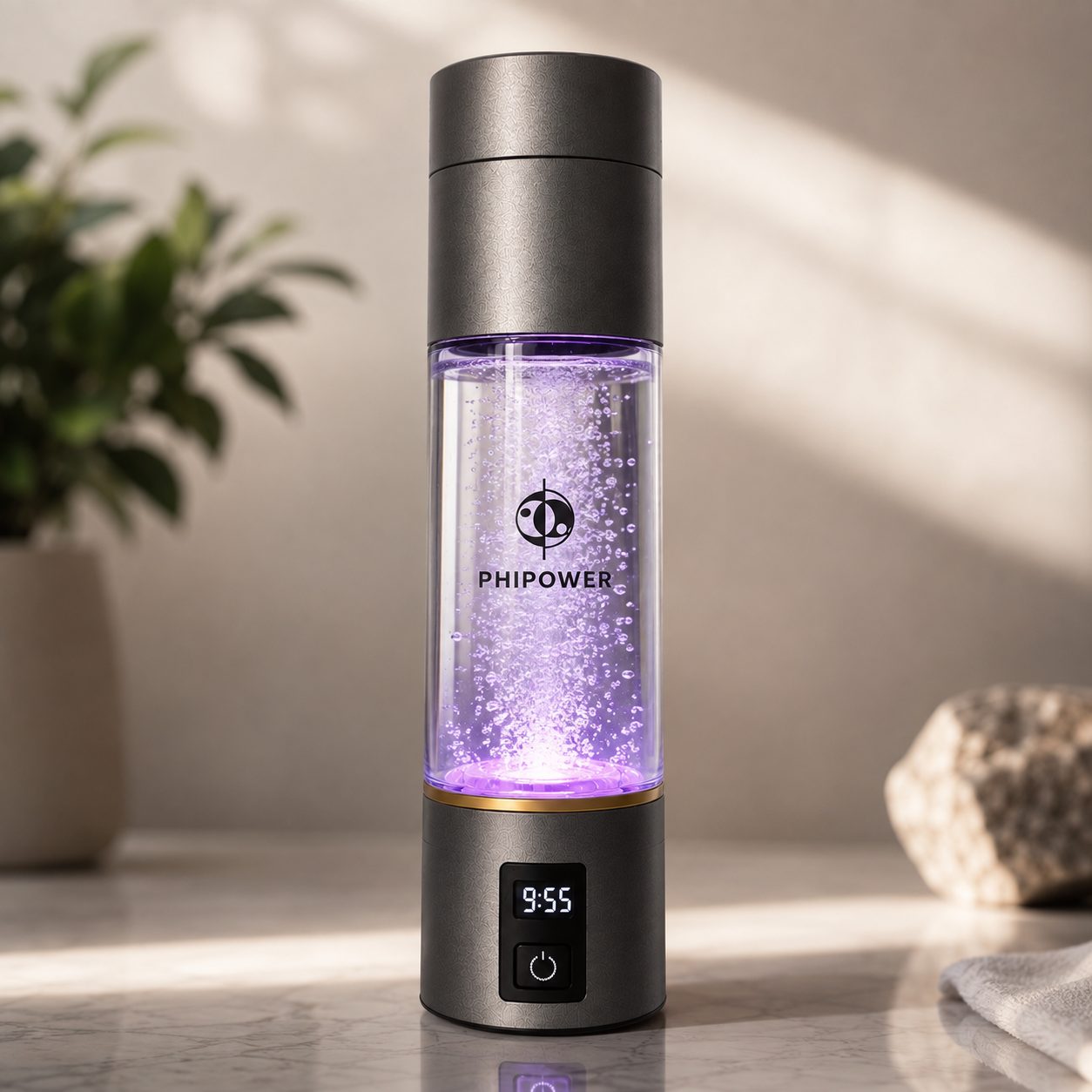
How does a hydrogen water maker work?
A hydrogen water maker is a device that generates molecular hydrogen gas (H₂) and dissolves it into drinking water. Modern devices commonly use electrolysis, an electrical process that splits water molecules into hydrogen and oxygen.
Advanced hydrogen water generators often use PEM/SPE technology, which incorporates a specialised polymer membrane to help separate the gases produced during electrolysis.
This separation is important because the goal is to introduce molecular hydrogen into drinking water while managing oxygen and other electrochemical reaction products appropriately.
The resulting water is called hydrogen-rich water.
It still consists primarily of ordinary H₂O molecules, but it contains additional dissolved H₂ gas.
Hydrogen water looks and tastes much like ordinary water. The difference is measurable using suitable dissolved-hydrogen testing equipment.
The short answer: PEM/SPE technology in five steps
- Electricity is supplied. A rechargeable battery or external power supply activates the electrolysis cell.
- Water molecules are split. Electrochemical reactions produce hydrogen and oxygen at different electrodes.
- The membrane separates the reactions. A proton-conducting polymer membrane allows hydrogen ions to move between the electrodes while helping limit gas mixing.
- Hydrogen gas is generated. Hydrogen molecules form at the cathode and can be directed into the drinking-water compartment.
- Hydrogen dissolves into the water. A proportion of the generated H₂ enters solution, producing hydrogen-rich drinking water.
The process combines established electrochemistry with compact water-generation technology.
However, the actual dissolved hydrogen concentration depends on much more than simply having a PEM/SPE membrane.
1. What is PEM/SPE technology?
Two important terms frequently appear in the specifications of hydrogen water generators.
PEM: Proton Exchange Membrane
PEM stands for Proton Exchange Membrane.
It describes a specialised polymer membrane that conducts positively charged hydrogen ions, or protons (H⁺), while substantially restricting the passage of electrons and separating the gas-producing electrode compartments.
In a typical PEM electrolysis cell, the membrane enables an electrochemical process in which oxygen and hydrogen are generated on opposite sides.
The membrane is a key component in managing gas separation.
SPE: Solid Polymer Electrolyte
SPE stands for Solid Polymer Electrolyte.
This term refers to the solid polymer material that conducts ions within the electrolysis system.
In many hydrogen generator descriptions, PEM and SPE refer to closely related aspects of the same membrane-based technology.
They should not automatically be interpreted as two completely separate generation systems.
What is the difference between PEM and SPE?
In everyday product specifications:
- PEM emphasises the membrane's ability to conduct protons.
- SPE emphasises the solid polymer electrolyte used in the electrochemical cell.
- PEM/SPE usually indicates a membrane-based electrolysis system.
The exact construction still varies between manufacturers.
Not every device labelled PEM/SPE has identical electrodes, membranes, gas pathways or performance.
2. The science behind water electrolysis
Electrolysis is a well-established chemical process that uses electrical energy to split water into hydrogen and oxygen.
The overall chemical reaction is: 2 H₂O → 2 H₂ + O₂
This means that two water molecules can produce two hydrogen molecules and one oxygen molecule.
A PEM electrolysis cell uses two electrodes separated by a proton-conducting membrane.
Step 1: Water reacts at the anode
The anode is the electrode where oxidation occurs.
In a conventional proton exchange membrane electrolyser, water molecules react to form oxygen, hydrogen ions and electrons.
Anode reaction: 2 H₂O → O₂ + 4 H⁺ + 4 e⁻
The oxygen is managed through the anode-side gas pathway.
Step 2: Hydrogen ions pass through the membrane
The H⁺ ions travel through the polymer electrolyte membrane.
Electrons move through the external electrical circuit rather than directly through the membrane.
This separation of ionic and electronic transport is essential to the electrochemical process.
Step 3: Hydrogen forms at the cathode
At the cathode, hydrogen ions combine with electrons to form molecular hydrogen gas.
Cathode reaction: 4 H⁺ + 4 e⁻ → 2 H₂
The generated hydrogen can then be collected, channelled or introduced into water, depending on the device design.
Step 4: Hydrogen dissolves into drinking water
In a hydrogen water maker, the hydrogen-generation system is integrated with a drinking-water compartment.
Some of the produced H₂ gas dissolves into the water.
Not all generated hydrogen necessarily remains dissolved: some may form bubbles, collect in the headspace or escape.
The amount that remains in solution determines the actual dissolved H₂ concentration.
This is the critical distinction between hydrogen production and hydrogen-water concentration.
A generator may produce visible hydrogen bubbles without achieving a particularly high dissolved concentration.
3. Why is a membrane important in a hydrogen water generator?
A major engineering challenge in electrolysis is managing the different gases and reaction products.
Hydrogen forms at one electrode and oxygen at the other.
Without suitable separation and gas management, these products can mix or interact with the water in unwanted ways.
The role of the proton exchange membrane
In an appropriately designed PEM cell, the membrane helps:
- Conduct hydrogen ions between the electrodes.
- Keep hydrogen and oxygen generation pathways separated.
- Limit gas crossover between the compartments.
- Support controlled electrochemical operation.
- Maintain a compact electrolysis-cell design.
However, gas separation is not perfect under all operating conditions. Performance can be affected by membrane properties, wear, pressure differences and equipment design.
Does a PEM membrane automatically make water safe?
No.
The membrane is an important component, but it is not a complete water purification or safety system.
The quality of the final water also depends on the electrodes, incoming water, seals, flow pathways and overall design.
A well-designed system must manage unwanted electrochemical reaction products and use materials appropriate for contact with drinking water.
A PEM/SPE label is useful technical information, but it is not an independent guarantee of product safety or quality.
4. What is a dual-chamber hydrogen water generator?
Some advanced hydrogen water makers use a dual-chamber configuration.
This means that the electrochemical system has distinct regions for managing the hydrogen-producing and oxygen-producing reactions.
In practice, the membrane separates the electrode compartments while the system directs the generated gases through different pathways.
Why is dual-chamber construction useful?
An appropriately engineered dual-chamber design can offer several advantages.
Better management of gas separation. Hydrogen and oxygen are generated in distinct electrochemical regions.
Controlled gas delivery. The drinking-water compartment can receive hydrogen through a designated pathway.
Management of unwanted reaction products. The system may be designed to divert oxygen and certain electrolysis by-products away from the drinking-water outlet.
Compact construction. Membrane-based electrolysis can be incorporated into portable, rechargeable devices.
Does dual-chamber always mean better?
Not necessarily.
Two devices can both be marketed as dual-chamber PEM/SPE generators while differing considerably in build quality and performance.
For example, one may use a higher-quality membrane, better seals or more effective gas dissolution.
The correct way to compare them is through measured performance, materials documentation and reproducible testing.
5. Why are titanium and platinum used in hydrogen generators?
Electrode materials are important because electrolysis takes place in an electrically active and chemically demanding environment.
Titanium electrodes
Titanium is often used in electrochemical systems because of its corrosion resistance and mechanical properties.
Depending on the design, titanium may serve as a structural electrode or conductive support for a catalyst coating.
However, titanium alone does not guarantee suitability for every electrode reaction.
The catalyst and coating systems are equally important.
Platinum catalysts
Platinum is an effective catalyst for the hydrogen evolution reaction in acidic PEM electrolysis systems.
It helps facilitate the conversion of hydrogen ions and electrons into molecular hydrogen.
The required quantity and configuration depend on the electrochemical design.
What about the oxygen-producing side?
Industrial PEM electrolysis frequently uses iridium-based catalysts for oxygen evolution because the anode operates under strongly oxidising conditions.
Compact consumer devices may use different proprietary electrode constructions.
Unless the manufacturer supplies verified technical documentation, the precise catalyst composition should not be assumed.
Does a platinum-coated electrode produce healthier water?
The presence of platinum does not itself demonstrate a health benefit.
Its technical purpose is to support the electrochemical reaction.
Consumers should evaluate catalyst materials through engineering performance, durability, material safety and device testing rather than claims about special biological properties.
6. How does generated hydrogen become hydrogen-rich water?
Producing hydrogen gas and dissolving hydrogen in water are two related but distinct processes.
A hydrogen water maker must achieve both.
Hydrogen gas production
The electrolysis cell generates H₂.
The amount produced depends on factors such as electrical current, operating time and electrochemical efficiency.
Hydrogen dissolution
The generated gas must then enter the water.
Dissolution depends on several physical variables:
- Hydrogen partial pressure.
- Water temperature.
- Contact time between gas and water.
- Mixing and gas-liquid contact area.
- Water volume.
- Container pressure and headspace.
- The design of the gas delivery pathway.
Why does pressure matter?
Hydrogen has relatively low solubility in water.
Near 25°C, water equilibrated with pure hydrogen gas at approximately one atmosphere of hydrogen partial pressure contains around 1.6 mg/L of dissolved H₂.
Higher concentrations can be achieved under suitable conditions, including elevated pressure or temporary supersaturation.
However, a supersaturated sample may lose dissolved gas as it returns toward equilibrium.
This is why measured concentration can decline after a generator finishes operating or after the bottle is opened.
What is supersaturated hydrogen water?
Supersaturation means that the water contains more dissolved hydrogen than would be present at equilibrium under the surrounding conditions.
Such a state may be temporary.
A high concentration measurement is meaningful only when the measurement conditions are clearly reported.
For example, measurements taken immediately after a generation cycle may differ from measurements taken several minutes later.
7. Understanding hydrogen concentration: 1500, 3000 and 6000 ppb
A central specification of hydrogen water makers is the amount of dissolved H₂.
The most common units are ppm, ppb and mg/L.
| Hydrogen concentration | Approximate equivalent |
|---|---|
| 500 ppb | 0.5 ppm or 0.5 mg/L |
| 1,000 ppb | 1 ppm or 1 mg/L |
| 1,500 ppb | 1.5 ppm or 1.5 mg/L |
| 3,000 ppb | 3 ppm or 3 mg/L |
| 6,000 ppb | 6 ppm or 6 mg/L |
These approximate relationships apply to dilute solutions in water at typical drinking-water densities.
What does 6000 ppb mean?
A water sample containing 6,000 ppb H₂ has approximately 6 milligrams of dissolved hydrogen per litre.
For a 270 ml bottle: 0.270 L × 6 mg/L = 1.62 mg of dissolved H₂
This calculation assumes that the measured concentration is actually 6 mg/L throughout the water at the relevant moment.
It is not a statement that every 270 ml hydrogen generator contains exactly 1.62 mg after every cycle.
Does a higher concentration mean better performance?
A higher accurately measured H₂ concentration represents more dissolved hydrogen per unit volume.
However, this number alone does not establish the overall quality of a generator.
Other important considerations include:
- Consistency between repeated cycles.
- Retention of dissolved hydrogen.
- Drinking-water safety.
- Device durability.
- Battery performance.
- Ease of cleaning and maintenance.
Does more hydrogen mean greater health benefits?
Not necessarily.
Although molecular hydrogen is being investigated for possible biological effects, a clear clinical dose-response relationship for ordinary consumer hydrogen water use has not been established.
A generator's concentration should be regarded as a measurable technical specification, not a guaranteed indicator of health effectiveness.
Learn more: Hydrogen Water Benefits: What Does the Science Actually Say?
8. PEM/SPE hydrogen water makers vs other technologies
Different technologies can introduce hydrogen into drinking water.
They should be compared according to actual output, reliability, convenience and water quality rather than marketing terminology alone.
| Technology | How it produces hydrogen-rich water | Main considerations |
|---|---|---|
| PEM/SPE electrolysis | Uses a proton-conducting polymer membrane and electrodes to generate H₂ | Membrane quality, gas separation, measured concentration, maintenance |
| Other electrolysis systems | Generate H₂ using alternative electrochemical arrangements | Electrode materials, electrolyte, gas pathways and possible by-products |
| Hydrogen tablets | Use a chemical reaction, often involving magnesium, to release H₂ | Reaction ingredients, dissolved concentration, cost per use |
| Pressurised H₂ dissolution | Introduces hydrogen gas into water under controlled conditions | Pressure, gas purity, container compatibility and concentration retention |
Which technology is best?
There is no universally superior technology for every application.
PEM/SPE can be attractive for compact rechargeable generators because of its membrane-based architecture.
Hydrogen tablets may be convenient for occasional use.
Pressurised dissolution systems may be suitable when specific concentrations or volumes are required.
Ultimately, performance must be measured in the finished drinking water.
A system producing higher amounts of hydrogen gas does not necessarily deliver a higher dissolved concentration.
9. Is a hydrogen water maker the same as an alkaline water ionizer?
No.
Both may use electrochemical processes, but their purposes are different.
Hydrogen water maker
The primary purpose is to introduce measurable molecular hydrogen (H₂) into drinking water.
The most relevant output measurement is dissolved H₂ concentration.
Alkaline water ionizer
The primary purpose is usually to produce water with an elevated pH, commonly through electrochemical separation of water streams.
The most relevant measurements include pH, alkalinity and water composition.
Some alkaline ionizers can also generate dissolved hydrogen, but alkaline pH does not prove that meaningful H₂ concentrations are present.
What about ORP?
ORP stands for oxidation-reduction potential, typically measured in millivolts (mV).
Hydrogen-rich water may show negative ORP values under some conditions.
However, ORP is influenced by several chemical and measurement factors.
ORP is not a reliable substitute for direct dissolved hydrogen measurement.
A generator advertising −500 mV ORP cannot be assumed to produce a particular ppm concentration of H₂.
10. Why does water quality matter in PEM/SPE generators?
Water quality is an important technical factor in electrolysis.
Even advanced membranes and electrodes can be affected by the composition of the input water.
Minerals and hardness
Calcium and magnesium ions contribute to water hardness.
Depending on the device design, mineral accumulation can contribute to deposits and maintenance requirements.
Chloride and other dissolved substances
Water can contain chloride ions and other dissolved compounds.
Under certain electrochemical conditions, unwanted substances such as chlorine-containing oxidants can form.
Proper electrode design, reaction control and gas separation are therefore important.
Not every electrolyser produces harmful levels of these substances, but their presence or absence should be determined through appropriate testing rather than assumptions.
Does a hydrogen generator purify water?
No.
A hydrogen water maker is not automatically a filtration or water purification system.
It should not be used to make unsafe water drinkable.
Always begin with water suitable for human consumption.
Which water should you use?
Use only the types of water approved by the manufacturer of your particular generator.
Some systems require highly purified water, while other consumer devices are designed to work with different types of drinking-quality water.
Do not assume that instructions for a large industrial PEM electrolyser apply to a small drinking-water device, or vice versa.
For the Phipower Hydrogen Water Bottle, the published instructions permit drinking-quality tap, filtered, reverse-osmosis, distilled and still bottled water.
Sparkling water, salt water, flavoured beverages and liquids containing added powders or oils are not recommended.
11. What determines the quality of a hydrogen water maker?
A good hydrogen water maker should be assessed through several measurable and practical characteristics.
1. Verified dissolved H₂ concentration
Look for actual concentration measurements rather than relying solely on bubble production or theoretical estimates.
2. Consistent performance
The generator should produce reasonably repeatable results when tested under comparable conditions.
3. Suitable electrode materials
Materials and catalyst coatings should be appropriate for the intended electrochemical environment.
4. Membrane and gas separation quality
The membrane, seals and flow pathways should support safe and reliable operation.
5. Drinking-water safety
The device should use suitable food-contact materials and have evidence that relevant unwanted electrolysis by-products are adequately controlled.
6. Maintenance requirements
Clear cleaning, storage and membrane-care instructions help protect performance.
7. Reliable battery operation
Portable systems should disclose battery specifications and charging requirements.
8. Transparent product information
A trustworthy supplier should distinguish between published specifications, independent testing and unproven medical claims.
12. How can hydrogen water maker performance be tested?
A properly designed test should measure dissolved H₂ in the finished water.
A useful evaluation involves repeated trials under documented conditions.
Recommended measurement conditions
Record:
- Generator model and serial number.
- Water source and starting composition.
- Water volume.
- Initial water temperature.
- Generation-cycle duration.
- Battery or electrical conditions.
- Instrument or validated testing method.
- Time between the end of generation and measurement.
- Repeated measurements and variability.
Measure hydrogen retention
Because dissolved H₂ can escape, it is useful to examine both immediate and delayed measurements.
For example, a testing protocol may record concentration:
- Immediately after the generation cycle.
- After two minutes.
- After five minutes.
- After ten minutes.
These intervals are examples for equipment evaluation, not recommended drinking intervals.
Why is this important?
Two devices can advertise the same maximum concentration while behaving differently under real-world conditions.
One may produce consistent dissolved H₂ measurements, while another shows substantial variation.
Independent testing helps consumers understand those differences.
Are visible bubbles proof of hydrogen concentration?
No.
Visible bubbles indicate gas formation or movement, but they do not quantify how much H₂ remains dissolved.
Is ORP enough?
No.
Direct hydrogen measurement is preferable when evaluating dissolved concentration.
13. How to use and maintain a PEM/SPE hydrogen water maker
Proper operation and maintenance are important for membrane-based electrolysis equipment.
Always follow the instructions for the specific model.
Using a portable hydrogen water bottle
A typical process involves:
- Charging the device.
- Filling the drinking-water compartment with an approved type of water.
- Closing the bottle securely.
- Starting the automatic electrolysis cycle.
- Allowing the cycle to finish.
- Drinking the hydrogen-rich water shortly after preparation.
Opening the container or moving the water to another vessel may encourage some dissolved H₂ to escape.
Keeping the membrane in good condition
Some PEM systems are designed to retain moisture in the membrane compartment.
Allowing the membrane to dry out can affect performance or durability, depending on the specific material and design.
Other systems have different storage requirements.
Do not generalise moisture and storage instructions between different devices.
Cleaning and descaling
Mineral deposits may develop during repeated use, especially with harder water.
Cleaning frequency depends on water quality and the manufacturer's recommendations.
Only use approved cleaning methods and concentrations.
Avoid abrasive materials, unsuitable chemicals and procedures that could damage the membrane, electrode coatings or seals.
Common operating problems
| Observation | Possible explanation |
|---|---|
| Reduced hydrogen output | Membrane condition, deposits, battery state or electrode performance |
| Shorter battery life | Battery ageing, charging conditions or usage |
| Unusual deposits | Minerals or other substances present in the water |
| Inconsistent concentration | Water conditions, measurement timing or device performance |
| Leaks | Seal wear, incorrect assembly or damaged components |
If a device behaves unusually, stop using it and consult the manufacturer's instructions or support service.
Do not attempt to modify the electrolysis cell.
14. Inside the Phipower Hydrogen Water Bottle
Portable dual-chamber PEM/SPE technology
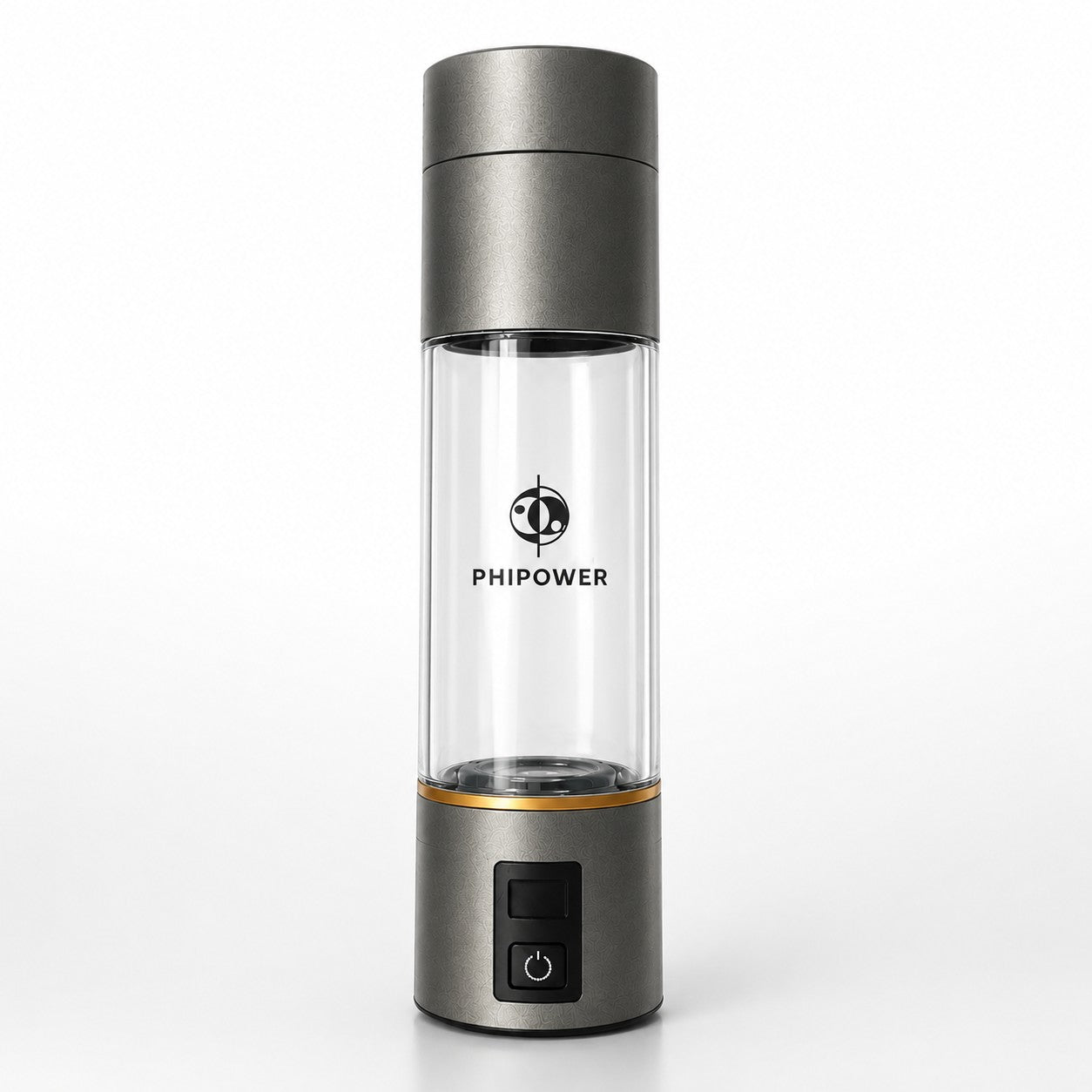
The Phipower Hydrogen Water Bottle combines membrane-based electrolysis with a compact rechargeable drinking-water system.
Its published technical specifications include:
| Specification | Phipower Hydrogen Water Bottle |
|---|---|
| Technology | Dual-chamber PEM/SPE electrolysis |
| Electrodes | Titanium |
| Membrane | Ion-exchange membrane |
| Catalyst | Platinum-coated components |
| Advertised H₂ concentration | Up to 6,000 ppb (6 ppm) |
| Drinking-water capacity | 270 ml |
| Automatic generation cycle | Approximately five minutes |
| Battery | 1,400 mAh lithium-ion |
| Charging | USB, 5V/2A input |
| Bottle material | BPA-free, food-grade plastic |
| Additional accessory | Hydrogen inhalation module with nasal cannula |
These are manufacturer-published specifications. The maximum dissolved hydrogen concentration depends on operating and measurement conditions.
How the Phipower system works
The generator uses an electrolysis cell incorporating a proton-conducting membrane.
When a generation cycle is started, electrical energy drives hydrogen and oxygen production.
The dual-chamber configuration helps manage the separate gas streams, while hydrogen is introduced into the drinking-water compartment.
The user can then consume the freshly prepared hydrogen-rich water.
Because H₂ gradually escapes from water, the product instructions recommend drinking the water soon after preparation.
What makes the system convenient?
The design brings several practical features together:
- A compact rechargeable generator.
- A self-contained 270 ml drinking bottle.
- An approximately five-minute automatic cycle.
- No hydrogen-generating tablets or powders required.
- Membrane-based electrolysis.
- A separate accessory for hydrogen gas delivery.
The inhalation accessory is a different mode of use and requires its own safety considerations. It is not a medical respiratory system.
What does the 6,000 ppb specification mean?
The device is advertised as capable of producing up to 6 ppm dissolved H₂ under suitable operating conditions.
That is a concentration specification, not a statement about guaranteed health effects.
For meaningful verification, dissolved H₂ should be measured with an appropriate test method, under documented conditions and close to the time of consumption.
Explore the product
Phipower Hydrogen Water Bottle: 6000 ppb PEM/SPE Generator
Phipower hydrogen products are consumer wellness devices. Their specifications do not establish medical benefits, and they are not intended to diagnose, treat, cure or prevent disease.
15. Frequently asked questions about PEM/SPE hydrogen water makers
What does PEM/SPE mean in a hydrogen water bottle?
PEM stands for Proton Exchange Membrane, while SPE stands for Solid Polymer Electrolyte. These terms describe related aspects of a polymer membrane-based electrolysis system used to generate hydrogen.
How does a hydrogen water maker generate H₂?
It uses electricity to drive electrochemical reactions that split water into hydrogen and oxygen. The generated hydrogen is then introduced into the drinking-water compartment.
Does a PEM/SPE hydrogen generator produce oxygen?
Yes. Oxygen is produced at the anode as part of water electrolysis. In a properly designed system, the oxygen and hydrogen pathways are managed separately.
Is PEM/SPE technology better than ordinary electrolysis?
PEM/SPE systems can offer advantages in membrane-based gas separation and compact design. However, actual performance depends on the complete device, and no technology label alone guarantees superior results.
Is a dual-chamber hydrogen water maker safer?
A well-engineered dual-chamber design can help manage gas separation and reaction products. Safety still depends on the complete equipment design, materials, testing and proper use.
Can a hydrogen water maker produce 6000 ppb?
Some devices are advertised as achieving 6,000 ppb or 6 ppm under specific conditions. Such concentrations are above the equilibrium value at ordinary atmospheric conditions and require suitable generation and dissolution conditions. Independent, time-specific measurements are needed to verify a claim.
Does hydrogen water become alkaline?
Not necessarily. Dissolved hydrogen concentration and pH are different measurements. Some electrochemical systems alter both, but the presence of H₂ does not require alkaline water.
Does negative ORP prove a high hydrogen concentration?
No. ORP is influenced by several factors and cannot reliably establish dissolved H₂ concentration by itself.
Can I use ordinary tap water?
That depends on the particular generator. Use only water that is safe to drink and approved by the manufacturer. Water hardness and dissolved substances may influence maintenance and operation.
Does PEM/SPE technology filter contaminants from water?
No. It is an electrolysis technology, not automatically a drinking-water purification process.
How long does a PEM membrane last?
There is no universal lifespan for consumer hydrogen water generators. Membrane durability depends on construction, water quality, operating conditions, maintenance and usage.
Does a higher hydrogen concentration mean greater health benefits?
Not necessarily. Higher dissolved concentration means more H₂ per unit volume, but a reliable clinical relationship between concentration and improved health outcomes has not been established.
Can PEM/SPE technology be used for hydrogen inhalation?
PEM electrolysis can be used in systems that generate hydrogen for gas delivery, but a hydrogen-water device is not automatically suitable for inhalation. Only use a manufacturer's designated accessories and approved operating instructions. Hydrogen is flammable, and inhalation systems require additional safety considerations.
16. Explore more in the Phipower Hydrogen Water Knowledge Cluster
Understanding PEM/SPE technology is only one part of understanding hydrogen-rich water.
Explore the related knowledge areas.
Molecular Hydrogen (H₂): The Complete Guide
Learn what molecular hydrogen is, why scientists are investigating it, and how drinking hydrogen-rich water compares with other delivery methods. Read the guide
Hydrogen Water: The Complete Guide
Explore the fundamentals of hydrogen-rich water, scientific research, concentration measurements, safety and hydrogen water makers. Read the guide
Hydrogen Water Benefits: What Does the Science Actually Say?
An evidence-based review of the potential biological effects of hydrogen-rich water, including oxidative stress, exercise performance and metabolic research. Read the science review
Hydrogen Water Concentration: 1500 vs 3000 vs 6000 ppb
A technical comparison of dissolved H₂ concentration, measurement methods, solubility and hydrogen retention. (Coming soon)
How Long Does Hydrogen Stay in Water?
Understand the physical factors that influence hydrogen loss after preparation. (Coming soon)
How to Choose a Hydrogen Water Maker
A practical guide to technology, materials, measurements, performance and buying considerations. (Coming soon)
Hydrogen Water vs Hydrogen Inhalation
Explore the differences between molecular hydrogen dissolved in drinking water and H₂ supplied as a gas. Read the comparison
Conclusion: the technology matters, but measurement matters more
PEM/SPE electrolysis is an established engineering technology built around proton-conducting membranes and controlled electrochemical reactions.
In portable hydrogen water makers, it provides a way to generate H₂ without relying on consumable hydrogen tablets.
A well-designed system can integrate hydrogen generation, gas separation and drinking-water preparation into a compact rechargeable device.
But the presence of a membrane, platinum-coated electrodes or a high advertised concentration does not automatically establish superior performance.
The true quality of a hydrogen water maker depends on how reliably it produces measurable dissolved hydrogen, how safely it operates and how transparently its performance is documented.
At Phipower, we believe that understanding the technology makes it easier to distinguish measurable engineering characteristics from unsupported wellness claims.
Molecular hydrogen is scientifically interesting, hydrogen generation is well-established chemistry, and hydrogen-rich water can be measured.
The remaining questions about specific health effects require continued independent research.
That is the foundation of an informed choice.
Scientific and technical references
- U.S. Department of Energy: Hydrogen Production, Electrolysis. Technical explanation of water electrolysis, proton exchange membrane systems and the electrode reactions involved in hydrogen production. Hydrogen Production: Electrolysis, U.S. DOE
- Proton Exchange Membrane (PEM) Water Electrolysis: Cell-Level Considerations for Gigawatt-Scale Deployment (2025). Chemical Reviews. DOI: 10.1021/acs.chemrev.3c00904 Detailed review of PEM membranes, catalysts, gas transport, performance and electrolysis-cell engineering.
- Becker H. et al. (2023) Impact of impurities on water electrolysis: a review. Sustainable Energy & Fuels, 7, 1565-1603. DOI: 10.1039/D2SE01517J Review discussing how water impurities influence electrolysis performance, hydrogen quality and equipment lifetime.
- Essentials of High Performance Water Electrolyzers, From Catalyst Layer Materials to Electrode Engineering (2021). Advanced Energy Materials. DOI: 10.1002/aenm.202101998 Overview of electrolysis-cell construction, catalyst materials, membranes and electrode engineering.
- Electrolytic Hydrogen-Generating Bottle Supplies Drinking Water with Free/Combined Chlorine and Ozone Repressed Within Safety Standard Under Hydrogen-Rich Conditions (2021). Experimental study investigating dissolved hydrogen and selected electrolysis by-products in one hydrogen-generating bottle design. Read the study on PubMed Central The measurements are specific to the equipment and conditions examined and should not be generalised to all hydrogen water generators.
Technical and scientific disclaimer: this article is provided for educational purposes. Descriptions of electrolysis, PEM membranes and dissolved hydrogen relate to established chemical and engineering principles. Product specifications should be verified under appropriate operating and measurement conditions. Research into the potential biological effects of hydrogen-rich water is ongoing. Phipower products are consumer wellness devices, not medical treatments, and no specific health outcome is guaranteed. Always follow the manufacturer's operating and safety instructions.