
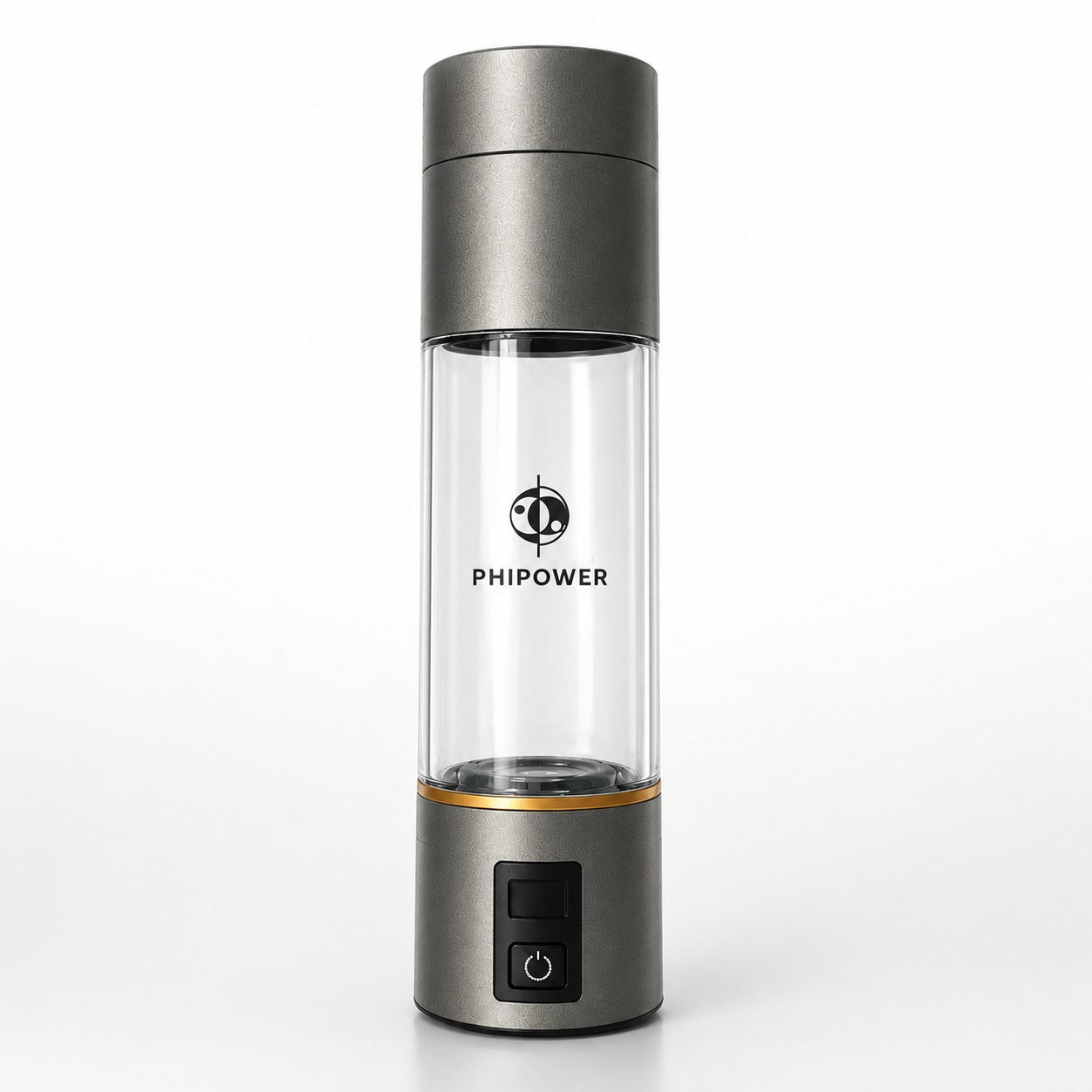
What does 1500, 3000 or 6000 ppb mean in hydrogen water?
Hydrogen water concentration describes the amount of molecular hydrogen gas (H₂) dissolved in drinking water. 6000 ppb contains four times as much dissolved hydrogen per unit volume as 1500 ppb. However, a higher concentration does not automatically mean greater health benefits.
Many hydrogen water makers advertise concentrations such as 1500, 3000 or even 6000 parts per billion (ppb). What do they actually measure? Is 6000 ppb scientifically possible? How much hydrogen is in a glass of water? And does a higher concentration mean better performance? To answer these questions, we need to distinguish three different concepts:
This guide explains the differences and helps you evaluate hydrogen water makers using measurable technical characteristics rather than marketing claims alone.
Understanding ppm, ppb and mg/L
Hydrogen water concentrations are commonly expressed in parts per million (ppm), parts per billion (ppb) or milligrams per litre (mg/L). These units are closely related, but they are not identical definitions.
Hydrogen concentration conversion table
For scientific measurements, mg/L is often the clearest unit because it explicitly expresses the mass of hydrogen dissolved in a known volume of water.
Does 6000 ppb mean 6000 times more hydrogen?
No. The number describes parts per billion, not a multiplication factor compared with ordinary water. 6000 ppb equals 6 ppm. Compared with 1500 ppb, it represents a fourfold increase in dissolved H₂ concentration, provided both measurements are accurate and use the same basis.
Hydrogen water at 1500 vs 3000 vs 6000 ppb
The three concentrations most frequently encountered in hydrogen water generator specifications, side by side.
Calculated quantities, assuming the stated dissolved H₂ concentrations are present throughout the water at the time of measurement. Not measurements of any particular product.
Important distinction: a device advertised as capable of producing up to 6000 ppb does not necessarily deliver water containing exactly 6000 ppb after every generation cycle.
How much molecular hydrogen is actually in a bottle?
A concentration figure tells only part of the story. To calculate the total amount of dissolved H₂, you also need to know the water volume.
Example: a 270 ml hydrogen water bottle
Why bottle size matters
Measured 1500 ppb
Total 0.75 mg H₂
Measured 6000 ppb
Total 1.62 mg H₂
Despite containing less water, Bottle B holds more than twice the total dissolved H₂ at the stated concentrations. The opposite is also possible with other volumes and concentrations, which is why a fair comparison considers both the dissolved concentration and the water volume.
Does all this hydrogen enter the body?
Not necessarily. The calculated amount describes hydrogen dissolved in the water at a particular moment. Some may escape before or during consumption. The amount absorbed and its biological distribution depend on physiological factors that cannot be determined from a bottle’s ppm figure alone.
What is the maximum solubility of hydrogen in water?
Molecular hydrogen has relatively low solubility in water. Its equilibrium concentration depends primarily on hydrogen partial pressure and temperature.
Hydrogen solubility at atmospheric pressure
At approximately 25°C, water exposed to pure hydrogen gas at one atmosphere of hydrogen partial pressure reaches an equilibrium concentration of roughly:1
This value is often described as the saturation concentration of hydrogen in water. But saturation must be understood in context: it refers to equilibrium under specific pressure and temperature conditions, not an absolute limit under all circumstances.
What is Henry’s law?
Henry’s law describes the relationship between the concentration of a dissolved gas and its partial pressure above a liquid, under conditions where the law applies.
- C · equilibrium dissolved-gas concentration
- kH · Henry’s law solubility constant at a stated temperature
- P · the gas’s partial pressure
In simple terms: increasing the hydrogen pressure above water can increase the equilibrium amount of hydrogen that dissolves. That explains why some systems can exceed 1600 ppb.
Can hydrogen water really reach 6000 ppb?
Yes. Concentrations above the ordinary reference equilibrium value are physically possible under suitable conditions, through elevated hydrogen partial pressure and transient supersaturation. Claims of 6000 ppb should still be assessed carefully: a valid measurement must establish that the sample genuinely contains about 6 mg/L of dissolved H₂, not confuse it with visible bubbles or headspace gas, and specify when and under what conditions it was measured.
What is supersaturated hydrogen water?
Supersaturation occurs when water contains more dissolved gas than would be present at equilibrium under its surrounding conditions. Water may temporarily contain 3 or 6 mg/L of dissolved H₂, even though its equilibrium under one atmosphere of pure H₂ near room temperature is about 1.6 mg/L. When conditions change, the water moves back toward equilibrium and hydrogen can leave the liquid.
How long does hydrogen stay dissolved in water?
Hydrogen concentration changes over time. After a generation cycle, some of the dissolved gas may escape as the water moves toward equilibrium with its surroundings.
What determines hydrogen retention?
Hydrogen does not vanish the moment a bottle is opened; it escapes over time, at a rate that depends on conditions. There is no universal five-, ten- or thirty-minute retention period that applies to every hydrogen water generator.
When should you drink hydrogen-rich water?
If you want to consume as much freshly generated H₂ as practical, drinking it shortly after preparation generally limits gas loss. A straightforward routine:
A more detailed guide, How Long Does Hydrogen Stay in Water?, is coming soon.
How is hydrogen concentration measured?
Reliable measurement is essential when comparing hydrogen water products. A concentration figure should represent actual dissolved molecular hydrogen, not an indirect electrical measurement or an estimate based on visible bubbles.
Why measurement timing matters
A reading taken immediately after generation may differ from one taken several minutes later, so devices should only be compared under similar conditions. For a useful report, record:
A documented measurement is more meaningful than an impressive concentration number without a test protocol.
Can ORP tell you how much hydrogen is in water?
No. Oxidation-reduction potential (ORP) is not a direct measurement of dissolved molecular hydrogen concentration.
ORP is reported in millivolts (mV) and measures an electrode potential influenced by the chemical conditions of a solution. Hydrogen-rich water may show negative ORP values under certain circumstances, but ORP also depends on:
Does a more negative ORP mean more H₂?
Not reliably. A 2022 article in Frontiers in Food Science and Technology examined the theoretical relationship between ORP and dissolved H₂ and showed why ORP cannot reliably be used to estimate or compare hydrogen concentrations.3 The International Hydrogen Standards Association also discourages ORP-based estimation of dissolved H₂.
Does 6000 ppb hydrogen water provide greater health benefits?
A higher dissolved concentration means more H₂ per litre, assuming accurate measurement. But there is currently insufficient high-quality clinical evidence to conclude that 6000 ppb hydrogen water produces better health outcomes than 1500 ppb.
What does scientific research show?
A 2024 systematic review by Dhillon and colleagues evaluated 25 studies of hydrogen-rich water.4 It identified areas of potential interest, including oxidative stress, exercise physiology and metabolic markers, but also highlighted small study populations, varying protocols and the need for more rigorous research. Many studies use different concentrations, volumes and schedules, which makes it difficult to isolate the effect of concentration alone.
Does four times the hydrogen mean four times the effect?
No. Biological responses are not necessarily proportional to the amount consumed. Even if a particular effect is eventually established, its relationship with exposure may depend on:
A reliable dose–response relationship has not yet been established for general use of hydrogen-rich drinking water.
What can be stated confidently: 6000 ppb represents a greater amount of dissolved H₂ per litre than 1500 ppb. That is scientifically measurable. It does not, by itself, demonstrate superior health benefits.
Evidence reviewHydrogen Water Benefits: What Does the Science Actually Say? →Is higher concentration always a sign of a better water maker?
Concentration is an important performance characteristic, but it should not be the only buying criterion. Consider two hypothetical hydrogen water makers:
Eight things to compare
A trustworthy hydrogen water maker should be evaluated as a complete product rather than by a single ppb number.
Why PEM/SPE technology matters for high-concentration hydrogen water
Many portable generators use membrane-based electrolysis. PEM stands for Proton Exchange Membrane, SPE for Solid Polymer Electrolyte. Electricity drives reactions that produce hydrogen and oxygen, while the membrane separates the electrochemical compartments and transports hydrogen ions.
Does PEM/SPE guarantee 6000 ppb?
No. Membrane-based electrolysis is useful for compact hydrogen generation, but the final dissolved concentration depends on the entire system:
Even two PEM/SPE generators may produce different dissolved concentrations. What matters most is the actual concentration in the finished water, measured with a suitable method. A high gas-production rate is not the same as a high dissolved concentration.
For a detailed technical explanation, read How Does a PEM/SPE Hydrogen Water Maker Work?.
Phipower Hydrogen Water Bottle: up to 6000 ppb
A compact approach to hydrogen-rich drinking water: according to its published specifications, the device combines dual-chamber PEM/SPE electrolysis with a compact rechargeable bottle.
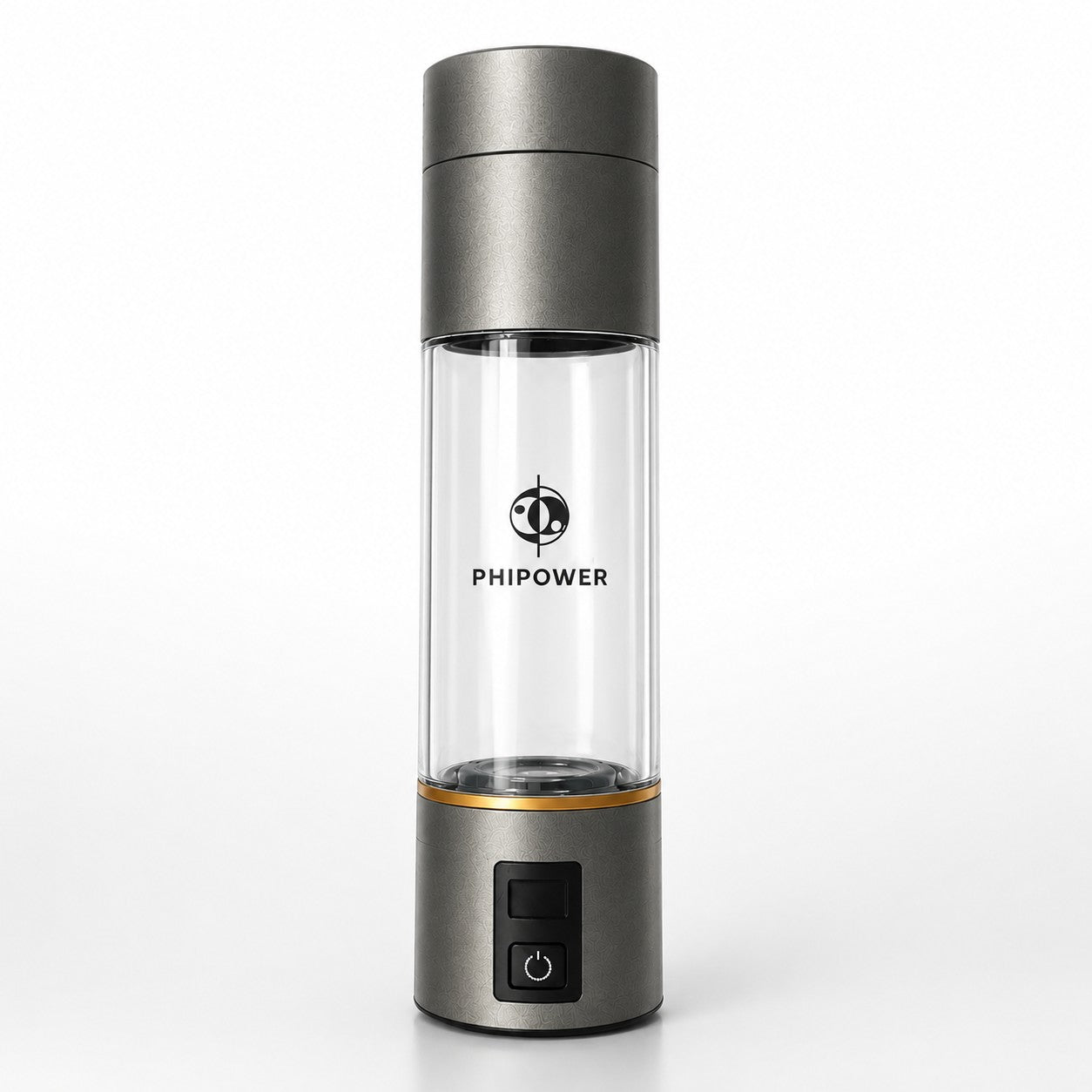
The device is intended for consumer wellness use. A higher H₂ concentration does not guarantee a specific health effect, and the product is not intended to diagnose, treat, cure or prevent disease.
Frequently asked questions about hydrogen water concentration
What does 6000 ppb mean in hydrogen water?+
It means a dissolved molecular hydrogen concentration of 6000 parts per billion, equivalent to approximately 6 ppm or 6 mg/L in water.
Is 6000 ppb better than 1500 ppb?+
It represents four times the dissolved H₂ concentration at the same water volume. However, greater health benefits have not been established.
Is 6000 ppb hydrogen water scientifically possible?+
Yes. Concentrations above the ordinary equilibrium value can be physically possible through suitable pressure or temporary supersaturation. Claims should be verified through reliable dissolved-hydrogen measurements.
What is the normal hydrogen saturation level in water?+
Near 25°C, water equilibrated with pure hydrogen gas at approximately one atmosphere of hydrogen partial pressure contains around 1.6 mg/L dissolved H₂.
Is 1600 ppb the absolute maximum hydrogen concentration?+
No. It is an approximate equilibrium value under specified conditions, not a universal upper limit.
Is 3000 ppb hydrogen water effective?+
A concentration of 3000 ppb means approximately 3 mg/L dissolved H₂. Whether that concentration produces a meaningful health benefit has not been established.
Does 6000 ppb contain four times as much H₂ as 1500 ppb?+
Yes, per equal volume, assuming both concentrations are measured accurately at the relevant time.
How much hydrogen is in 270 ml at 6000 ppb?+
Approximately 1.62 mg dissolved H₂, assuming a uniform concentration of 6 mg/L.
Does a higher ppm number always mean a better hydrogen generator?+
No. Product quality also depends on accuracy, repeatability, gas separation, materials, maintenance and overall safety.
Can ORP measure hydrogen concentration?+
No. ORP is not a hydrogen-specific measurement and should not be used to determine ppm or ppb values.
Can I measure hydrogen water with a TDS meter?+
No. A TDS meter estimates electrical conductivity related to dissolved ionic substances. It does not directly measure molecular hydrogen gas.
Does pH indicate the amount of hydrogen in water?+
No. pH measures acidity or alkalinity, not dissolved molecular hydrogen concentration.
How quickly does hydrogen escape from water?+
The rate depends on temperature, concentration, container design, exposure to air and agitation. There is no single retention time for all hydrogen water products.
Should hydrogen water be consumed immediately?+
Drinking it shortly after preparation generally reduces the opportunity for dissolved H₂ to escape.
Can you get 6000 ppb from an ordinary water filter?+
Ordinary filtration does not generally generate high concentrations of molecular hydrogen. Producing hydrogen-rich water requires an appropriate H₂ generation or dissolution method.
Can a hydrogen water bottle be tested independently?+
Yes. Dissolved H₂ can be measured using properly calibrated hydrogen-specific instruments or suitable laboratory analytical methods.
Explore more in the Hydrogen Water Knowledge Cluster
Understanding concentration is one part of understanding hydrogen-rich water.
- Hydrogen Water: The Complete GuideWhat hydrogen-rich water is, how it is produced, what studies investigate and how to evaluate water makers.Read →
- Hydrogen Water Benefits: What Does the Science Actually Say?The difference between preliminary research findings and established health benefits.Read →
- How Does a PEM/SPE Hydrogen Water Maker Work?How electrolysis, membranes, electrodes and gas separation influence hydrogen generation.Read →
- Molecular Hydrogen: Drinking vs InhalingHow hydrogen-rich water compares with hydrogen inhalation as a delivery method.Read →
- How Long Does Hydrogen Stay in Water?Retention, solubility, storage and the physical factors that influence dissolved H₂.Coming soon
- Is Hydrogen Water Safe?Drinking-water quality, equipment materials, maintenance and the limits of safety research.Coming soon
- How to Choose a Hydrogen Water MakerGenerator technology, concentration claims, independent testing, build quality and convenience.Coming soon
- Hydrogen vs Alkaline vs Structured Water: What’s the Difference?How hydrogen, alkaline and structured water compare: definitions, measurements and evidence.Coming soon
- Best Hydrogen Water Maker: 12 Buying TipsHow to compare PEM/SPE technology, H₂ concentration, electrodes, safety, maintenance and total value before buying a hydrogen water maker.Coming soon
Conclusion: concentration matters, but accurate measurement matters more
The difference between 1500, 3000 and 6000 ppb is straightforward from a chemical perspective. At equal volumes:
These are measurable physical differences. But a higher number is not automatically evidence of better health outcomes or a better product. A meaningful comparison requires accurate dissolved H₂ measurements, the water volume, appropriate testing conditions and an understanding of retention. Research is ongoing, and there is no established general-use concentration that guarantees a particular health benefit.
Consumers should understand not only how much hydrogen a device claims to produce, but how that concentration is measured, what it means and what conclusions can responsibly be drawn from it.
A transparent approach to hydrogen technology begins with measurable facts.
Scientific and technical references
-
Molecular Hydrogen Institute. Concentration and Solubility of H₂. Updated February 2026. Read the technical reference
Dissolved H₂ concentration, Henry’s law, saturation, partial pressure and ppm/mg/L conversions. -
International Hydrogen Standards Association. Methods for Determining the Hydrogen Concentration. Read the measurement guidance
Gas chromatography, hydrogen-specific electrodes, limitations of ORP and mg/L as a unit. -
LeBaron T.W. et al. (2022). ORP should not be used to estimate or compare concentrations of aqueous H₂: An in silico analysis and narrative synopsis. Frontiers in Food Science and Technology, 2. DOI: 10.3389/frfst.2022.1007001
Why oxidation-reduction potential cannot reliably quantify dissolved H₂. -
Dhillon G. et al. (2024). Hydrogen Water: Extra Healthy or a Hoax? A Systematic Review. International Journal of Molecular Sciences, 25(2), 973. DOI: 10.3390/ijms25020973
Systematic review of 25 publications on the emerging evidence and limitations of hydrogen-rich water research. -
Molecules (2022). Electrolyzed–Reduced Water: Review I. Molecular Hydrogen Is the Exclusive Agent Responsible for the Therapeutic Effects. Molecules, 27(22), 7690. Read the review
Therapeutic interpretations in this review should be regarded as research claims, not established clinical benefits.
Scientific and technical disclaimer: this article is intended for educational purposes. Calculated hydrogen amounts assume that the stated dissolved concentrations have been accurately measured and remain present at the relevant time. Product specifications should not be confused with independent laboratory verification or guaranteed health outcomes. Research into hydrogen-rich water is ongoing. Phipower consumer wellness products are not intended to diagnose, treat, cure or prevent disease. Always use safe drinking water and follow the manufacturer’s instructions.