
Meditation Pyramid: The Complete Guide to Pyramid Meditation, Geometry & Practice
A meditation pyramid creates a defined geometric space for stillness, breathwork and contemplation. This guide explores what a meditation pyramid is, how to use one, what meditation research can tell us, what remains unproven about "pyramid energy," and how the Phipower Meditation Pyramid is designed for practical daily use.
The strongest evidence is for meditation itself. Whether pyramid geometry adds a distinct physiological or energetic effect remains an open question that requires better controlled research — so this guide keeps the two claims separate.
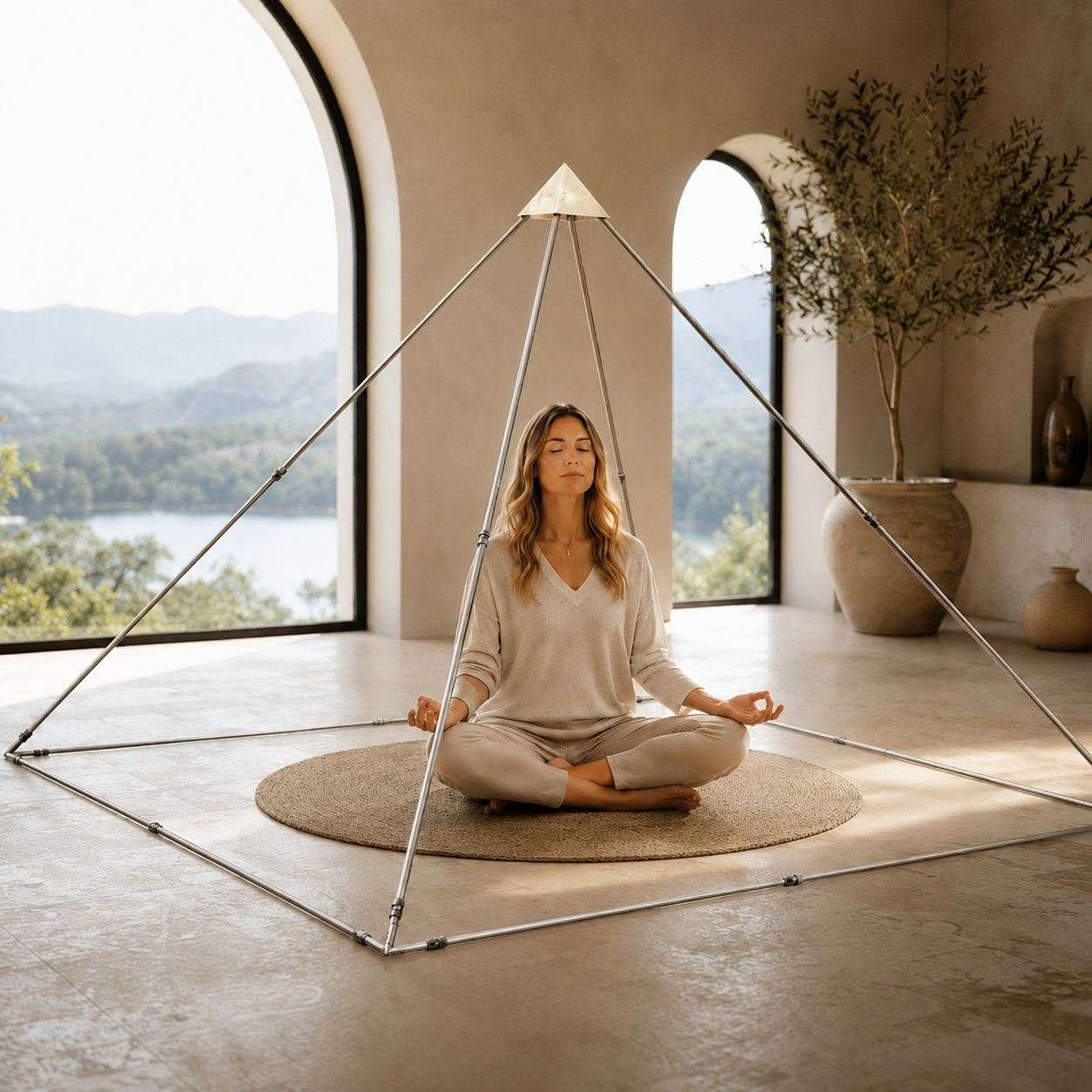
Start with the practice itself — what pyramid meditation is and what a first session looks like.
Start with the beginner guide →Jump straight to the Cheops proportions, the evidence review and the pyramid-energy claims, all covered below.
Explore geometry & evidence ↓Compare geometry, usable space, stability, assembly and claims before choosing a product for your own practice.
Read the buying guide →What is a meditation pyramid?
A meditation pyramid is an open geometric frame with four triangular faces converging toward one apex, sized so a person can sit or lie within its footprint during meditation. Its purpose works at several levels: practical — it marks out a dedicated meditation space; visual — the converging lines draw attention upward and inward; ritual — assembling, entering and sitting beneath the structure can become part of a repeated practice; and symbolic — pyramids are long associated in modern spiritual culture with stability, ascent, sacred geometry and transformation. None of those functions require claiming that the structure generates a new form of physical energy.
Why have pyramids become associated with meditation?
Pyramids are among the most visually powerful geometric forms in architecture. Their broad base and converging sides naturally suggest stability below and a single point of focus above. Modern meditation pyramids are often connected to ancient civilizations and to the Great Pyramid of Giza — that historical imagery is an important part of the modern tradition. But modern claims that ancient pyramids were built specifically as "energy resonators" or therapeutic devices go beyond what archaeological evidence establishes.

Meditation pyramid geometry: why shape matters experientially
A pyramid reduces visual complexity to a few strong lines. Viewed from inside, those lines converge toward one apex, which can make the structure feel more intentional than meditating in an undefined room. That is an architectural and attentional explanation — not proof of a special energy field.
What does "Cheops geometry" mean?
The Phipower Meditation Pyramid is built to Cheops dimensions — referring to the Great Pyramid of Khufu (Cheops) at Giza. The most useful way to describe this is as a design proportion inspired by the Great Pyramid: it gives the structure a recognizable geometric reference without claiming that reproducing those proportions recreates a scientifically proven energetic property of the ancient monument.
What can meditation itself do?
Meditation has a much stronger evidence base than pyramid-specific claims. Modern research includes mindfulness-based stress reduction, focused-attention meditation, breath awareness and other practices. Meta-analyses of randomized studies report modest reductions in stress, anxiety or depressive symptoms in several populations, though effect sizes, certainty and comparator groups vary.
Stress & anxiety
Recent meta-analyses of mindfulness-based interventions report improvements in perceived stress and anxiety in some populations. These findings support meditation practice in general.
Attention & brain dynamics
EEG and neuroimaging studies show meditation practices can be associated with changes in attention-related neural dynamics. The pattern depends on the type and experience level of meditation.
Does pyramid meditation work better than ordinary meditation?
At present, the evidence is not strong enough to say that it does. There are small and exploratory studies involving people meditating in pyramid environments — one often-cited EEG study involved only 15 meditators and compared measurements before and after meditation under a pyramid, a design that cannot isolate the effect of geometry from the meditation itself, expectation, time or environment. A 2026 high-density EEG study recorded experienced focused-attention meditators at Pyramid Valley International and reported meditation-related microstate dynamics — valuable meditation research, but the pyramid environment was not isolated as the causal experimental variable.
What about "pyramid energy"?
The term pyramid energy is widely used in alternative and spiritual literature to describe a proposed field or concentrating effect created by pyramid geometry — claims include amplification of cosmic energy, enhancement of the Earth's magnetic field, preservation of food, improved plant growth, pain relief, healing and expanded consciousness. These claims circulate widely, but they should not be repeated as established facts.
| Claim | Evidence-led Phipower position |
|---|---|
| The pyramid creates a measurable healing energy field. | Not established |
| The pyramid can create a distinctive meditation environment. | Yes — experiential / design claim |
| Meditation can alter attention and subjective state. | Supported broadly |
| Pyramid geometry causes alpha/theta changes beyond meditation itself. | Insufficient evidence |
| Users may report warmth, tingling, calm or altered spatial awareness. | Possible subjective reports |
| Those sensations prove an energy field exists. | No |
Why can meditating inside a pyramid feel different?
You do not need a new form of physics to explain why a session may feel different.
Defined space
Entering a dedicated structure can signal that ordinary activity has stopped and contemplative practice has begun.
Converging attention
Symmetry and the apex can create a strong visual and spatial anchor.
Repetition
Using the same environment repeatedly may make it easier to settle into a familiar practice.
Meaning matters
Beliefs, context and expectation can influence subjective experience — that does not make the experience unreal, it changes how we interpret its cause.
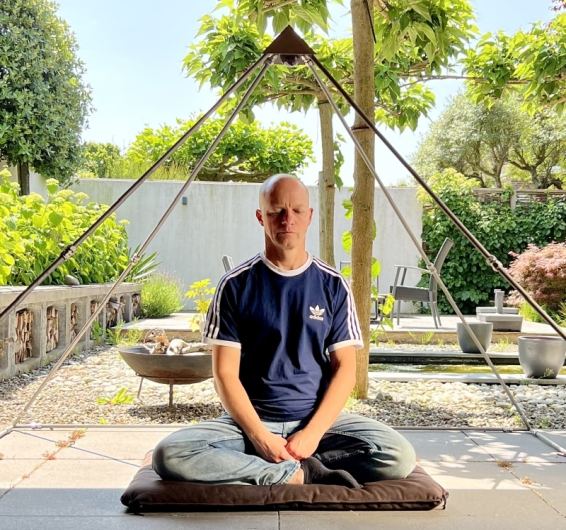
Meditation pyramid benefits
The strongest benefits should be framed around the practice environment rather than unverified energetic mechanisms.
- Creates a dedicated space for regular meditation.
- Provides a clear geometric focal environment.
- Can support breath awareness, mantra, visualization or silent sitting.
- May help some users experience a stronger sense of ritual, focus or separation from external activity.
- Can be used indoors or, in appropriate conditions, outdoors.
- Can make a personal meditation practice visually distinctive and intentional.
Users may also report calm, warmth, tingling, spaciousness or a sense of intensified focus. These are valid subjective experiences, but they are not marketed here as proof of a specific field or medical effect.
How to use a meditation pyramid
Choose your place
Use a calm, stable, uncluttered surface where the frame can stand securely.
Set your position
Sit or lie comfortably so your body is centered within the usable space.
Choose a practice
Breath awareness, mantra, visualization, prayer or open monitoring all work.
Stay consistent
Begin with 10–20 minutes and build a routine that suits you.
Where should you sit?
Centering your body within the frame is a sensible practical instruction. The claim that one exact point contains the strongest "pyramid energy" is not scientifically established. Center yourself comfortably, avoid forcing posture to match the geometry, keep enough clearance from the frame, and prioritize stable breathing and relaxed alignment.
Should it face magnetic north?
Some traditions recommend aligning one side with magnetic north. There is no strong evidence that north alignment is necessary for meditation or that it measurably amplifies a pyramid-specific field. If directional alignment is meaningful to you, use it as a consistent ritual — if not, place the pyramid where it feels practical and peaceful. Either approach can support meditation.
How long should you meditate?
There is no scientifically established pyramid-specific session length. 10–15 min is a manageable start for learning to settle attention, 20–30 min suits a more developed breath, mantra or mindfulness session, and 30+ min works once longer sessions are already comfortable.
Which methods work inside it?
The geometry does not require one specific technique: focused attention on breath or a mantra, open monitoring, body scan, visualization using the apex or symmetry, prayer or contemplation, and sound practice such as humming or singing bowls all work well.
Choose a level surface with enough clearance around the frame.
Use only in calm weather and on stable ground. Wind can turn a lightweight geometric frame into a safety risk — avoid storms, strong wind or moisture that could damage components.
Which size meditation pyramid?
One complete Phipower kit builds two configurations at the same Cheops proportions. Exact suitability depends on your height, preferred sitting or lying posture and available floor space.
Approx. 140 cm high
Enough physical space to sit — or fully recline — beneath the frame.
Approx. 77 cm high
A smaller top pyramid for a chair, treatment table or altar — ideal where portability matters most.
What is the amethyst orgonite sphere?
The Phipower pyramid includes an orgonite sphere containing amethyst crystals and a copper spiral that can be positioned at the apex. Orgonite traditions describe such objects in terms of orgone, prana or life energy — concepts with cultural and spiritual meaning for some users, but not established physical energy categories in conventional science.
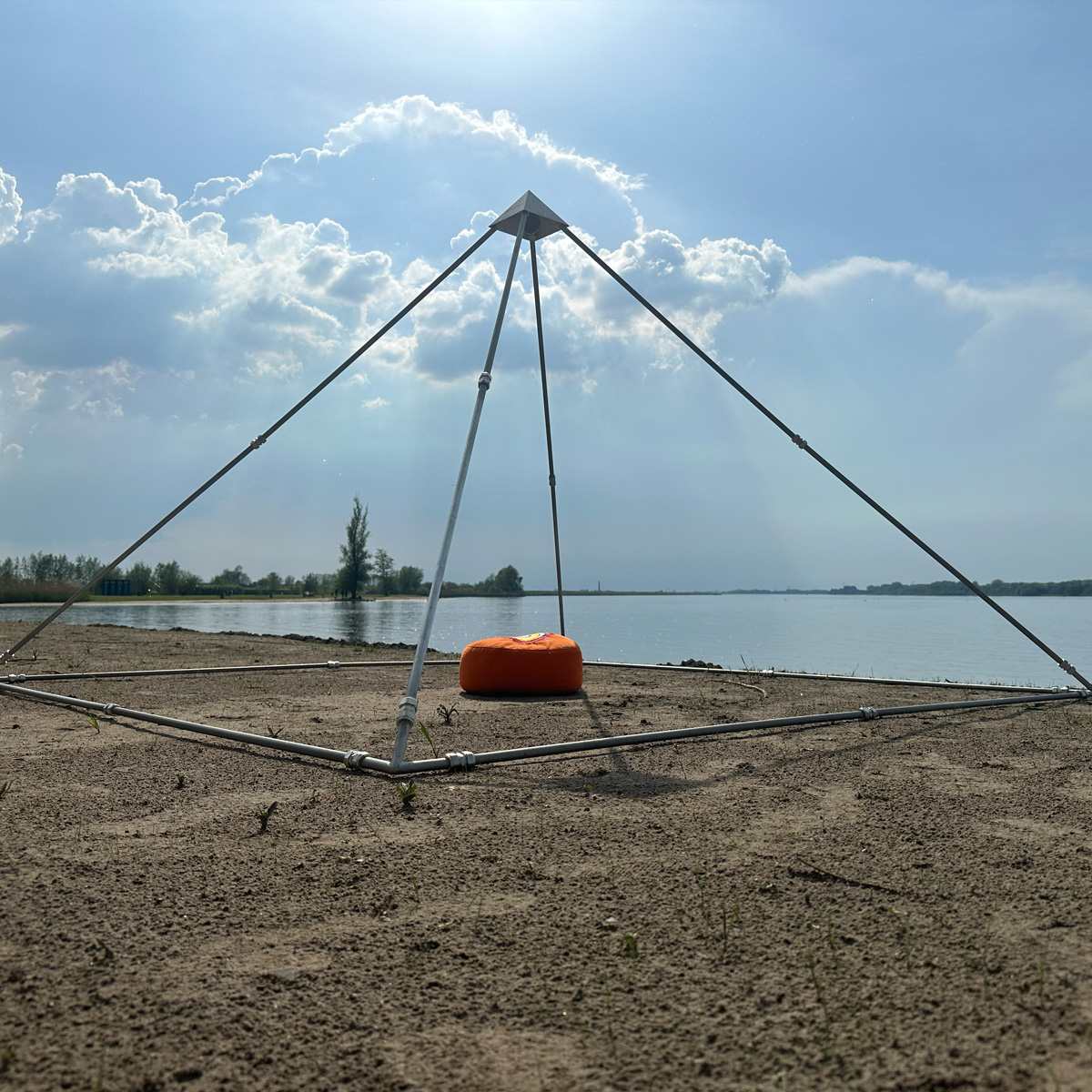
The Phipower Meditation Pyramid
A handcrafted, portable meditation structure inspired by the proportions and 51.83° angle of the Great Pyramid of Giza. One complete kit builds two sizes: a large 140 cm pyramid to sit beneath, or a compact 77 cm version for a chair, treatment table or altar.

How Phipower could research pyramid meditation properly
Because the Meditation Pyramid is a Phipower product, there is an opportunity to create original first-party research instead of repeating decades-old pyramid-energy claims. A useful study design would compare the same meditation practice inside the pyramid, the same practice in the same room without the pyramid, and ideally a visually comparable control structure that does not use the pyramid geometry — measuring subjective calm and focus ratings, heart-rate variability, EEG or attention measures with qualified researchers, session adherence, and blinded or partially blinded environmental measures where feasible.
- Assemble the structure exactly as instructed and check all connectors.
- Place it on a stable, level surface.
- Keep children and pets from climbing on the frame.
- Do not suspend heavy objects from the apex unless the product is specifically designed for them.
- Use caution outdoors and avoid strong winds.
- If meditation brings up distressing psychological experiences, stop the session and seek appropriate professional support if needed.
Meditation Pyramid Knowledge Cluster
From what a meditation pyramid is to how to choose one — every guide in one place, grouped by the question it answers.

What Is Pyramid Meditation? A Beginner's Guide
The basics: what a meditation pyramid is, where the practice comes from, and how to start.

Meditation Pyramid Benefits: Experience, Claims & What Science Says
A closer look at reported benefits — separating what's supported by research from what isn't.

How to Choose a Meditation Pyramid
A 9-point checklist covering geometry, size, stability, materials, assembly and how to evaluate energy claims.
Fundamentals
What a meditation pyramid is, where the practice comes from, and the geometry behind the frame.
Reported effects & evidence
What practitioners report, what research says, and what a first session actually feels like.
Practice
Posture, placement, direction, crystals and combined practices — how to actually use a pyramid.
Choosing & professional use
A 9-point buying checklist and multi-unit use for retreats, studios and group sessions.
Meditation pyramid FAQ
Short answers to the questions most likely to bring visitors to this pillar. The sections above provide the deeper explanation.
Every claim traceable to its source.
Each scientific claim on this page links to its underlying source where available. Historical documentation, independent research and spiritual traditions stay clearly separated.
- Mindfulness-Based Stress Reduction and mental health outcomes (2024)
Supports modest improvements in stress, anxiety and related outcomes — evidence for mindfulness practice, not pyramid geometry. - Mindfulness meditation and sleep quality — meta-analysis
Illustrates why meditation outcomes should be described with nuance: results differ by control comparison. - Microstate Dynamics of Focused Attention Meditation — Brain Topography (2026)
High-density EEG at Pyramid Valley International; does not isolate pyramid geometry as the causal variable. - Architectural geometric forms and brainwaves
Useful historical context, but the small pre/post designs cited are not strong enough to prove a pyramid-specific effect.
A meditation pyramid can be valuable without requiring exaggerated claims.
That combination gives Phipower a stronger story: respect the tradition, enjoy the experience, test the claims and keep the evidence visible.
The Phipower Meditation Pyramid is a wellness and meditation product, not a medical device. This page is educational and does not claim that pyramid geometry diagnoses, prevents, treats or cures disease. Spiritual and energetic interpretations are described as traditions, beliefs or subjective experiences unless supported by appropriate scientific evidence.
Assemble the structure, enter the space, choose your practice.
The Phipower Meditation Pyramid is designed to make meditation feel intentional — and to return to, consistently.