
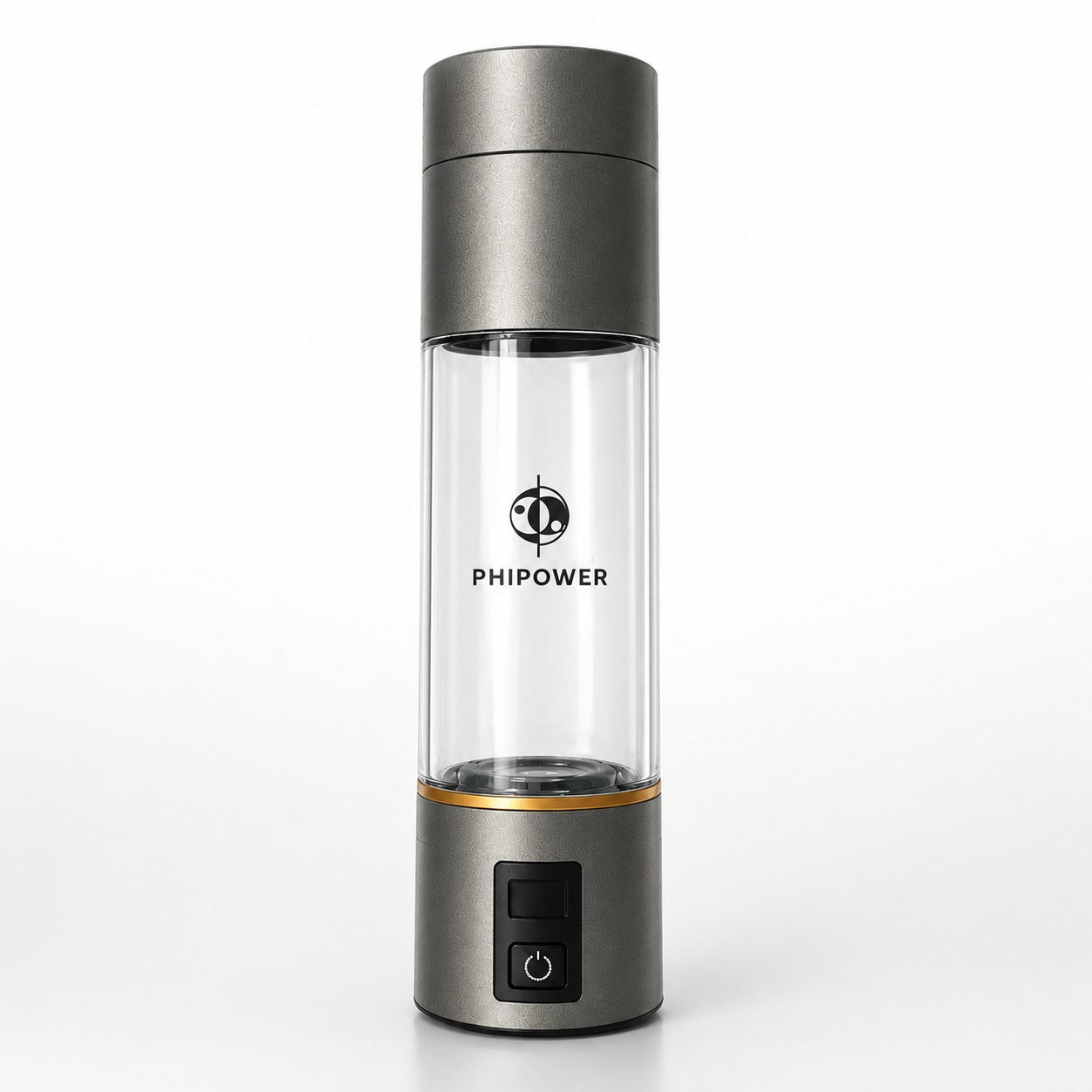
How long does hydrogen stay in water?
Molecular hydrogen (H₂) can remain dissolved in drinking water for minutes, hours or potentially longer, depending on temperature, container, pressure, exposure to air and storage. Once hydrogen-rich water is opened and exposed to ordinary air, dissolved H₂ generally begins to escape. However, it does not disappear instantly.
There is no universal expiration time for hydrogen-rich water. An open glass, a tightly sealed bottle and a specially designed hydrogen-retaining pouch can all behave differently.
Research involving specially prepared supersaturated hydrogen water found that substantial concentrations could be maintained in unopened containers for several days; after opening, concentrations decreased significantly over the following hours.1 This does not mean every commercial hydrogen water bottle will retain H₂ for days: the experimental systems, pressure conditions and packaging were important to the results.
The practical recommendation: prepare hydrogen-rich water shortly before you intend to drink it. This reduces the time available for dissolved hydrogen to escape.
Hydrogen retention at a glance
General physical trends, not guaranteed performance figures for a particular bottle.
Why does molecular hydrogen escape from water?
Hydrogen-rich water contains molecular hydrogen gas physically dissolved in ordinary water. The extra H₂ molecules are not chemically bonded to the H₂O molecules, so they can move between the liquid and the surrounding gas phase.
The role of gas equilibrium
Gases dissolve in liquids according to temperature, pressure and chemical equilibrium. Henry’s law describes the relationship between the equilibrium concentration of a dissolved gas and its partial pressure above the liquid:
- C · equilibrium dissolved-gas concentration
- kH · temperature-dependent solubility coefficient
- P · partial pressure of the gas
At approximately 25°C, water exposed to pure H₂ at one atmosphere can dissolve about 1.6 mg/L at equilibrium. Ordinary air, however, contains only a very small proportion of hydrogen, so hydrogen-rich water exposed to air tends to release H₂ until it approaches a much lower equilibrium concentration.
The important principle: dissolved hydrogen is dynamic, not permanently locked into the water.
Does hydrogen disappear immediately after opening the bottle?
No. This is one of the most common misconceptions about hydrogen-rich water.
Although hydrogen begins to escape when conditions favour gas release, the process takes time. The concentration decreases progressively rather than instantly becoming zero.
What does the research show?
A 2015 study by Kurokawa and colleagues examined specially prepared supersaturated hydrogen water in sealed containers and how concentrations changed after opening.1 In one preliminary experiment, the reported dissolved concentrations were approximately:
The experiment involved a particular supersaturated-water preparation and repeated removal of water from the container. It shows that measurable hydrogen can remain after opening, while also showing substantial loss over time.
These measurements should not be interpreted as a universal retention curve. Other containers, volumes, temperatures and initial concentrations may behave differently.
In practice: hydrogen water does not become ordinary water instantly after opening. But if retaining as much freshly generated H₂ as practical is your goal, drinking it soon after preparation makes sense.
What is the half-life of hydrogen in water?
Half-life is the time required for a measured concentration to fall to half its initial value under defined conditions; for example, from 4 mg/L to 2 mg/L. Unlike radioactive decay, hydrogen loss from water is not governed by one universal half-life.
Why is there no fixed half-life?
A wide, shallow glass may lose hydrogen differently from a tall, narrow bottle with the same amount of water. Continuously stirred water may behave differently from undisturbed water.
C(t) is the concentration at time t, C₀ the initial concentration and k an experimentally determined rate constant. Real systems do not necessarily follow a perfect exponential curve, especially when pressure changes, bubbles form or container conditions vary.
A measured decay curve is more informative than a universal claim that hydrogen disappears after a fixed number of minutes.
Does temperature affect hydrogen retention?
Yes. Temperature influences both the solubility of hydrogen and the speed of gas transfer. As a general trend, cooler water can favour retention compared with warmer water under otherwise comparable conditions, although the relationship becomes more complex in systems still generating H₂ or under pressure.
What does scientific research show?
A 2019 study by Sonobe, Ariumi and Yoshiyama examined five commercial hydrogen-water products stored at 26°C and 37°C, packaged in aluminium pouches, aluminium cans and plastic bottles.2 Results differed substantially. One aluminium-pouch product maintained its measured concentration over the 120-day observation period at both temperatures, while other products lost more hydrogen at the higher temperature. Storage temperature and packaging interact; the findings do not establish a universal shelf life.
Should you store your hydrogen generator in the refrigerator? Not unless the manufacturer expressly permits it. A rechargeable generator contains electronics, seals and an electrolysis system with specific storage requirements. Advice for packaged hydrogen water does not apply to an electronic generator.
Does the type of bottle affect hydrogen retention?
Yes. The material, closure system and overall construction of a container can influence how effectively it retains dissolved hydrogen.
Comparing different containers
The best container depends on whether the goal is freshly generated water, short-term storage or commercially packaged hydrogen water.
Why does headspace matter?
Headspace is the gas-filled volume above the liquid inside a container. It plays a significant role in dissolved gas equilibrium.
Should you fill a bottle completely? Follow the manufacturer’s recommended fill level. Never exceed the specified capacity of a hydrogen-generating device to improve retention: electrolysis systems may need designated gas spaces to operate safely. Do not pressurise, modify or overfill an ordinary drinking bottle.
Does shaking, stirring or vortexing remove hydrogen?
Agitation can increase gas exchange between water and the surrounding atmosphere, especially when hydrogen-rich water is supersaturated or exposed to air.
Can you combine structured water and hydrogen water?
Yes, water that has undergone a physical preparation process may subsequently be enriched with molecular hydrogen. Combining vortexing with hydrogen generation has not been shown to create additional medical benefits. If the goal is to preserve dissolved H₂, a sensible sequence is:
This minimises unnecessary agitation after hydrogen enrichment. Learn more in the Phipower Structured Water Knowledge Guide.
Does hydrogen water lose its properties overnight?
It may lose some or much of its dissolved hydrogen overnight, depending on how it is stored. The answer is not the same for every product.
Is it still safe to drink the next day? Hydrogen concentration and drinking-water safety are separate issues. Losing dissolved H₂ does not make safe water unsafe, but water can become contaminated through handling, an unclean container or improper storage. Hydrogen enrichment is not a substitute for normal drinking-water hygiene.
Can you preserve hydrogen water for several days?
Some specially prepared and packaged hydrogen-water products can retain measurable concentrations over several days. This should not be assumed for ordinary drinking bottles.
If a product claims long-term retention, look for:
A claim such as “retains hydrogen for seven days” is incomplete without this context.
How can you measure hydrogen loss over time?
The best way to determine retention is to measure actual dissolved H₂ under controlled conditions, using calibrated dissolved-hydrogen sensors, validated membrane-based instruments, gas chromatography with appropriate sample preparation or other validated hydrogen-specific methods.4 ORP is not a reliable substitute for direct H₂ measurement.
A practical hydrogen retention test
Suggested research intervals, not established half-life values or recommended drinking times.
- Fresh hydrogen water in an open glass.
- Fresh hydrogen water in a suitable sealed container.
- Water stored at different controlled temperatures.
- Different container materials under similar conditions.
A generator’s advertised maximum concentration tells you what it claims to achieve under particular conditions. Retention measurements tell you what happens afterwards. Both are useful, but they describe different aspects of performance.
How to keep hydrogen-rich water fresh
For most people, the simplest approach is to minimise unnecessary storage.
These steps help manage measurable physical conditions. They do not establish a particular health benefit.
Fresh hydrogen water with the Phipower Hydrogen Water Bottle
Prepare molecular hydrogen when you need it. Rather than storing prepared hydrogen water for long periods, the device builds a rechargeable hydrogen generator into a compact drinking bottle.
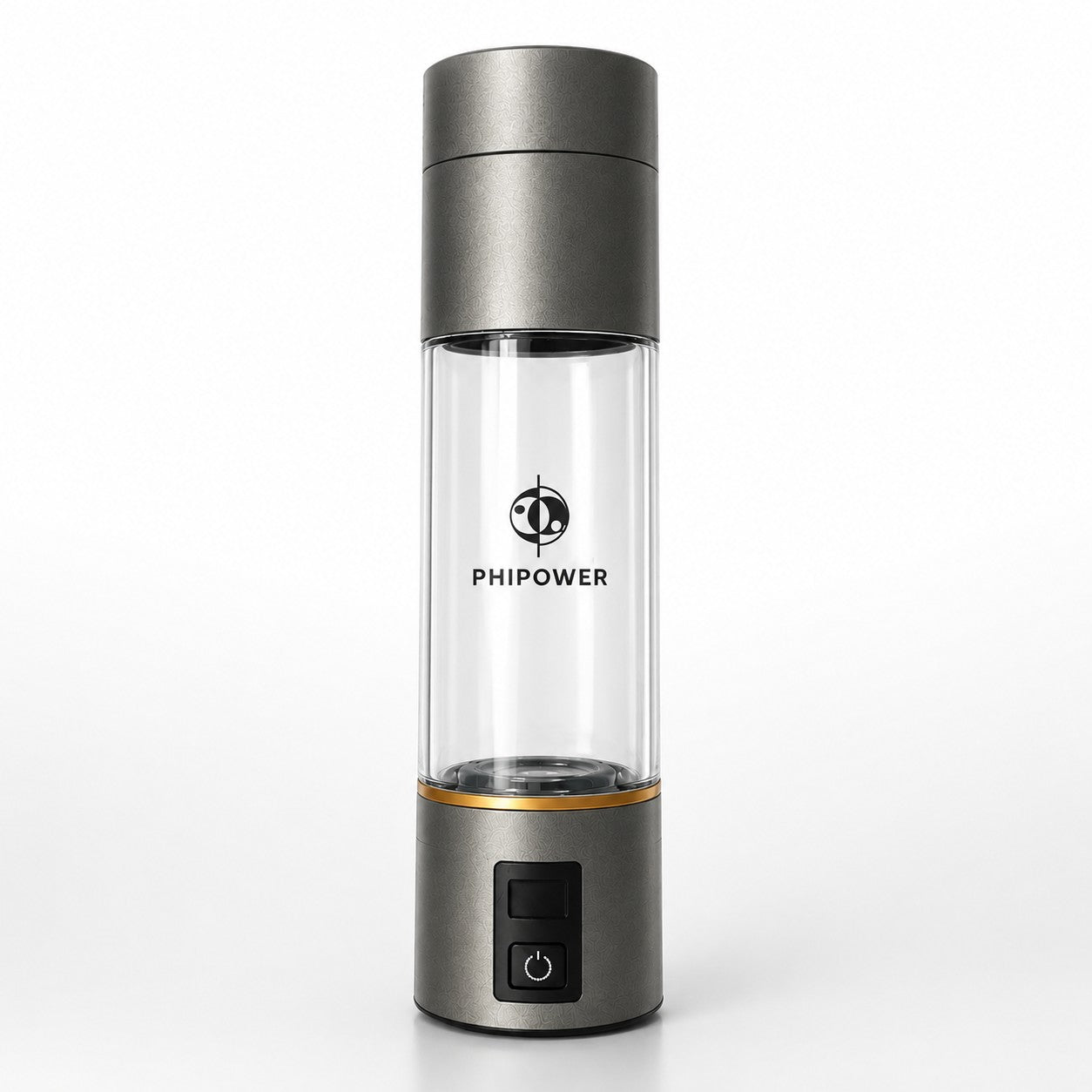
Manufacturer-published specifications. Actual dissolved H₂ varies with operating conditions and should be verified with an appropriate measurement method.
Why fresh generation makes sense
Hydrogen-rich water can gradually lose dissolved H₂ after production. Generating it shortly before drinking means less reliance on the gas-retention properties of an external storage container. The routine is simple:
The Phipower Hydrogen Water Bottle is a consumer wellness device. Its technical specifications do not establish medical benefits or guarantee a particular physiological outcome.
Frequently asked questions about hydrogen water retention
How long does hydrogen stay in water after opening?+
It depends on the temperature, water volume, exposed surface area, agitation and initial concentration. Hydrogen begins escaping when conditions favour gas release, but it does not disappear instantly.
Does hydrogen water lose hydrogen after five minutes?+
Some loss may occur within five minutes, but the amount depends on the conditions. There is no universal rule that all dissolved H₂ disappears after five minutes.
Does hydrogen water still contain H₂ after one hour?+
It can. Experimental research has demonstrated measurable dissolved hydrogen after one hour under particular conditions. The remaining amount depends on the sample and storage method.
Does hydrogen water last 24 hours?+
Some specially packaged hydrogen-water products retain measurable H₂ for 24 hours or longer. An ordinary open glass or portable bottle should not be assumed to do so.
Can hydrogen water be stored overnight?+
Yes, water can be stored in a suitable clean container, but its dissolved hydrogen concentration may decrease. The amount retained overnight requires measurement.
Is hydrogen water better when consumed fresh?+
Freshly generated hydrogen water generally provides a shorter interval for dissolved H₂ to escape. This can help retain more of the initial concentration, but it does not prove superior health outcomes.
Does refrigeration preserve hydrogen water?+
Cooler temperatures can favour hydrogen retention under appropriate conditions. However, the result depends on the container, seal and storage conditions. Do not refrigerate electronic generators unless the manufacturer permits it.
Can hydrogen water be frozen?+
Freezing changes how dissolved gases are distributed between water, ice and gas spaces. It should not be assumed to preserve the original H₂ concentration. Do not freeze water inside an electronic hydrogen generator or unsuitable sealed container.
Does shaking hydrogen water remove hydrogen?+
Agitation can increase gas exchange and may accelerate hydrogen loss, particularly in an open or supersaturated system.
Does boiling remove hydrogen from water?+
Heating and boiling promote dissolved gas release. Boiling previously prepared hydrogen-rich water will generally reduce its dissolved H₂ concentration substantially.
Is hydrogen retained better in glass or plastic?+
Glass generally provides a stronger barrier against gas permeation through the wall than many ordinary plastics. However, the closure, headspace and overall construction matter.
Does a stainless steel bottle preserve hydrogen?+
A suitably designed metal container may reduce gas permeation through its walls. Retention still depends on its closure and suitability for the intended conditions.
Can hydrogen escape from a sealed bottle?+
Yes. H₂ can move into the headspace, through permeable materials or through imperfect seals. A sealed bottle is not automatically a perfectly closed system for hydrogen.
Does hydrogen water lose its H₂ if poured into a glass?+
Pouring can increase gas–liquid contact and agitation, potentially causing some hydrogen to escape. The amount depends on the conditions.
Can I add lemon or minerals to hydrogen water?+
Adding substances changes the water’s composition and may influence gas transfer or measurement conditions. If using a hydrogen water generator, add nothing to the device unless the manufacturer explicitly permits it.
Is ORP a reliable way to test hydrogen retention?+
No. ORP is not a direct H₂ concentration measurement. Use a suitable hydrogen-specific method.
Does losing hydrogen make the water unsafe?+
Not by itself. Hydrogen loss changes the dissolved gas concentration, not necessarily drinking-water safety. Contamination and hygiene are separate concerns.
What is the best way to keep hydrogen water fresh?+
For freshly generated water, prepare it shortly before consumption, avoid unnecessary agitation and follow the equipment manufacturer’s instructions.
Explore the Hydrogen Water Knowledge Cluster
Hydrogen retention is one of several important aspects of molecular hydrogen technology.
- Molecular Hydrogen (H₂): The Complete GuidePhysical properties of H₂, why researchers investigate it and how delivery methods compare.Read →
- Hydrogen Water: The Complete GuideHow hydrogen-rich water is produced, what PEM/SPE means and how hydrogen water makers work.Read →
- Hydrogen Water Benefits: What Does the Science Actually Say?Clinical studies, potential biological effects, oxidative stress research and important limitations.Read →
- How Does a PEM/SPE Hydrogen Water Maker Work?How electrolysis, proton exchange membranes and gas separation contribute to hydrogen generation.Read →
- Hydrogen Water Concentration: 1500 vs 3000 vs 6000 ppbCompare dissolved concentrations, understand solubility and calculate total dissolved H₂.Read →
- Hydrogen Water vs Hydrogen InhalationThe differences between drinking dissolved hydrogen and breathing H₂ gas.Read →
- Is Hydrogen Water Safe?Drinking-water quality, equipment maintenance, safety research and practical precautions.Coming soon
- How to Choose a Hydrogen Water MakerConcentration claims, generation technology, capacity, reliability and independent testing.Coming soon
- Best Hydrogen Water Maker: 12 Buying TipsHow to compare PEM/SPE technology, H₂ concentration, electrodes, safety, maintenance and total value before buying a hydrogen water maker.Coming soon
Conclusion: hydrogen retention depends on science, not a fixed countdown
Hydrogen-rich water contains molecular hydrogen physically dissolved in ordinary drinking water. Because H₂ moves between water and the surrounding gas phase, its concentration changes with temperature, pressure, agitation and storage. Scientific studies have demonstrated that:
- ✓Dissolved hydrogen does not disappear instantly after opening.
- ✓Concentrations generally decrease when hydrogen-rich water is exposed to ordinary air.
- ✓Temperature and packaging influence retention.
- ✓Certain specially prepared and sealed systems can retain measurable H₂ for extended periods.
- ✓Retention results from one product cannot automatically be applied to another.
Generate hydrogen-rich water fresh, minimise unnecessary handling and drink it reasonably soon after preparation.
Understanding the physical behaviour of molecular hydrogen is just as important as understanding the technology used to produce it. Reliable measurements and transparent explanations provide a stronger foundation than unsupported claims about concentrations or guaranteed health effects.
Scientific and technical references
-
Kurokawa R., Seo T., Sato B., Hirano S.-I. & Sato F. (2015). Convenient methods for ingestion of molecular hydrogen: drinking, injection, and inhalation. Medical Gas Research, 5, Article 13. DOI: 10.1186/s13618-015-0034-2
Hydrogen concentrations in specially prepared supersaturated water before and after opening sealed containers. The systems differ from ordinary portable bottles. -
Sonobe T., Ariumi H. & Yoshiyama Y. (2019). Effect of Temperature on Changes in the Concentration of H₂ in Commercial Hydrogen Water. Japanese Journal of Pharmaceutical Health Care and Sciences, 45(6), 344–349. DOI: 10.5649/jjphcs.45.344
Changes in dissolved H₂ across five commercially packaged products at different storage temperatures. -
Molecular Hydrogen Institute (updated 2026). Concentration and Solubility of H₂. Read the technical reference
Solubility, partial pressure, units and illustrative loss rates. The approximate half-life should not be treated as a universal value. -
International Hydrogen Standards Association. Methods for Determining the Hydrogen Concentration. Read the measurement guidance
Approaches to measuring dissolved H₂, including hydrogen-specific methods and the limits of indirect measurements. -
Dhillon G. et al. (2024). Hydrogen Water: Extra Healthy or a Hoax? A Systematic Review. International Journal of Molecular Sciences, 25(2), 973. DOI: 10.3390/ijms25020973
Why measurable H₂ exposure should not be confused with established clinical benefits.
Scientific and technical disclaimer: this article is for educational purposes. Hydrogen retention depends on specific measurement and storage conditions. Findings from one container or experimental system cannot be assumed to apply to every consumer product. Hydrogen-rich water is not an established medical treatment, and Phipower consumer wellness products are not intended to diagnose, treat, cure or prevent disease. Always use safe drinking water and follow the manufacturer’s operating and maintenance instructions.