
Is hydrogen water safe to drink?
Hydrogen water, also known as hydrogen-rich water (HRW), has generally been well tolerated in the short-term human studies conducted so far. However, long-term safety data remain limited, and the safety of a hydrogen water maker depends on more than the molecular hydrogen itself.
Hydrogen-rich water is ordinary drinking water containing additional dissolved molecular hydrogen gas (H₂). Molecular hydrogen is colourless, odourless and tasteless, and does not change water into a fundamentally different chemical compound. Several human trials have used hydrogen-rich water for periods ranging from days to several months without identifying major safety problems.
This does not establish that every hydrogen water product is safe under all circumstances, that long-term daily consumption is risk-free, or that a particular concentration suits everyone. Understanding hydrogen water safety requires three separate questions:
These distinctions matter because a safe dissolved gas does not automatically guarantee a safe finished product.
Hydrogen water safety: the key facts
What makes molecular hydrogen different from other substances?
Hydrogen is the most abundant element in the universe. Molecular hydrogen consists of two hydrogen atoms bonded together (H₂), one of the smallest molecules in nature. In drinking water it exists as dissolved gas rather than becoming chemically incorporated into the water molecules.
Hydrogen is not hydrogen peroxide
Hydrogen peroxide should never be confused with hydrogen-rich drinking water. The safety characteristics of H₂O₂ cannot be applied to H₂.
What happens to hydrogen after drinking it?
Some of the dissolved H₂ may be absorbed through the gastrointestinal tract, distributed through tissues and largely eliminated through exhalation. The fact that a molecule can enter the body does not prove a health benefit; likewise, its simple structure does not remove the need for proper safety research.
What do human studies say about hydrogen water safety?
Hydrogen-rich water has been investigated in a growing number of clinical trials. Many report good tolerability, but the findings need to be understood in context.
Research showing why caution is necessary
Not all studies report exclusively reassuring findings. In an eight-week randomised trial in patients with chronic mountain sickness, adverse events occurred in:4
Dizziness was the most frequently reported event. The difference does not establish that hydrogen water caused the symptoms: participants had a specific medical condition and dizziness occurred in both groups. It does show why adverse-event monitoring matters and why broad claims that hydrogen water has no side effects are inappropriate.
What can reasonably be concluded: hydrogen-rich water appears generally well tolerated in many small, short-term clinical studies, but the evidence is not sufficient to establish universal or lifelong safety. Larger trials with consistent adverse-event reporting and longer follow-up are still needed.
What are the possible side effects of hydrogen water?
The most accurate answer is that a characteristic, well-established side-effect profile has not yet been defined. That does not mean side effects are impossible.
Are headaches a sign of detoxification?
No. There is no reliable scientific evidence that headaches after drinking hydrogen water indicate a beneficial detoxification reaction. The liver and kidneys already process and eliminate substances. If symptoms develop after using a product, discontinue use and seek medical advice when appropriate.
Can you drink hydrogen water every day?
Daily consumption has been investigated in multiple clinical studies, some over several weeks or months, which shows repeated consumption is feasible under controlled conditions. However, there is no scientifically established daily dose of hydrogen-rich water that is optimal for everyone.
Is there a recommended daily hydrogen dose?
Not at present. Research protocols vary considerably in:
One study may use about 1–2 mg/L, another substantially higher concentrations. Research protocols are not universal consumer recommendations.
Should you drink more water to obtain more hydrogen?
No. Increasing fluid intake purely to increase hydrogen intake is not supported by clinical evidence. Drinking excessive amounts of water can be harmful, especially when large volumes are consumed rapidly or when the body cannot eliminate water normally. In extreme cases it may contribute to hyponatraemia, a potentially serious condition of abnormally low blood sodium. People advised to restrict fluid intake should follow their medical recommendations.
A sensible approach: for adults without medical reasons to restrict fluids, hydrogen-rich water may be part of the normal drinking-water routine, provided the water and equipment are suitable. There is no need for excessive volumes or unsupported high-dose protocols. Adequate hydration matters more than the additional dissolved H₂.
Is high-concentration hydrogen water safe?
Hydrogen water makers sometimes advertise 1500, 3000 or 6000 ppb, which refer to dissolved H₂ concentration.
The scientifically appropriate conclusion is that further controlled research is required. Learn more in Hydrogen Water Concentration: 1500 vs 3000 vs 6000 ppb.
Is a hydrogen water maker safe? Understanding electrolysis
A hydrogen water maker does not simply add a gas to water. In many devices, electrochemical reactions take place: electricity splits water into hydrogen (at the cathode) and oxygen (at the anode).
Why can electrolysis produce unwanted substances?
Under certain conditions, chloride-containing water can form unwanted chlorine-containing oxidants. Other possible concerns include ozone formation, material degradation or release of substances from unsuitable components. Whether these appear in significant amounts depends on the actual device and operating conditions.
What did a 2021 study find?
Hatae and Miwa investigated an electrolysis-based hydrogen water bottle using tap water. Under the conditions studied, several measured chlorine-related substances did not increase and ozone remained below the detection threshold.5 Certain designs can therefore control measured by-products under defined conditions.
But: the study evaluated one particular device. Its results cannot establish that every electrolysis-based hydrogen water maker is equally safe. Product-specific testing remains important.
Why does PEM/SPE technology matter for safety?
Many modern hydrogen water makers use PEM/SPE electrolysis: a Proton Exchange Membrane / Solid Polymer Electrolyte that conducts protons. Hydrogen and oxygen are generated in separate electrode compartments, and the membrane helps limit mixing between the gas streams.
The presence of a PEM membrane is an engineering characteristic, not proof of complete product safety. More in How Does a PEM/SPE Hydrogen Water Maker Work?.
Why drinking-water quality matters
A hydrogen water generator is not automatically a water purifier. It may add dissolved H₂ without removing bacteria, heavy metals, pesticides or other contaminants already present in the water.
What about BPA, plastics and other materials?
The safety of the drinking-water container is separate from the safety of dissolved hydrogen. Bottles may contain plastics, metals, seals and adhesives, which should all be appropriate for contact with drinking water.
Does BPA-free mean completely safe? No. BPA-free describes the absence of bisphenol A; it is not a complete assessment of all substances in a material. Appropriate material selection, manufacturing quality and migration testing remain important.
What should manufacturers verify?
For products on the European market, food-contact materials must comply with applicable legislation, including Regulation (EC) No 1935/2004 and, where relevant, rules for plastic food-contact materials.7 Depending on the material, declarations of compliance and migration-test documentation may be required. Useful documentation for a hydrogen water maker includes:
- ✓Food-contact material specifications.
- ✓Relevant material compliance declarations.
- ✓Appropriate migration testing.
- ✓Instructions on operating temperatures.
- ✓Cleaning and maintenance instructions.
- ✓Suitability of seals and electrolysis components.
Could poor maintenance make hydrogen water unsafe?
Yes. Like other reusable drinking-water equipment, hydrogen generators require appropriate cleaning and care.
Practical maintenance principles
- Use approved drinking water.
- Follow the cleaning instructions for the specific model.
- Avoid harsh chemicals unless explicitly permitted.
- Do not scratch or modify the electrodes or membrane.
- Keep electrical components dry where required.
- Stop using the device if it leaks, overheats, smells unusual or behaves abnormally.
- Replace damaged components through an authorised supplier.
Who should take additional precautions with hydrogen water?
Although many studies report favourable tolerability, certain groups need greater care because research is insufficient or their medical circumstances change the risks.
Hydrogen water versus hydrogen inhalation: different safety considerations
Drinking hydrogen-rich water and inhaling molecular hydrogen both involve H₂, but the methods are not interchangeable.
A portable hydrogen water maker should never be improvised into a medical respiratory device. Only use manufacturer-designated accessories according to the supplied safety instructions.
Learn more: Molecular Hydrogen: Drinking vs Inhaling H₂
How to choose a safe hydrogen water maker
When comparing generators, prioritise safety and transparent documentation over impressive marketing claims.
Safety, engineering quality and measurable hydrogen concentration should be evaluated together.
Using the Phipower Hydrogen Water Bottle responsibly
Portable PEM/SPE hydrogen generation: the bottle produces fresh hydrogen-rich drinking water through dual-chamber PEM/SPE electrolysis.
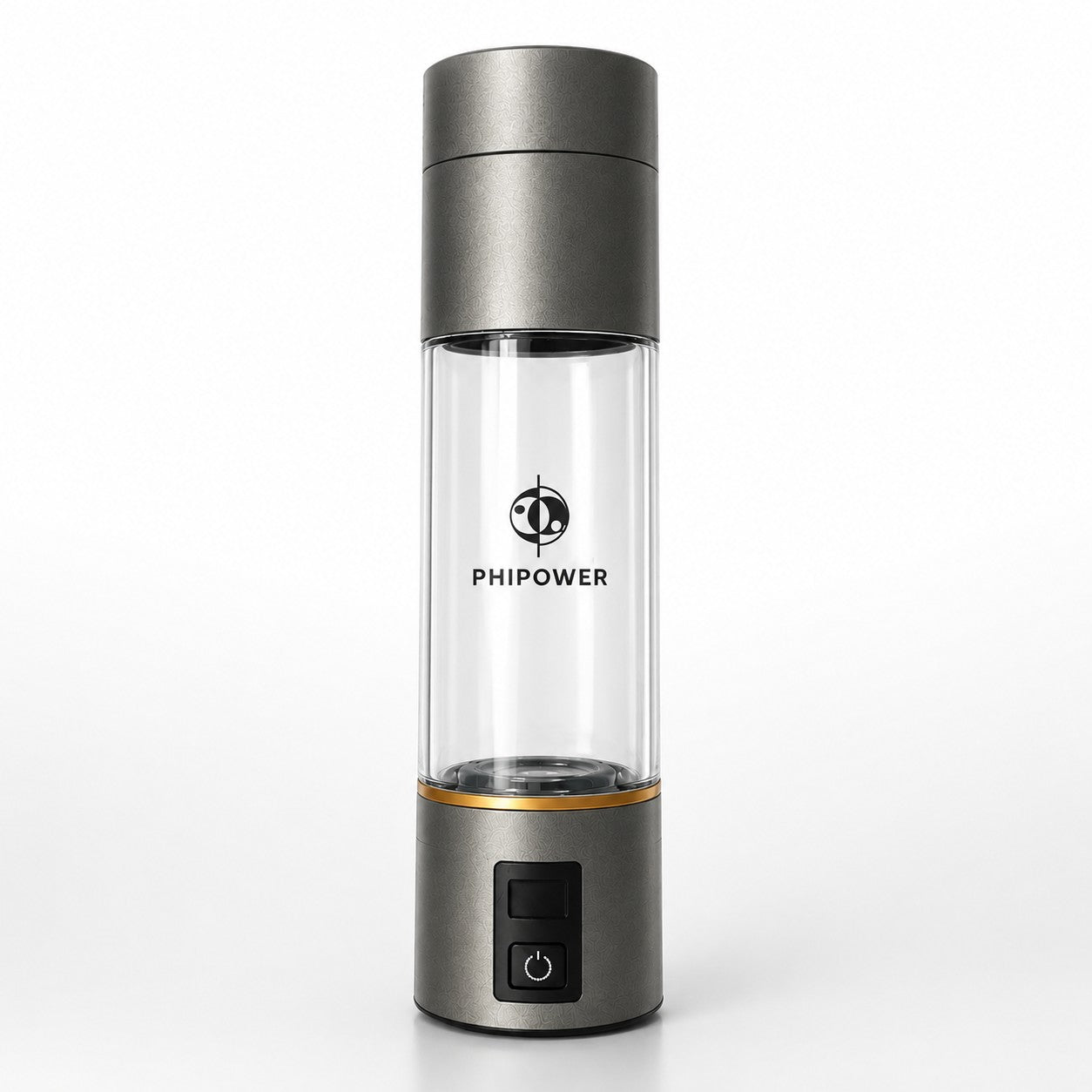
Manufacturer-published specifications. Not independent verification of particular concentrations, material compliance or clinical outcomes.
- ✓Drinking-quality tap water
- ✓Filtered drinking water
- ✓Reverse-osmosis water
- ✓Distilled water
- ✓Still bottled drinking water
- ✕Sparkling water
- ✕Sugary or flavoured beverages
- ✕Salt water
- ✕Juices, coffee or tea
- ✕Oils or added supplements
How to prepare hydrogen-rich water
- Check that the generator is clean and undamaged.
- Attach the drinking bottle securely.
- Fill it with an approved type of water to the recommended level.
- Close the bottle correctly.
- Start the automatic generation cycle.
- Allow the approximately five-minute cycle to complete.
- Drink the freshly prepared water shortly afterward.
The Phipower Hydrogen Water Bottle is a consumer wellness product. It is not intended to diagnose, prevent, treat or cure disease. Specific product performance should be evaluated using appropriate testing and documentation.
Frequently asked questions about hydrogen water safety
Is hydrogen water safe to drink every day?+
Many short-term human studies report favourable tolerability with daily consumption. However, long-term safety has not been comprehensively established, and there is no universally recommended daily dose.
Does hydrogen water have side effects?+
A consistent hydrogen-specific side-effect profile has not been established. Some studies report adverse events, while others report none. Individual symptoms should not be dismissed or interpreted as beneficial detoxification.
Can hydrogen water cause headaches?+
Headaches have not been established as a characteristic effect of dissolved H₂. If headaches occur after consumption, discontinue use and consider other possible causes. Seek medical advice if symptoms persist or are concerning.
Can hydrogen water cause nausea or bloating?+
Gastrointestinal symptoms are possible during changes in drinking habits or with products containing additional ingredients. Current evidence does not establish that dissolved hydrogen itself consistently causes them.
Is 6000 ppb hydrogen water safe?+
There is no established evidence identifying 6000 ppb as an inherently toxic concentration. However, long-term safety at specific concentrations has not been fully characterised. Product quality and individual circumstances also matter.
Can you drink too much hydrogen water?+
Yes, because hydrogen water is still water. Excessive fluid intake can be harmful, especially for people with conditions affecting fluid balance.
Is hydrogen water safe for the kidneys?+
There is insufficient evidence to recommend hydrogen water for preventing or treating kidney disease. People with kidney problems should follow medical advice concerning fluid intake and treatment.
Is hydrogen water safe during pregnancy?+
Insufficient research exists to establish an appropriate intake or specific safety profile during pregnancy. Professional medical guidance is recommended.
Is hydrogen water safe for children?+
Safety and dosing data for children are limited. Hydrogen water should not be promoted as a treatment for paediatric conditions.
Can hydrogen water interact with medication?+
Well-controlled interaction studies are limited. No universal medication adjustment is recommended, but interactions cannot be comprehensively ruled out.
Can hydrogen water increase blood pressure?+
There is insufficient consistent clinical evidence that hydrogen-rich water reliably increases or decreases blood pressure. It should not be used as a treatment for hypertension or low blood pressure.
Does hydrogen water change the pH of water?+
Dissolved H₂ and pH are different properties. Certain electrolysis technologies may also alter pH, but hydrogen-rich water does not have to be alkaline.
Does hydrogen water contain hydrogen peroxide?+
No. Molecular hydrogen is H₂, while hydrogen peroxide is H₂O₂. They are different chemical substances.
Does a PEM/SPE hydrogen generator remove bacteria?+
No. PEM/SPE electrolysis should not be assumed to disinfect or purify drinking water.
Can hydrogen generators create chlorine?+
Depending on water chemistry and electrolysis design, chlorine-containing reaction products are possible. Proper device design, gas separation and product-specific testing are important.
Are platinum-coated electrodes safe?+
Platinum is used as an electrochemical catalyst in suitable systems. Coating quality and drinking-water safety must be assessed as part of the complete device design.
Is BPA-free plastic automatically safe?+
No. BPA-free is only one material characteristic. Food-contact compliance and appropriate migration testing remain relevant.
Is hydrogen water safer than hydrogen inhalation?+
The two methods have different risk profiles. Drinking mainly raises water-quality and fluid-consumption considerations; inhalation adds gas-delivery and flammability risks. A universal safety ranking has not been established.
Is hydrogen water safer than ordinary water?+
There is no evidence that hydrogen-rich water is generally safer than ordinary drinking water that already meets applicable drinking-water standards.
How do I know whether my hydrogen water maker is safe?+
Evaluate food-contact materials, electrolysis design, relevant by-product testing, electrical safety, instructions, maintenance and supplier documentation. A maximum ppb claim alone does not establish safety.
Explore the Hydrogen Water Knowledge Cluster
Understanding safety is an important part of evaluating hydrogen-rich water.
- Hydrogen Water: The Complete GuideMolecular hydrogen in drinking water: research, concentrations, technology and preparation.Read →
- Hydrogen Water Benefits: What Does the Science Actually Say?The evidence on oxidative stress, exercise performance, recovery and metabolic markers.Read →
- How Does a PEM/SPE Hydrogen Water Maker Work?Electrolysis, electrode materials, membranes and hydrogen/oxygen separation.Read →
- Hydrogen Water Concentration: 1500 vs 3000 vs 6000 ppbWhat concentration measurements mean and why more H₂ is not automatically better.Read →
- How Long Does Hydrogen Stay in Water?Retention, storage, temperature and why freshly generated water is often preferred.Read →
- Molecular Hydrogen: Drinking vs Inhaling H₂Drinking dissolved hydrogen compared with inhaling hydrogen-containing gas.Read →
- How to Choose a Hydrogen Water MakerProduct quality, specifications, concentration measurements and maintenance.Coming soon
- Best Hydrogen Water Maker: 12 Buying TipsHow to compare PEM/SPE technology, H₂ concentration, electrodes, safety, maintenance and total value before buying a hydrogen water maker.Coming soon
Conclusion: safety depends on science, product quality and responsible use
Studies so far generally indicate favourable short-term tolerability in many research populations. Current evidence does not establish universal safety, an ideal daily dose or the consequences of lifelong use. Dissolved molecular hydrogen is only one part of the complete product: water quality, electrolysis technology, electrode materials, possible by-products, hygiene and maintenance all contribute to safety.
- ✓Use drinking water that is already safe.
- ✓Choose appropriately designed equipment.
- ✓Follow the manufacturer’s instructions.
- ✓Avoid unsupported high-dose protocols.
- ✓Consider individual medical circumstances.
- ✓Do not interpret preliminary research as proven medical benefits.
Trustworthy hydrogen technology starts with scientific transparency, measurable specifications and responsible product design.
Understanding both what science has established and what remains uncertain is essential to making informed choices about hydrogen-rich water.
Scientific references and further reading
-
Dhillon G. et al. (2024). Hydrogen Water: Extra Healthy or a Hoax? A Systematic Review. International Journal of Molecular Sciences, 25(2), 973. DOI: 10.3390/ijms25020973
Systematic review of 25 studies on potential effects and limitations of hydrogen-rich water research. -
Todorovic N. et al. (2025). The Effects of 8-Week Hydrogen-Rich Water Consumption on Appetite, Body Composition, Sleep Quality, and Circulating GLP-1 in Obese Men and Women (HYDRAPPET): A Randomized Controlled Trial. Medicina, 61(7), 1299. DOI: 10.3390/medicina61071299
36 adults; no severe adverse effects over eight weeks. Partial industry funding. -
Ogannisyan M. et al. (2025). Hydrogen-Rich Water Decreases Muscle Damage and Improves Power Endurance in Elite Athletes. Journal of Lifestyle Medicine, 15(1), 8–17. DOI: 10.15280/jlm.2025.15.1.8
22 elite female athletes; favourable tolerability. Commercial relationships disclosed. -
(2025). Does Hydrogen-Rich Water Reduce Oxidative Stress in Patients with Chronic Mountain Sickness? A Randomized, Blinded, Controlled Trial. PubMed PMID: 41371770
Adverse events in both hydrogen-water and placebo groups, illustrating the importance of safety monitoring. -
Hatae T. & Miwa N. (2021). Electrolytic hydrogen-generating bottle supplies drinking water with free/combined chlorine and ozone repressed within safety standard under hydrogen-rich conditions. Medical Gas Research, 11(2), 61–65. DOI: 10.4103/2045-9912.311496
Selected electrolysis by-products in one particular bottle design. -
World Health Organization (2026). Guidelines for Drinking-water Quality: Fourth Edition incorporating the First, Second and Third Addenda. WHO drinking-water guidelines
International reference for assessing and managing drinking-water quality risks. -
European Commission. Food Contact Materials: Legislation. Regulation (EC) No 1935/2004 and related rules. Read the overview
Scientific and medical disclaimer: this article is provided for educational purposes only. Available clinical research does not establish that hydrogen-rich water is universally safe or effective for every person. Individual circumstances, water quality and equipment design can influence risk. Phipower hydrogen products are consumer wellness devices and are not intended to diagnose, treat, cure or prevent disease. This information does not replace medical advice, professional assessment or the manufacturer’s operating instructions.